Located in Xiannüshan Town, Wulong District, Chongqing, Tian Sheng San Qiao is a UNESCO World Natural Heritage Site, a national 5A-level tourist attraction, and a core component of the Wulong Karst landscape. The scenic area covers approximately 4.7 square kilometers, with its centerpiece being three grand and majestic natural stone arch bridges—Tianlong Bridge, Qinglong Bridge, and Heilong Bridge—arranged longitudinally and spanning parallel across the Yangshui River canyon, connecting the cliffs on both sides and forming the unique "three bridges with two sinkholes" landform. This type of carbonate-rock natural bridge cluster is extremely rare worldwide, holding high geological research value and tourist appeal. The area also features other karst landforms such as sinkholes, caves, and canyons, with high vegetation coverage and a sound ecological environment. It gained widespread fame as a filming location for the movie Curse of the Golden Flower.
History and Culture
As a naturally formed geological wonder, the history of Tian Sheng San Qiao is primarily reflected in its long geological evolution. According to geological experts, the formation of the Three Natural Bridges took about 200 million years, gradually shaped by weathering, dissolution, and collapse of carbonate rocks over vast geological ages, bearing witness to the crustal movements and the evolution of karst landforms.
In local folklore, the Three Natural Bridges are closely linked to ancient heroes, with many myths and legends about their origin, reflecting the local people's awe and imagination toward this natural marvel and adding rich cultural color to the site. Additionally, beneath Tianlong Bridge stands a Tang?style ancient building—Tianfu Government Post—originally built in the Tang Dynasty as an important courier station for official communications between Fuzhou and Qianzhou. The current structure is a historically accurate reconstruction, serving as a key link between natural scenery and cultural heritage.
Major Attractions
Tianlong Bridge
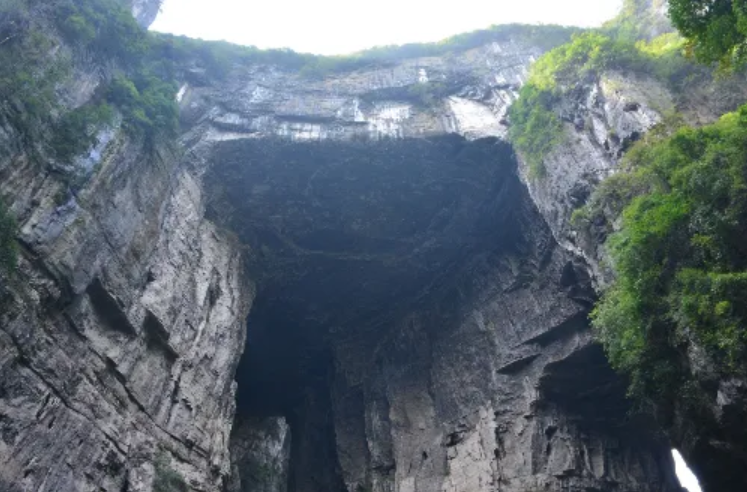
Tianlong Bridge is the first and widest of the three, with a height of 235 m, thickness of 150 m, width of 147 m, and length of 340 m. On both sides of the bridge deck, there are many dissolution?formed natural caves, some containing stalactites and stalagmites. Its arch is an irregular rectangle with a span of about 50 m. Beneath it lies Tianlong Sinkhole, about 100 m deep, with a stream and vegetation at the bottom. Tianfu Government Post is located right under the arch of Tianlong Bridge, nestled at the bottom of the sinkhole, surrounded by steep cliffs—a popular photo spot for visitors.
Qinglong Bridge
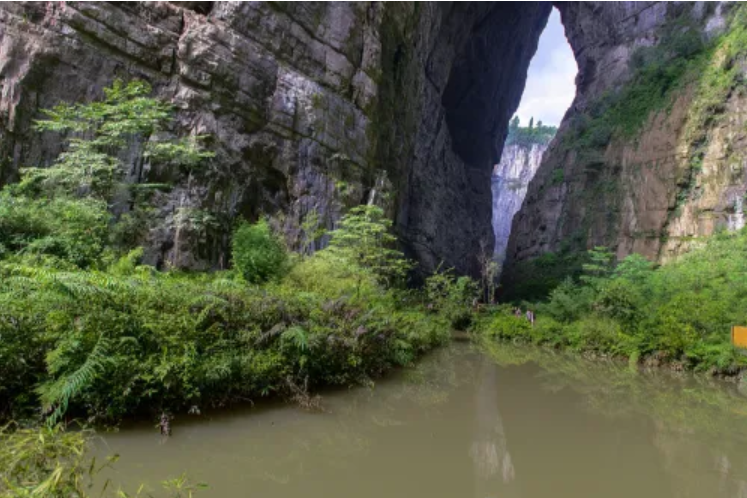
Qinglong Bridge is the second bridge, named for the greenish?black water stains on its cliff sides after rain, resembling a green dragon. It is the tallest of the three, standing 281 m high, with a thickness of 103 m, width of 124 m, and length of 280 m. Its arch is curved, with a span of about 102 m and a height of roughly 116 m, presenting an elegant and imposing form. A natural fissure called "Thread of Sky" runs across the bridge deck, allowing sunlight to cast unique light?and?shadow effects. Below is Qinglong Sinkhole, lush with vegetation and a babbling stream, creating a serene environment.
Heilong Bridge
Heilong Bridge is the third bridge, with a height of 223 m, thickness of 107 m, width of 193 m, and length of 228 m. Its interior is relatively dark, perennially in shadow, resembling a black dragon lurking, hence the name. It is distinguished by four natural springs within the arch: "Pearl Spring," "Mist Spring," "Thread Spring," and "Three?Tier Spring," each with unique water flows—some like falling pearls, others like drifting mist—adding a lively beauty to the bridge. Below is Heilong Sinkhole, with a relatively flat bottom, ideal for resting and sightseeing.
Tianfu Government Post
Located at the bottom of Tianlong Sinkhole beneath Tianlong Bridge, this Tang?style reconstructed complex covers about 500 m2, comprising the main post building, stables, kitchen, etc. The construction uses local stone and timber, with grey tiles and rammed?earth walls, faithfully recreating the appearance of an ancient relay station. Inside, exhibits include ancient weapons, documents, and daily utensils, vividly illustrating the functions and life of a historical post station. It was a key filming location for Curse of the Golden Flower, attracting many movie fans.
Tianlong Spiral Elevator
Asia’s first 360?degree rotating elevator, with a vertical height of 135.85 m and a travel height of 115 m. It features three parallel double?deck panoramic sightseeing elevators, each carrying 52 passengers, running at 3 m/s, with a combined daily capacity of 15,000 people. The rotating double?deck cabins slowly spin 360 degrees during operation, allowing visitors to enjoy panoramic views of the karst landscape from different angles, including bird’s?eye and distant perspectives. Compared to standard vertical elevators, the rotating ride is more comfortable, akin to floating in the clouds.
Glass Observation Platform
Built on a cliff above Qinglong Bridge, the platform extends about 28 m outward, with a vertical drop of 280 m to the sinkhole floor. It is paved with fully transparent glass, offering a 360?degree panoramic view of the "three bridges with two sinkholes" karst wonder.
Tour Route:
Upon entering, visitors take a sightseeing elevator down to the bottom of Tianlong Sinkhole (about 80 m vertical drop). Exiting the elevator, they first reach the vicinity of Tianlong Bridge, visit Tianfu Government Post to experience its historical atmosphere, then admire the grandeur of Tianlong Bridge, and pass through its arch into Qinglong Sinkhole. Along the trail in Qinglong Sinkhole, they closely view the steep and graceful Qinglong Bridge, passing by attractions like "Thread of Sky," then proceed through Qinglong Bridge into Heilong Sinkhole. There, they focus on the four springs of Heilong Bridge, appreciating their lively charm, and finally walk or take an electric cart back to the exit. The full route is about 3.5 km long, with a walking time of about 2.5–3 hours, and rest pavilions and signposts are available along the way.
Travel Tips:
Recommended visiting hours are between 9:00 AM and 3:00 PM for optimal lighting for viewing and photography.
Most paths are stone steps, some steep; wear comfortable sports shoes and avoid high heels.
In summer, the temperature inside the scenic area is 3–5°C lower than outside with high humidity—bring a light jacket; in winter, keep warm.
Audio guides are available for rent (approx. RMB 20/unit) to learn about geological origins and cultural history.
Few dining options inside; bring some water and snacks. After the tour, try local specialties like Wanyang lamb or Jiangkou fish in Xiannüshan Town.
To avoid peak crowds, choose weekdays; holidays may involve long queues for the elevator.
Important Notices:
Smoking and littering are strictly prohibited; follow ecological protection rules.
Stay on designated trails; do not enter closed areas for safety reasons.
On rainy days, paths can be slippery—watch your step; be alert to falling rocks and heed warning signs.
Do not carve or scribble on rock walls or buildings; protect cultural relics and natural scenery.
Visitors with children or elderly companions should supervise them closely to prevent accidents or getting lost.
Mobile phone signals may be weak in some areas; stay in touch with your group and avoid going alone.
Transportation:
Self?driving: From downtown Chongqing, take the G65 Baomao Expressway, exit at Wulong, then follow the Xiannüshan tourist route to the scenic area (approx. 180 km, about 2.5 hours). Parking fee: RMB 5/hour.
Public bus: Take a long?distance bus from Chongqing Longtou Temple Bus Station or Sikeshu Bus Station to Wulong District (departures every ~30 min, fare ~RMB 60), then transfer to the tourist shuttle to the scenic area (every ~30 min, fare ~RMB 10), about 40 minutes.
Tourist shuttle: Some travel agencies in Chongqing offer one?day tours including transport, tickets, and guide services—inquire in advance.
Train: Take a high?speed train from Chongqing North Station to Wulong Station (about 1 hour, fare ~RMB 55), then taxi to Wulong Bus Station and transfer to the tourist shuttle.
Opening Hours:
Hours vary by season:
Peak season (Mar 1 – Oct 31): 8:00 – 17:30
Low season (Nov 1 – Feb 28): 8:30 – 17:00
Ticket sales and entry stop 1 hour before closing. Hours may be temporarily adjusted due to extreme weather or special events; check the official website or call ahead for confirmation.
Ticket Price:
Combo ticket: RMB 155/person.