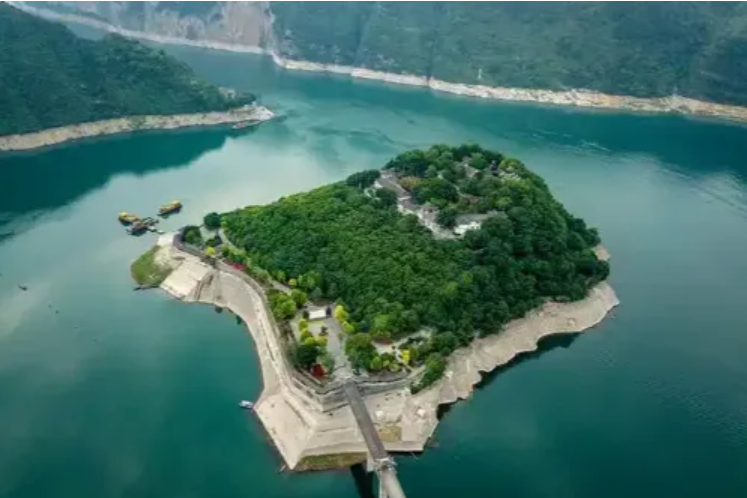
Baidi City is located on the north bank of the Yangtze River at the mouth of Qutang Gorge in Fengjie County, Chongqing Municipality. It is a national 5A-level tourist attraction. With profound historical and cultural heritage and unique natural scenery, the scenic area covers approximately 10.5 square kilometres. Baidi City is an ancient mountain town. The existing Baidi Temple and other structures occupy about 17 mu (approx. 1.13 hectares), with well?laid?out buildings featuring red walls and green glazed tiles, presenting a grand and imposing appearance. Commanding the entrance to Qutang Gorge, it is surrounded by water on three sides and backed by mountains on one, making it a strategically vital location since ancient times. It is also an excellent vantage point for viewing the magnificent scenery of the Three Gorges of the Yangtze River.
Historical Culture
Baidi City has a long history. At the end of the Western Han Dynasty, Gongsun Shu occupied the Shu region and built a city on the mountain. Because a well in the city often emitted white vapour, resembling a white dragon, Gongsun Shu used this to claim the title "White Emperor" (Baidi), hence the name Baidi City.
During the Three Kingdoms period, Liu Bei, after his defeat in the battle against Eastern Wu, retreated to Baidi City. Before his death, he entrusted his son and kingdom to Zhuge Liang at the Yong'an Palace in Baidi City, making the site an important relic of Three Kingdoms culture. Later, numerous poets and literati, including Li Bai, Du Fu, and Liu Yuxi, visited Baidi City and left behind a wealth of celebrated poems, such as Li Bai's Leaving Baidi City at Dawn, adding a rich cultural aura to the place.
The architecture of Baidi City blends styles from the Ming and Qing dynasties. Within Baidi Temple, many ancient stelae and cultural relics are preserved, serving as important materials for the study of ancient Chinese history and culture, and bearing witness to the city's transformations over the centuries.
Major Attractions
Baidi Temple
Baidi Temple is the core attraction of Baidi City, covering about 17 mu (1.13 hectares). The main buildings within the temple include Mingliang Hall, Wuhou Shrine, and Guanying Pavilion. Mingliang Hall enshrines statues of Liu Bei, Zhuge Liang, Guan Yu, Zhang Fei, and others, depicting historical figures and stories from the Three Kingdoms period. Wuhou Shrine, dedicated to Zhuge Liang, houses a statue of him and related historical artefacts. Guanying Pavilion is traditionally the place where Zhuge Liang observed the stars at night; the pavilion is elegant and antique in style.
Zhongyi Square
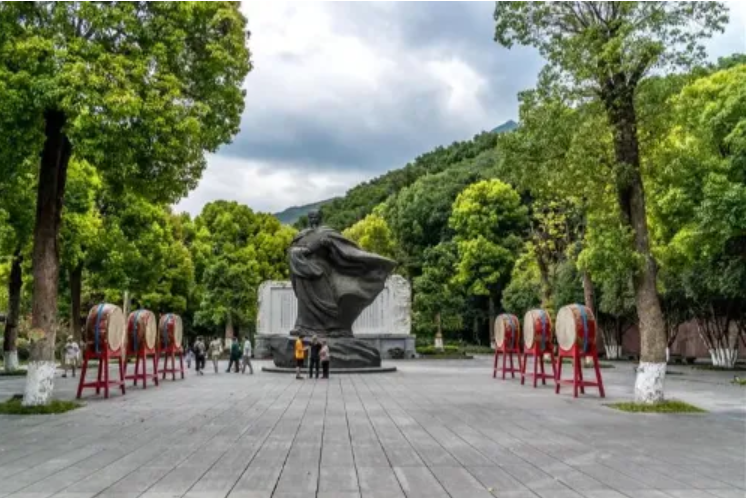
At the centre of the square stands a bronze statue of Zhuge Liang, with a total height of 7.9 metres and a figure height of 5 metres. Behind the statue is a stele inscribed with the Chu Shi Biao (Memorial to the Throne), measuring 16 metres long and 4 metres high, carved from fine white marble. The front bears the Former Memorial, and the back the Latter Memorial.
Kui Gate
Located near Baidi City, Kui Gate is the western entrance to Qutang Gorge and a key scenic spot of the Three Gorges. With towering peaks and sheer cliffs on both sides, the river flowing through creates the magnificent spectacle known as "the most majestic pass under heaven." The grand view of Kui Gate attracts numerous visitors and is a favourite for photographers. It is also the scene depicted on the back of the 10?yuan RMB banknote.
Tuogu Hall
Tuogu Hall was built to commemorate the historical event of Liu Bei's entrustment of his heir to Zhuge Liang. Through sculptures and scene reconstructions, the hall vividly presents the moment of Liu Bei's deathbed commission. The lifelike figures and realistic settings allow visitors to feel transported back to the Three Kingdoms era and experience the weight of history.
East and West Stele Forests
The East and West Stele Forests together house over 40 stelae from various dynasties, serving as physical carriers of Baidi City's "City of Poetry" culture. The East Stele Forest features inscriptions mainly from Ming and Qing literati; among them, the Bamboo?Leaf Stele resembles bamboo leaves but actually forms the poetic line "Never fading in the east grove's shade, my name stands alone in verdant art"; the Phoenix Stele depicts a phoenix, peonies, and a parasol tree, also known as the "Three Treasures Stele." The West Stele Forest contains important stelae from the Sui to Qing dynasties, including the Stele of the Golden Wheel Temple Relic Pagoda from the Sui Dynasty and the Stele of the Great Completed Hall Inscription from the Yuan Dynasty, both of great calligraphic and historical value.
Mingliang Hall
Mingliang Hall is the main hall of Baidi Temple, with a floor area of about 200 square metres, located on the central axis of the complex and built in the Qing dynasty style. Originally dedicated to Gongsun Shu, it was later changed to honour Liu Bei, Zhuge Liang, Guan Yu, and Zhang Fei, reflecting the theme of "wise ruler and virtuous ministers." Above the main entrance hangs a plaque inscribed "Han Dynasty Wise Ruler and Good Ministers," which is included in the Collection of Chinese Famous Plaques. The hall features a post?and?lintel structure with carved doors and windows, thick beams and columns, exemplifying the typical Qing?dynasty temple architecture of southwest China.
Guanying Pavilion
Guanying Pavilion is a two?storey hexagonal pavilion on the west side of Baidi Temple. Its 12 pillars on the ground floor symbolise the 12 months of the year, while the 6 pillars on the upper floor represent heaven, earth, and the four directions, reflecting the ancient concept of "unity of heaven and man." It is said that Zhuge Liang once observed the stars here for military strategy. Inside, the stone tables and stools are engraved with verses from Du Fu's Eight Autumn Meditations. Climbing the pavilion offers a distant view of Qutang Gorge, making it an excellent spot for sightseeing and nostalgic reflection.
Fengyu Corridor Bridge
The Fengyu (Wind and Rain) Corridor Bridge is an important passage connecting Baidi City Island with the north bank of the Yangtze River, serving both transportation and scenic functions. With a total length of over 650 metres, it is built in an antique style with upturned eaves and corners, harmonising with the historical charm of Baidi City. Walking across, visitors can shelter from wind and rain while leaning on the rails to enjoy expansive views of the Yangtze River, the majestic Kui Gate, and the landscapes on both banks. It offers a unique point where natural beauty and human culture blend, adding a leisurely sightseeing experience before entering the main scenic area.
Jiangxia Culture Museum
The Jiangxia Culture Museum is a thematic venue displaying the history, culture, and natural landscapes of the Three Gorges. Through artefact exhibits, multimedia interactions, and scene reconstructions, it systematically presents the geographical evolution, folk customs, shipping history, and poetic culture of the Three Gorges region. The museum houses precious physical items such as components of ancient plank roads, ancient shipping tools, and rubbings of stelae inscribed with poems by literati from past dynasties. Particularly noteworthy is the "Three Gorges Resettlement" exhibition area, which vividly documents the human stories behind the Three Gorges Project.
Qutangguan Site Museum
The Qutangguan Site Museum, built on the ancient Qutangguan (Qutang Pass) ruins, focuses on the military and transport history of this "throat of Sichuan." Through excavated weapons, stelae, city bricks, and other artefacts, combined with scene reconstructions and graphic panels, it systematically traces the evolution of the defensive system of Qutang Pass from the pre?Qin period to the Ming and Qing dynasties. Items such as Han?dynasty arrowheads and Song?dynasty city?defence components attest to its strategic significance as a "pass that one man can hold against ten thousand."
Qutang Gorge
Qutang Gorge is the first of the Three Gorges of the Yangtze River, extending westward from Baidi City to Daxi Town in Wushan County, with a total length of about 8 kilometres – the shortest yet most magnificent of the Three Gorges. The cliffs on both sides are as sheer as cut, with the highest point reaching over 1,200 metres above sea level, and the narrowest part of the river just over 100 metres wide. The grand spectacle of "Kui Gate, the most majestic under heaven" is on display here, and it is also the scene featured on the back of the fifth?series 10?yuan RMB note. Visitors can take boat tours to view natural and cultural sites such as Mengliang Ladder, Inverted Monk Rock, and Rhino Gazing at the Moon, experiencing the powerful momentum of the Three Gorges.
Top of the Three Gorges
The Top of the Three Gorges is located on Chijia Mountain on the north bank of Qutang Gorge, at an altitude of 1,388 metres – the highest point of the Three Gorges. Its name derives from Du Fu's poem Ten Quatrains on Kuizhou, which says, "Chijia and Baijian both pierce the sky, their dwellings stretch to the mountain's crest." From the summit, one can enjoy a 360?degree panoramic view of Qutang Gorge, taking in the vastness of "Kui Gate under heaven," the surging Yangtze, and distant sights such as Baidi City and Baijian Mountain. Visitors can hike from Baidi City to the Top of the Three Gorges, a trail of about 10 kilometres.
Suggested Tour Route:
Upon entering the scenic area, visitors are advised to first visit Baidi Temple to appreciate its ancient architecture and cultural relics, and to learn about the history of the Three Kingdoms and Baidi City. Next, proceed to Tuogu Hall to experience the historical scene of Liu Bei's deathbed commission. Then head to Kui Gate to enjoy the magnificent gorge views. Along the way, there are viewing platforms where visitors may pause to admire the beauty of the Yangtze River. The entire tour takes approximately 2–3 hours, and visitors can adjust their route and stop durations according to personal interests and schedules.
Travel Tips:
It is recommended to learn about the history and culture of Baidi City beforehand by reading relevant books or watching documentaries, so as to better appreciate the attractions during the visit.
Please protect the cultural relics and environment within the scenic area – do not touch artefacts, and do not litter.
Some sections of the trails are steep; visitors should take care, especially the elderly and children, who should be accompanied by family members.
When trying local cuisine, choose reputable restaurants to ensure food safety. Fengjie navel oranges are a local specialty – when buying, select fresh fruit.
For the best photos of Kui Gate, visit on a clear day; the optimal shooting times are early morning or late afternoon for the best lighting.
Consider combining your visit with other attractions in Fengjie County, such as Kuizhou Ancient City and the Top of the Three Gorges, to enrich your travel experience.
Important Notices:
Respect local customs and religious beliefs; refrain from inappropriate behaviour.
The scenic area has many steep steps and mountain paths; wear comfortable shoes and walk carefully.
Follow the instructions of staff; do not enter restricted or unopened areas.
Be cautious when buying souvenirs from street vendors – check quality and prices to avoid being overcharged.
In case of emergency, seek help from staff; the visitor service centre is available for assistance.
The site contains numerous cultural relics – do not touch, climb on stelae, statues, or ancient building components; do not use flash photography; protect the cultural heritage.
When on Qutang Gorge boat tours, follow crew instructions, wear life jackets properly, do not run or play near the deck edges, and stay safe on the water.
When purchasing boat tickets, confirm the route and schedule to avoid delays.
Transportation:
By air: Visitors can first arrive at Chongqing Jiangbei International Airport, then take a long?distance bus or high?speed train to Fengjie County. Upon arrival in Fengjie, take local buses or taxis to Baidi City. The bus journey from the airport to Fengjie takes about 4–5 hours, while the high?speed train takes about 2 hours.
By train: Arrive at Fengjie Railway Station, then take a bus or taxi to the scenic area. The bus ride takes about 30 minutes, and a taxi about 20 minutes.
Self?driving: Use a navigation app and enter "Baidi City" as the destination. The scenic area has a car park for visitors. Drivers should pay attention to road conditions, especially on mountain sections, and drive carefully.
Opening Hours:
Baidi City is open year?round. Summer (May 1 – October 31): 08:00 – 17:30; Winter (November 1 – April 30): 08:30 – 17:00. Visitors may enter during opening hours. Times are subject to change according to actual conditions; please check the latest announcements from the scenic area.
Admission:
The ticket price for Baidi City is 100 RMB per person. Some activities within the area may charge extra – enquire on site. The scenic area also offers promotional discounts during different seasons and events; visitors can check the official channels for the latest ticket information.