Mount Jinfo is located in Nanchuan District, Chongqing, China. It is a national 5A-level tourist attraction and a UNESCO World Natural Heritage site. The scenic area covers a planned area of 441 square kilometers. Mount Jinfo is a typical tableland karst landform, composed of 108 peaks across three mountain ranges: Jinfo, Baizhi, and Qingba. Its main peak, Fengchui Ridge, rises to 2,251 meters, making it the highest peak of the Dalou Mountain Range. The mountain features spectacular terrain with steep cliffs, precipices, strange peaks, karst caves, gorges, ecological stone forests, springs, and waterfalls, as well as magnificent meteorological phenomena such as ice and snow, clouds and mist, and sunsets. The area is rich in flora and fauna, including national-level protected plants like the silver fir (known as the "giant panda of the plant world") and protected animals such as the white-cheeked black langur and the Guizhou snub-nosed monkey.
History and Culture
Mount Jinfo has a Buddhist history spanning over a thousand years. Buddhist temples were first built here in the Tang Dynasty, flourished during the Ming and Qing dynasties, declined in the Republic of China period, and revived in the late 1980s. Today, it is a renowned Buddhist sacred site in the Sichuan–Chongqing–Guizhou region.
During the Song Dynasty, Longyan City (or Longyan Fortress) on Mount Jinfo was constructed between the third and fourth years of the Baoyou era (1255–1256) under Emperor Lizong. In the sixth year of Baoyou (1258), the Mongol Khan M?ngke led an army to attack Sichuan. The vanguard forces assaulted Longyan City twice but were both repelled by the defending Song troops. The successful resistance earned commendation from the emperor for the garrison commanders. The ruins of Longyan City cover an area of 2,400 square meters and are now a municipal-level cultural heritage site in Chongqing.
Caves such as Gufo Cave within Mount Jinfo contain rich sulfate and nitrate deposits. Local saltpeter?extraction (nitre?making) activities can be traced back as early as 700 years, providing evidence for China’s gunpowder production.
In the 1940s, the Mount Jinfo area served as one of the rear?area support bases during the War of Resistance against Japan, providing medical production and research, air?raid warning systems, and other logistical support.
Major Attractions
Jinfo Temple
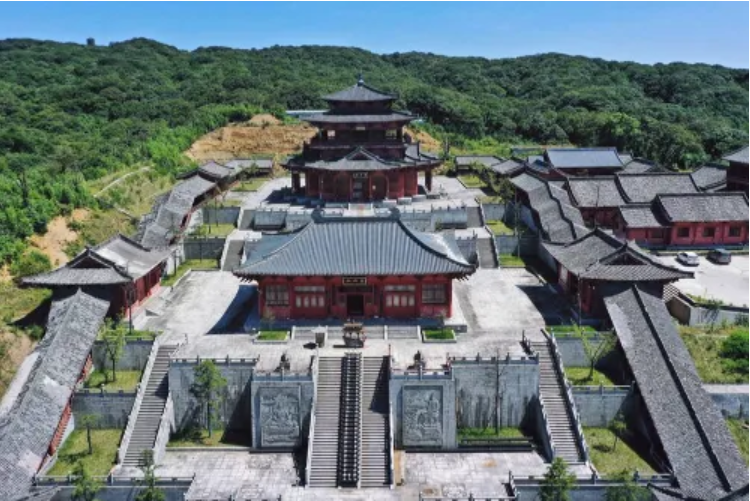
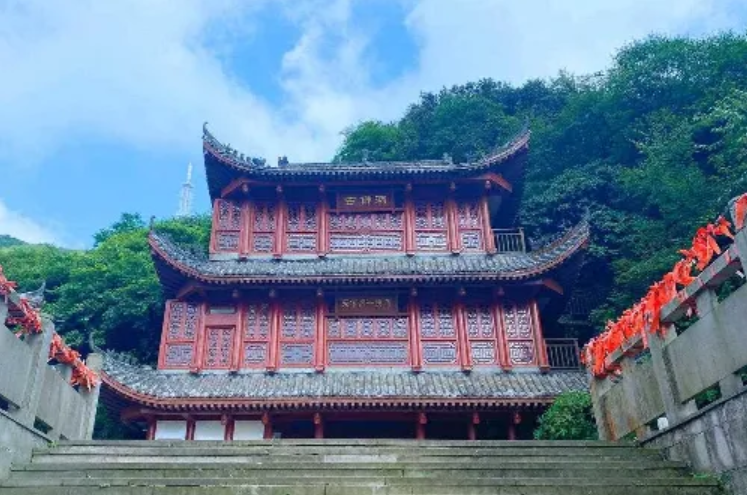
Located in the northwest of the scenic area, Jinfo Temple is one of the largest Tang?style temple complexes in Southwest China. The original temple was built on the southeastern part of the summit terrace during the Tang Dynasty and was the foremost of the four great temples on Mount Jinfo. In 2014, it was relocated to the southwest side of Phoenix Temple and reconsecrated after reconstruction. Covering an area of over 10,000 square meters, it includes a bell tower, drum tower, Heavenly King Hall, Mahavira Hall, Seven Buddha Hall, sutra depository, and other structures. It is a well?known Buddhist sanctuary in the Sichuan–Chongqing–Guizhou region.
Gufo Cave
Gufo Cave is one of the core attractions of Mount Jinfo. The cave is about 3,000 meters long, with spacious chambers and a myriad of stalactites in various shapes—some resembling Buddhist figures, others animals, all vividly lifelike. An underground river runs through the cave, its clear waters shimmering with fantastic colors under the lighting. The temperature inside remains constant at around 16–18°C, making it an ideal summer retreat.
Bitan Yougu (Blue Pool and Secluded Valley)
Bitan Yougu is a valley about 3 kilometers long, with babbling streams, emerald pools, and dense vegetation on both sides, offering fresh air. Along the valley are several pools and waterfalls of varying sizes; the most famous is "Yixian Quan" (Thread Spring), where water gushes from a cliff face, creating a beautiful scene. A wooden boardwalk allows visitors to stroll and enjoy the valley scenery.
Cliffside Plank Walkway
Built on sheer cliffs at an elevation of about 2,000 meters, this plank walkway is approximately 3.5 kilometers long and about 1.5 meters wide, with some sections made of suspended glass. Walking on it, visitors look down into a deep abyss, with steep rock faces on one side and distant mountains on the other—a thrilling experience. Several viewing platforms along the way offer panoramic views of Mount Jinfo’s magnificent landscape.
Golden Turtle Facing the Sun (Jin Gui Zhao Yang)
This is one of Mount Jinfo’s iconic landmarks—a huge turtle?shaped rock tens of meters high. At sunrise, the sunlight gilds the rock, making it look like a golden turtle facing the sun, hence the name. It is an excellent spot for watching the sunrise and attracts many photographers.
Yaochiba (Medicine Pond Flat)
Yaochiba is a small mountain basin on the summit of Mount Jinfo, covering about 0.5 square kilometers. It is flat, lush with grass, and surrounded by peaks. Legend has it that immortals once refined medicine here, giving it its name. The basin contains several natural pools whose water is rich in minerals and is believed to have certain health benefits. It is also a great place for summer escapes and autumn leaf viewing.
Ecological Stone Forest
In the vast primeval forest, ancient rare trees and oddly shaped stone formations coexist—stone peaks, pillars, screens, and caves hide like wise hermits deep in the mountains, creating a unique spectacle of stone?tree and vine?tree symbiosis. Ecologists have praised it as an "ancient ecological expo garden" and a "living textbook" for ecological education.
North Slope Cable Car of Mount Jinfo
Construction of the North Slope Cable Car began in January 1998 and took 12 months, with trial operation at the end of that year. Using Siemens technology from Germany and designed by the Beijing Crane Research Institute, it is a double?bearable reciprocating cable car. It is 1,056 meters long, with a vertical drop of 525 meters and a maximum incline of about 45°, making it the steepest cable car in Asia. Its completion turned a "natural chasm" into a thoroughfare, greatly improving visitor access and convenience, earning it the nickname "Airbus" of Mount Jinfo.
Suggested Tour Routes:
Hiking enthusiasts can enter via the West Gate.
Self?driving visitors may enter through the South Gate (a vehicle pass of RMB 200 per car is required, and parking is limited).
The North Gate is the most traditional route.
Recommended route (West Gate in/out):
West Gate → shuttle bus → cable car → Qianniuping → Gufo Cave → Yaochiba → Cloud Walkway → Yanzidong (Swallow Cave) → Golden Turtle Facing the Sun → cable car → shuttle bus → West Gate exit.
Alternative route:
West Gate Visitor Center → Bitan Yougu → Shuangye Bridge → Mo Huitou (Don't Look Back) → Golden Turtle Facing the Sun viewing platform → Yanzidong → Yaowang Pond (Medicine King Pool) → cable car and bus back to West Gate.
Travel Tips:
To view azaleas (rhododendrons), visit in late April; the blooming season lasts from mid?April to late May.
Accommodation is available within the scenic area, but hotels in Tianxing Town, about 1 km outside the park, offer hot springs at night.
Some sections of the scenic area have no supply points, so bring your own snacks and water.
Plan for a two?day trip to fully enjoy the scenery.
Temperatures are cooler at higher elevations; bring a jacket even in summer, and take warm winter clothing and precautions in winter.
The cliffside and glass walkways are thrilling; visitors with acrophobia should proceed with caution.
Important Notices:
Pets are not allowed in the scenic area.
On dangerous sections like the cliffside walkway, do not run, chase, or lean against the railings.
Some paths are steep; follow safety instructions and signs.
In winter, bring warm clothing and anti?slip gear; in case of severe weather, check the park’s contingency measures in advance.
When entering caves, do not touch stalactites or other formations.
Respect the park’s opening hours and do not linger after closing.
Do not enter undeveloped areas to avoid hazards.
Transportation:
Self?driving: From downtown Chongqing, take the G65 Yu?Xiang Expressway → Nanchuan Interchange → Nanwan Expressway → exit at Jinfo Mountain West → follow to the West Gate.
Public transport: Visitors from the city can take a coach from Chongqing Sigongli Coach Station or Caiyuanba Coach Station to Nanchuan, then transfer to a local bus to Mount Jinfo.
Opening Hours:
Monday–Friday: 8:30–17:30 (ticket sales stop at 15:30)
Saturday–Sunday: 8:30–17:30 (ticket sales stop at 16:00)
National holidays: 8:00–17:30 (ticket sales stop at 16:00)
The ski slope’s opening times depend on weather conditions; please call ahead for updates.
Tickets:
General admission: RMB 80
Sightseeing bus: RMB 20 (usually needed for West Gate visitors)
Free admission: children under 1.2 meters (or aged 6 and below), seniors aged 65 and above, military personnel, and journalists (with valid ID).
Half?price tickets: students and minors (with valid ID).
West Gate combo ticket for seniors 65 (free admission bus cable car): from RMB 100.
(All prices are in RMB.)