Heishan Valley Scenic Area is located in Heishan Town, Wansheng Economic and Technological Development Zone, Chongqing. It is a National 5A-level Tourist Attraction, as well as a National Forest Park and a National Geopark. The scenic area features a diverse array of landscapes, including majestic mountains, peak forests, deep gorges, sheer cliffs, forests, bamboo seas, waterfalls, crystal-clear waters, karst caves, replica ancient plank roads, floating bridges, seas of clouds, pastoral fields, primeval vegetation, and rare flora and fauna. Covering an area of 100 km2, it consists of two sub?areas: Heishan Valley and Longlin Stone Sea. The elevation difference between the mountaintop and the valley floor reaches up to 1,200 meters. The valley stretches 13 km in length, with slopes on both sides at 70°–80°, and a forest coverage rate of 97%. It is currently the largest and best?preserved natural ecological scenic area in the Chongqing region, and has been praised by experts as the “Chongqing?Guizhou Biological Gene Bank” and the “Shennongjia of the Southwest.”
History and Culture
The name “Heishan Valley” is linked to the ancient Yelang Kingdom, as this area was one of the important settlements of the Yelang people after they migrated northward. Legend has it that during the reign of Emperor Cheng of the Han dynasty, upon hearing of the beauty of the Yelang princess, he proposed a marriage alliance. When his proposal was rejected, he launched a military campaign. The Yelang soldiers and civilians fought bravely, but the princess preferred death to submission and took her own life at the Princess Peak. Her warhorse is said to have turned into the “Black Mountain Demon” to guard her forever. In addition, Heishan Valley blends the cultures of the Miao and Tujia ethnic groups, as well as Yelang culture, Bayu culture, and other cultural elements, creating a uniquely distinctive regional culture.
Major Attractions
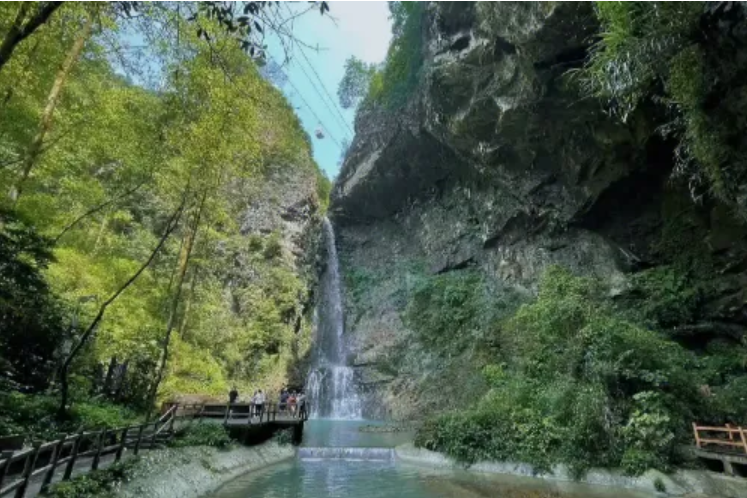
Shenlong Waterfall (Divine Dragon Waterfall)
Shenlong Waterfall is a magnificent waterfall in Heishan Valley, with a drop of about 80 meters and a width of about 15 meters. The water plunges down a steep cliff, crashing against rocks to create layers of mist, and under sunlight, a brilliant rainbow often appears. At the base lies a deep, clear pool surrounded by lush greenery. The thunderous roar of the water is awe?inspiring. Visitors can follow a plank road to view it up close and experience the grandeur described in the famous line “torrents of water plunge three thousand feet.” It is one of the iconic water features of Heishan Valley.
Feiyu Waterfall (Flying Fish Waterfall)
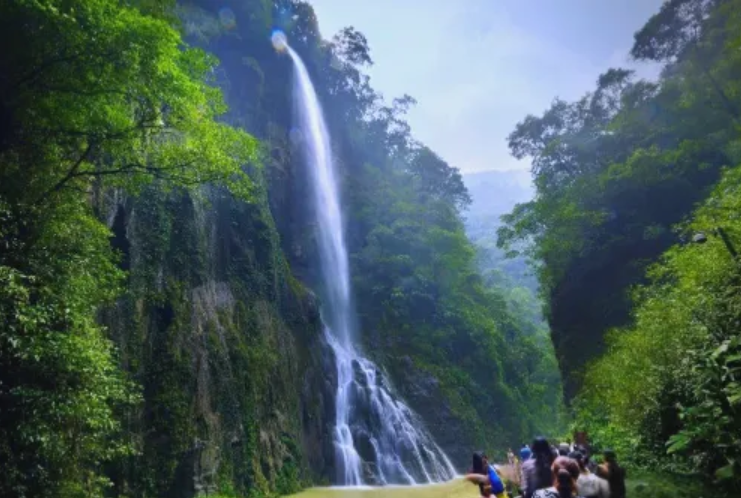
Located near the south gate, Feiyu Waterfall is one of the most spectacular among the valley’s hundreds of waterfalls, with a drop of about 80 meters. During the summer flood season, its flow can reach 5 m3/s, resembling the Milky Way cascading down from the heavens with overwhelming power.
Heishan Valley Gorge
The gorge is the core landscape of the scenic area, stretching 13 km in length, with its narrowest point only 1.9 meters wide. The large elevation difference creates a unique “one valley spanning two provinces” feature (straddling Wansheng in Chongqing and Tongzi in Guizhou). Inside the gorge, streams meander, and the vegetation cover on both banks exceeds 97%, hosting rare plants such as Chinese yew and dove trees, as well as protected animals like black?leaf monkeys and clouded leopards. Along the route, there are dozens of waterfalls, the highest with a drop of over 100 meters, sending spray flying in a spectacular display.
Chongqing?Guizhou Boundary Bridge
This small bridge spans the gorge and serves as both a physical connection between Wansheng (Chongqing) and Tongzi (Guizhou) and a symbol of the “one valley crossing two provinces” geography. The bridge is narrow and delicate, about 10 meters long and only 2 meters wide, with guardrails on both sides, and a babbling stream below. Standing on the bridge, one can cross from Chongqing to Guizhou in a single step; a boundary marker lies right beneath. The surrounding gorge scenery is impressive, and the bridge’s special geographic significance makes it a popular spot for visitors to take photos and enjoy the “one foot in two provinces” experience.
Suggested Itineraries:
One?day tour (recommended: South Gate in, North Gate out): In the morning, start from the Visitor Center, take the South Gate cable car to Feiyu Waterfall, then hike to Yutiao Gorge (4 km). In the afternoon, visit the Chongqing?Guizhou Boundary Bridge and the Ten?Li Gorge, and finally take the North Gate sightseeing bus back.
If time permits, a two?day tour is recommended: Day 1 – explore the core scenic area and stay overnight at Tianxing Town to enjoy hot springs; Day 2 – visit Wansheng Stone Forest (20 km from Heishan Valley, featuring karst landforms).
Travel Tips:
Visit in summer to escape the heat and enjoy water activities – bring swimwear and a change of clothes. Autumn offers beautiful red leaves; photography is recommended on the Cloud Side Plank Road.
If you have limited physical strength, consider purchasing a combined ticket that includes sightseeing buses and cable cars to save energy and better enjoy the views.
A two?day trip allows for a more immersive experience: spend the first day in the core area of Heishan Valley and the second day at Wansheng Stone Forest.
Some sections of the trail inside the gorge are damp and muddy; watch your step in summer, and beware of icy patches in winter.
If you plan to try the rafting activity, bring spare clothes – there are storage and shower facilities in the scenic area.
The trails are long, so wear comfortable sports shoes and consider bringing a trekking pole to reduce leg strain.
Important Notices:
Some sections of the trail are steep and rugged; follow the signposts, stay safe, and do not leave the designated paths.
In summer, take sun protection and anti?mosquito measures; in winter, keep warm and watch out for slippery sections.
The last return bus departs at 16:30 – plan your time accordingly to avoid missing it; otherwise, you may need to take a taxi back to Wansheng town (cost about 50 CNY).
Smoking, littering, picking plants, and capturing wildlife are strictly prohibited – help protect the ecological environment.
Minors, the elderly, and those with mobility difficulties should be accompanied by family members and avoid exploring alone.
Rafting is a potentially risky activity; read the safety instructions carefully, wear a life jacket, and follow the staff’s directions at all times.
Transportation:
Self?driving: From downtown Chongqing, take the G75 Lanhai Expressway to Wansheng, then continue to Heishan Valley. The drive takes about 1.5 hours and covers 63 km. It is recommended to navigate to “Heishan Valley Visitor Center”; parking fee is 5 CNY/day.
Public transport: Take a long?distance bus from Chongqing’s Sìkējī Shūniǔ Station or Chenjiaping Bus Station to Wansheng Bus Station (fare 38 CNY, about 1.5 hours), then transfer to Bus No. 106 to the North or South Gate of the scenic area (fare 4.5 CNY). Alternatively, take a high?speed train from Chongqing West Station to Qijiang East Station, then take a taxi to the scenic area (about 40 minutes).
Opening Hours:
Peak season (March 1 – October 31): 08:30–15:30
Low season (November 1 – February 28): 09:00–15:00
Tickets:
Peak season (March 1 – October 31): 85 CNY/person
Low season (November 1 – end of February): 60 CNY/person
The ticket price does not include off?site shuttle buses, on?site sightseeing buses, or cable cars. Cable car one?way ticket: 30 CNY (approx. 6 km); sightseeing bus one?way ticket: 30 CNY (approx. 1 km).