Jingyuetan is located in the southeast of Changchun City, Jilin Province, China, 18 kilometers from People's Square in the city center. It is a National 5A-Level Tourist Attraction, National-Level Scenic and Historic Area, National Forest Park, National Civilized Scenic Tourism Area Demonstration Site, National-Level Water Conservancy Scenic Area, and National-Level National Fitness Outdoor Activity Base. The scenic area covers an area of 96.38 square kilometers, with a water area of 5.3 square kilometers and a forest coverage rate of 96%. There are 119 large and small mountain ranges, with elevations ranging from 220 meters to 406.5 meters. Jingyuetan integrates wetland lakes and forest parks, and enjoys reputations such as "Asia's Largest Artificial Forest Sea," "Green Sea Pearl," and "Urban Oxygen Bar."
History and Culture
Jingyuetan was built in the early 1930s by the invading Japanese army. At that time, it was intended to solve the water shortage problem of the "South Manchuria Railway Affiliated Area" in Changchun. The plan was to intercept the Yitong River as the main water source and use the natural terrain to build a "storage reservoir." The project began construction at the end of 1933, was completed on November 21, 1935, and officially began supplying water to Nanling Water Plant in January 1936.
There are two theories about the origin of its name. One theory is that Zheng Yu, then director of the "Manchukuo" Capital Construction Bureau, named it "Jingyue Tan" based on the lines "One is the moon in the water, one is the flower in the mirror" from Dream of the Red Chamber, but because a Japanese translator mistakenly wrote it as "Jingyuetan," the name has been used ever since. Another theory is that when the Queen Mother of the West sent heavenly gods to recall the Seven Fairies, one tear from the Seven Fairies fell in Changchun and became Jingyuetan, making it a sister lake to Sun Moon Lake in Taiwan.
In 1948, Jingyuetan Forest Farm was taken over by the Northeast Administrative Committee and was then called Changchun Jingyuetan Agriculture and Forestry Experimental Farm. It was designated as a scenic health forest and was not open to the public. In 1958, after the completion of Xinlicheng Reservoir, Jingyuetan became a backup water source for Changchun City. In 1985, Changchun Jingyue Scenic Area Tourism General Company was established, marking the beginning of formal tourism operations at Jingyuetan.
Main Attractions
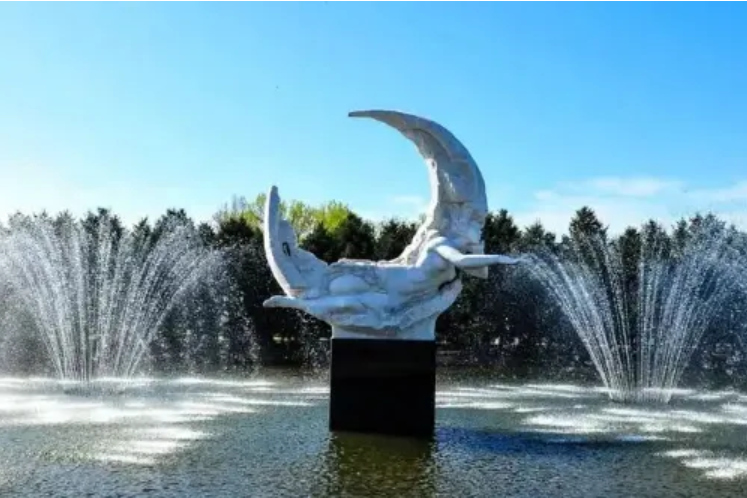
Goddess Square
Located southwest of the scenic area's main gate, it is the main venue for large-scale events in the scenic area. The Jingyue Goddess in the center of the square is a landmark welcoming landscape, sculpted by Mr. Ye Yushan and completed on August 7, 2012. The Jingyue Goddess is 8.2 meters tall, the moon is about 6 meters in diameter, and the base is 2.28 meters high.
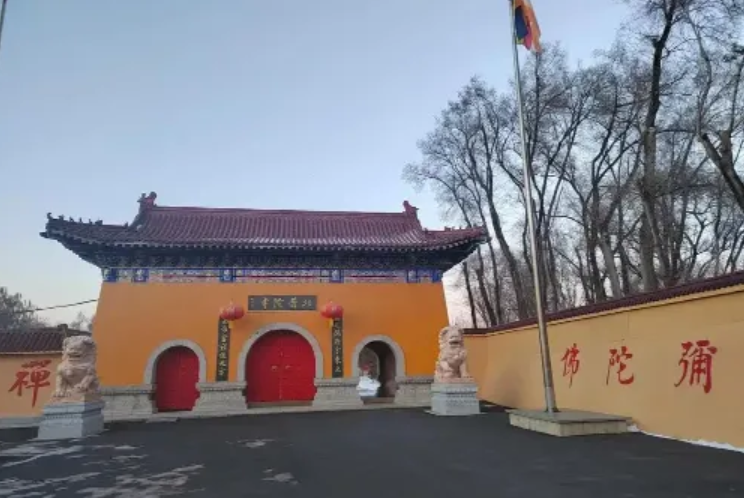
North Putuo Temple
Located south of Goddess Square, it covers an area of about 9,200 square meters. As of 2006, the mountain gate, Mahavira Hall, and Sutra Library had been completed. The Mahavira Hall covers an area of about 700 square meters and is 15 meters high, capable of accommodating more than 1,000 people for Dharma assemblies.
Lotus and Willow Garden
Located south of North Putuo Temple and north of the reservoir dam, it was completed in 2004 and covers an area of about 0.3 square kilometers. It consists of 5 lakes and 10 bridges, and has two small boat docks.
Reservoir Dam
Located south of Lotus and Willow Garden, the dam is 555 meters long and 19 meters high. At the western end of the dam is a water release tower with a height of 19.5 meters and an internal diameter of 3.3 meters. At the eastern end of the dam is a dock for tourists to board boats.
Forest Bathing Area
Located south of the reservoir dam, it is the core attraction of Jingyuetan. It was planted in 1955 and opened to the public in 1999. It features 40,000 square meters of Mongolian Scots pine forest, with 3,000 to 5,000 negative oxygen ions per cubic centimeter of air.
Vasa Museum
Located east of the Forest Bathing Area, it is a museum mainly in the style of classical Nordic Swedish architecture. In front of the museum is a champions' stone recording the names of champions of the Jingyuetan Vasa International Ski Festival. The museum displays the evolution of skis through the ages and also exhibits many collections.
Wetland Park
Located east of the Vasa Museum, it covers an area of about 1 square kilometer.
Tour Routes:
Parent-Child Half-Day Tour: Main gate along the East Ring Lake on foot -> Goddess Square -> Children's Fun Camp -> Float Square -> Forest Adventure Park -> Main gate.
Parent-Child One-Day Tour: Main gate along the West Ring Lake by vehicle -> Starry Sky Cable Car, Time Slide -> Vasa Museum -> Snow World -> Children's Fun Camp -> Main gate; or Main gate along the West Ring Lake by vehicle -> Black Pine Forest -> Vasa Museum -> Wetland Bamboo Raft -> Forest Adventure Park -> Float Square -> Main gate.
Boat Tour of the Scenic Area: Enter from the West Gate, take a boat tour, and reach the Ski Resort Dock and Dam Dock directly.
Market Special Route: Main gate along the West Ring Lake by vehicle -> Forest Bathing Area -> Mushroom Square -> Float Square -> Goddess Square -> Main gate.
Relaxation Route: Enter from the West Gate of the scenic area, take a boat to the Ski Resort Dock -> hike to Vasa Museum Campground -> Golf Practice Range -> Wetland Bamboo Raft -> walk to the West Gate.
Travel Suggestions:
The scenic area is large, so it is recommended to arrange your time reasonably. If you want to visit comprehensively, you can choose to spend a full day.
When visiting in summer, take sun protection measures. There are many mosquitoes in the forest, so you may bring mosquito repellent.
Visitors who like hiking can choose to walk through some areas, but be sure to wear comfortable shoes.
You can follow the official information of the scenic area to learn whether events are being held, such as the Jingyuetan Vasa International Ski Festival, so as to better plan your itinerary.
Precautions:
Obey the rules and regulations of the scenic area and do not damage the environment or facilities at will.
Smoking is prohibited in forest areas to prevent fires.
When taking sightseeing vehicles or boats, follow the instructions of staff and pay attention to safety.
Visitors bringing children should take good care of them to avoid getting lost or accidents.
Transportation:
Bus: You can take buses such as No. 102, No. 120, and No. 160 to Jingyuetan Station.
Light Rail: Take Light Rail Line 3 and get off at Jingyuetan Park Station.
Opening Hours:
Open from 05:00 to 20:00 in summer and from 06:00 to 19:00 in winter.
Tickets:
Tickets are 30 yuan per person.