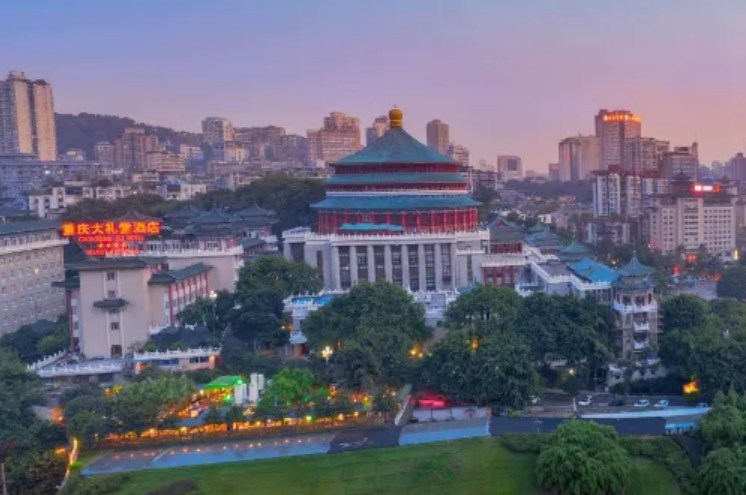
The Chongqing People's Auditorium is located at No. 173 Renmin Road, Yuzhong District, Chongqing, beside the Jialing River and adjacent to the People's Square. It is one of Chongqing's landmark buildings and a national 4A-level tourist attraction as well as a key national cultural heritage protection site. The architecture blends traditional Chinese palatial style with modern architectural elements, presenting a grand and imposing overall form that combines the solemn elegance of classical buildings with practical public functions. It serves as an important window showcasing Chongqing's urban culture and historical heritage. The main building stands 65 meters tall; its central hall spans 46.33 meters in width and rises 55 meters in height, accommodating over 4,200 people. The entire scenic area covers approximately 66,000 square meters, including the main auditorium, People's Square, and surrounding facilities. The square and the auditorium complement each other, together forming a vital public activity space and tourist area in Chongqing's core urban district. With its unique architectural art and profound cultural value, the site attracts a large number of visitors year-round and serves as a venue for many major political, cultural, and ceremonial events.
History and Culture
The construction of the Chongqing People's Auditorium was deeply rooted in its historical context. In the early years of the People's Republic of China, Chongqing, as the political, economic, and cultural center of Southwest China, urgently needed a venue capable of hosting large conferences and mass events. Construction officially began in June 1951, with design led by the renowned Chinese architect Zhang Jiade. The design drew heavily on the artistic features of traditional imperial architecture, such as the Temple of Heaven and the Summer Palace in Beijing, while incorporating modern structural requirements to achieve a balance between aesthetics and functionality.
The auditorium was completed and put into use in April 1954. Its completion not only filled the gap for large-scale public buildings in Southwest China but also set a benchmark for architecture in the region at that time. Over the decades following its completion, the auditorium witnessed countless historic moments, hosting key conferences across Southwest China, national-level cultural performances, and international exchange events. In 1987, the Royal Institute of British Architects included the Chongqing People's Auditorium in the History of World Architecture, recognizing its international artistic value. On June 25, 2001, the State Council of China designated it as a fifth?batch national key cultural heritage protection site, further cementing its important position in history and culture, and making it a vital carrier of Chongqing's urban memory and the innovative achievements of modern Chinese architecture.
Major Attractions
Main Auditorium Building
The main building is the core attraction of the scenic area. It adopts a symmetrical layout along a central axis, with a design based on traditional Chinese palatial architecture and meticulous attention to detail. The roof is a circular pyramidal shape covered with emerald?green glazed tiles, adorned with decorative ridge beasts, and the eaves feature intricate dougong (bracket sets) and colorful paintings with vivid hues and complex patterns, showcasing the essence of traditional decorative art. The front facade features a tall gate tower flanked by symmetrical side wings, forming a clear hierarchy of primary and secondary structures. The interior hall uses a column?free design, achieving an ultra?large span through advanced structural engineering. The seating is neatly arranged, stage facilities are comprehensive, and a huge crystal chandelier hangs from the ceiling, creating a solemn atmosphere while meeting the needs of large events. The exterior walls are finished in light beige, contrasting sharply with the green glazed tiles, producing unique visual effects under different lighting conditions—a perfect example of the fusion of traditional architecture and modern engineering.
People's Square
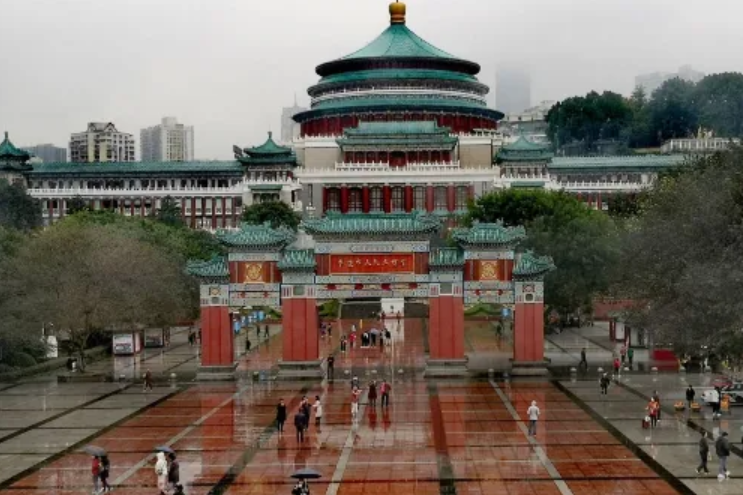
People's Square lies adjacent to the Chongqing People's Auditorium, covering about 30,000 square meters, and is an essential part of the scenic area. The square is paved with smooth stone slabs, offering an open view. At its center is a large musical fountain, surrounded by neatly arranged greenery and landscaped flower beds that provide seasonal scenery. The north side of the square connects to the main auditorium building, the south side is near the Chongqing Municipal People's Government, and the east side borders the Three Gorges Museum, forming an urban public space that integrates culture, politics, and leisure. As a key venue for daily recreation, fitness, and mass cultural activities for Chongqing residents, the square sees many locals walking, dancing, and engaging in recreational sports every day. It is also a resting place for tourists after visiting the auditorium; standing on the square offers a full panoramic view of the auditorium, making it one of the best spots for photographing the building's complete appearance.
Interior Exhibition Halls
The auditorium houses several themed exhibition halls within the auxiliary areas of the main building, with a total area of about 800 square meters. Through texts, images, physical objects, and multimedia displays, the exhibitions systematically present the construction history, architectural design details, historical events, and records of major activities held at the Chongqing People's Auditorium. Exhibits include reproductions of original architectural blueprints, construction tools, precious photographs from the completion ceremony, and commemorative items from various events over the years. A special focus is given to architect Zhang Jiade's design manuscripts and creative concepts, allowing visitors to gain an in?depth understanding of the entire process from conception to completion. In addition, the halls regularly host temporary exhibitions related to Chongqing's urban history and traditional architectural arts, enriching the cultural experience and helping visitors fully appreciate the auditorium's historical value and cultural significance.
Recommended Tour Route:
A half?day tour of the Chongqing People's Auditorium is recommended, lasting about 2.5 to 3 hours with a walking distance of approximately 1.5 kilometers. Visitors may enter from the northeast gate of the scenic area and first reach People's Square, where they can enjoy the full view of the auditorium, photograph the building's exterior and the fountain—spending about 30 minutes. Then proceed into the main auditorium building, first visiting the themed exhibition halls on the ground floor to learn about its history and architectural features (about 40 minutes). Next, move to the central hall to admire the column?free structure and traditional decorative art, experiencing the majestic spatial grandeur; you may stay here for 30 minutes to take photos. Afterwards, explore the side wing areas on both sides to see auxiliary facilities and small display zones (about 20 minutes). After the tour, exit from the south gate, near which multiple bus stops are conveniently located for onward travel; you may also walk to the nearby Three Gorges Museum to extend your visit.
Travel Tips:
The best seasons to visit are spring and autumn, when temperatures in Chongqing are mild (around 15–25°C), suitable for outdoor activities, and the greenery on People's Square is at its best for photography. In summer, avoid the peak heat hours of 10:00–16:00; in winter, keep warm, and occasional fog can offer a unique, misty landscape.
Free guided tours are available daily at 10:00 and 15:00, each lasting about 40 minutes. It is advisable to arrive early at the main entrance to join the tour, which provides deeper insights into architectural details and historical stories.
For the best panoramic shots, choose a clear day between 9–10 a.m. or 3–4 p.m., when the light is soft and backlighting is avoided; the central axis of People's Square is the optimal spot for capturing the full building.
Bring a lightweight camera and drinking water. Resting seats are mainly available around People's Square and the main hall, making it easy to take breaks.
In case of major conferences or events, some areas may be temporarily closed; check the official channels for the day's opening status in advance to avoid disappointment.
Important Notices:
Keep quiet inside the auditorium; loud talking, chasing, or roughhousing is prohibited to avoid disturbing other visitors and maintaining internal order.
Do not touch the exhibits in the exhibition halls; do not use flash when taking photos to protect artifacts and displays; tripods are not allowed inside the main hall.
Smoking and littering are forbidden throughout the scenic area. Please take care of public facilities and plants, and do not climb on exterior walls or decorative elements.
Group visits require reservation at least one day in advance via official channels, with a maximum of 50 people per group. Groups must present the reservation confirmation upon entry. Individual visitors do not need to book but must undergo security checks.
The interior floors are smooth, and some areas have multiple steps. The elderly and children should be accompanied to prevent falls; wear comfortable flat?soled shoes to reduce discomfort from prolonged walking.
Transportation:
Metro: Take Line 2 to Zengjiayan Station, exit C, and walk about 800 meters (10 minutes) to the northeast gate; or take Line 10 to Dali Hall Station, exit B, and walk about 500 meters (8 minutes) to the south gate.
Bus: Take bus routes 112, 145, 152, 262, 322, 421, 829, or 862 to Dali Hall Station, then walk less than 300 meters to the entrance; or take routes 465 or 601 to Renmin Road Station and walk about 400 meters.
Driving: There are underground and surface parking lots near the site, with a total of about 300 spaces. The fee is 5 RMB per 30 minutes, with a daily maximum of 50 RMB. During holidays, spaces are limited; public transport is recommended to avoid congestion.
Opening Hours:
People's Square is open 24 hours with no time restrictions.
The Chongqing People's Auditorium is open from 8:00 to 18:00 (ticket sales stop at 17:30).
Tickets:
People's Square is free of charge.
Admission to the Chongqing People's Auditorium costs 8 RMB per person.