Chongqing Huguang Guild Hall is located on the banks of the Yangtze River at Dongshuimen, Yuzhong District, Chongqing, at the eastern end of the Yuzhong Peninsula. It is one of the largest and best?preserved Ming?and?Qing?dynasty guild hall complexes still extant in China, a national 4A?level tourist attraction, and has a history of nearly 300 years. The site features distinctive migrant culture, exquisite ancient architectural craftsmanship, and profound regional cultural heritage, vividly presenting the migration, settlement, and cultural integration of immigrants from Huguang and other provinces during the Ming and Qing dynasties in Chongqing. The core area covers 18,418 square metres, with a built area of 7,653 square metres.
History and Culture
The construction of Chongqing Huguang Guild Hall is closely tied to the famous “Huguang Migrants to Sichuan” movement of the Ming and Qing dynasties. In the late Ming and early Qing periods, Sichuan suffered from wars, plagues, and other disasters, leading to a sharp population decline and widespread abandoned farmland. To revive production and stabilise rule, the Qing government from the Kangxi reign onward implemented large?scale resettlement policies, organising people from Hubei, Hunan, Guangdong, Guangxi, Jiangxi, Shaanxi, and other provinces to move into the Sichuan region. This historical event is known as the “Huguang Migrants to Sichuan”. As immigrant communities gathered in Chongqing, people from different places pooled funds to build guild halls for maintaining hometown ties, holding meetings, and performing rituals and prayers. The Chongqing Huguang Guild Hall was thus established in this context.
Construction of the guild hall complex began in the 24th year of the Qianlong reign (1759 AD). It underwent multiple expansions and renovations over time, and by the 26th year of the Daoguang reign (1846 AD) it had reached the scale seen today. Initially, the guild hall mainly served immigrants from Huguang, but gradually it became an important venue for cultural exchange among immigrants from many provinces. Besides fostering fellow?townsman bonds, it also functioned as a deliberative body for immigrant groups—mediating disputes, organising trade activities—and as a public space for worshipping deities such as Yu the Great and the God of Wealth, as well as for opera performances. It greatly facilitated the blending of diverse regional cultures in Chongqing.
Since the 20th century, the guild hall suffered damage from natural erosion and urban changes. In 1986, the Chongqing municipal government carried out its first systematic restoration; in 2001, it was listed as a fifth?batch national key cultural relic protection unit; from 2003 to 2005, relevant authorities launched a large?scale rescue restoration project covering 6,400 square metres, restoring the main buildings and historical appearance. It officially reopened to the public in 2005. Today, it is not only a tourist attraction but also an important memorial site for the “Huguang Migrants to Sichuan” culture, drawing numerous visitors and scholars every year to explore the traces of migration history.
Major Attractions
Yuwang Palace (Yu the Great’s Palace)
Yuwang Palace is the largest, earliest?built, and most magnificent core hall in the Chongqing Huguang Guild Hall complex. It was first constructed in the Kangxi reign of the Qing dynasty as a native?place guild hall for Huguang immigrants in Chongqing. It is not only the essence of the complex’s architectural art but also a “spiritual hall” bearing the epic migration history of “Huguang Migrants to Sichuan”. The palace is primarily dedicated to Yu the Great, the legendary hero who tamed floods. For immigrants from the two Hu (Hubei and Hunan) regions who made the arduous journey up the Yangtze River to the Ba?Shu area, Yu the Great was a patron deity who controlled floods and protected boats. Worshipping him was both a continuation of hometown culture and a prayer for safe navigation along the perilous Yangtze waterway.
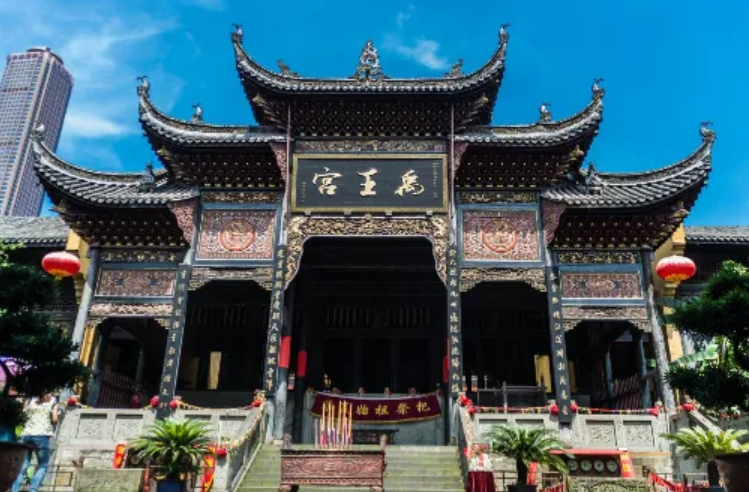
Guangdong Guild Hall
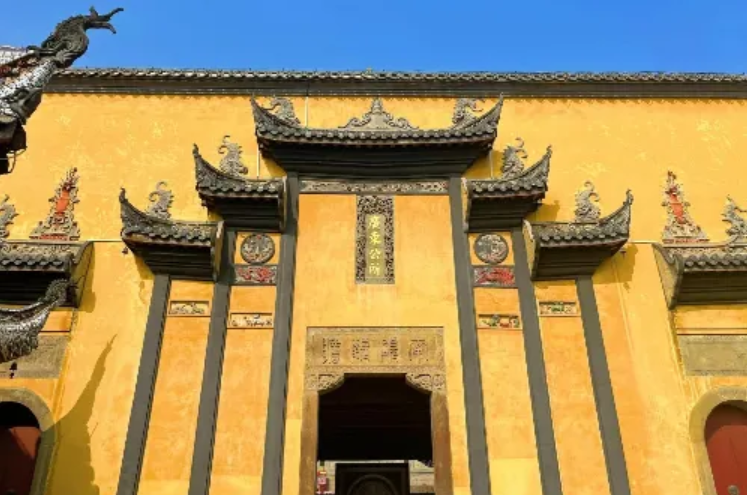
Guangdong Guild Hall lies immediately west of Yuwang Palace. It was built during the Jiaqing reign of the Qing dynasty, covering about 900 square metres with a built area of approximately 800 square metres. Its architectural style combines Lingnan and eastern Sichuan features. The main structure is a two?storey brick?and?timber building, with a hard?gabled roof common in Lingnan and the chuandou (column?and?tie) construction of eastern Sichuan, adapting to Chongqing’s climate while displaying regional fusion. The most distinctive feature is its wood carvings: on the gate’s wooden pillars are auspicious motifs such as “pine and crane for longevity” and “magpie on plum blossom”; the horizontal beams bear a wood?carved scene from the Romance of the Three Kingdoms, with vivid, lifelike figures in a continuous narrative—a masterpiece of woodcarving art. The brick?carved gate arch is also remarkable, featuring floral and auspicious?beast designs with meticulous composition and fine carving, showcasing the superb skill of Guangdong craftsmen.
Qi’an Guild Hall
Qi’an Guild Hall is situated east of Yuwang Palace. It was also built during the Jiaqing reign, covering about 850 square metres with a built area of about 700 square metres. It was established by immigrants from Huangzhou Prefecture, Hubei, and named after the ancient name of Huangzhou, “Qi’an”. The highlight of this hall is its stage, which faces south and is about 12 metres high, with a platform 10 metres wide and 8 metres deep. The stage floor is paved with bluestone slabs, and the edge is carved with exquisite scrolling?vine patterns. The roof is of the xieshan (hip?and?gable) type, with a plaque reading “Guandelou” (Virtue?Viewing Pavilion) hanging under the eaves. The wooden corbel brackets on both sides are uniquely carved as “two lions playing with a ball”. Historically, it regularly featured performances of Chu opera and other Hubei local operas, serving both as entertainment for immigrants and as a vehicle for spreading Hubei culture. In addition, the courtyard of Qi’an Guild Hall is elegantly laid out, with native trees such as banyan figs complementing the architecture, creating a peaceful and refined atmosphere.
Migration Museum
The Migration Museum is located west of Yuwang Palace, covering about 600 square metres, and was converted from an ancillary building of the guild hall. Through textual introductions, pictures, physical objects, and scene reconstructions, it systematically presents the historical background of the “Huguang Migrants to Sichuan”, the migration process, and the profound impact of immigrants on Chongqing’s politics, economy, and culture. The museum houses more than 300 artefacts from the Qing period, including farming tools, daily utensils, and contract documents used by migrants—such as earthenware jars carried during the journey, ploughs and harrows for cultivation, and land?transaction contracts. A multimedia area also uses video materials to recreate the hardships of the migration, allowing visitors to intuitively experience that epic chapter of history.
Suggested Tour Route:
We recommend a 2?hour highlights route, with a total walking distance of about 1.5 kilometres, suitable for most visitors. Entering through the main gate, first arrive at Yuwang Palace to admire its wood and brick carvings, study the steles, and learn about the guild hall’s core history and functions. After visiting the main hall, walk about 50 metres west to Guangdong Guild Hall, focusing on its Lingnan?style wood carvings and brick?carved gate. Then walk about 100 metres east to Qi’an Guild Hall, pause to enjoy the stage architecture, and imagine the lively opera performances of the past. After the main buildings, head west to the Migration Museum to systematically review the history of the “Huguang Migrants to Sichuan” through exhibits and multimedia. During the tour, you may rest briefly in the courtyards between buildings, enjoying the greenery and the ancient structures in harmony. We suggest taking your time to appreciate the architectural details and cultural nuances.
Travel Tips:
The best seasons are spring and autumn (March–May and September–November), when the weather in Chongqing is pleasant, mostly sunny or cloudy, making it easier to appreciate the architectural details while avoiding summer heat and winter dampness.
As the buildings are historically significant and some explanations involve complex migration and architectural knowledge, we recommend renting an audio guide or hiring a guide for a deeper understanding.
Plan about 1.5 to 2 hours for the visit; if you are particularly interested in history and architectural art, allow about 3 hours to study the carvings and museum exhibits in detail.
The site has a cultural and creative shop selling souvenirs such as bookmarks and postcards themed on migration culture and ancient architectural carvings—ideal as mementos.
Every Saturday at 2:00 pm, there is a traditional opera performance on the stage of Qi’an Guild Hall, lasting about 40 minutes. You may plan your schedule accordingly to enjoy the fusion of traditional opera and ancient architecture.
Important Notices:
All buildings in the site are national key cultural relics. Do not touch or carve any wood, stone, or brick carvings, and do not climb onto roofs or beams. Violators will be held legally liable.
Smoking is prohibited inside the site, and no flammable materials may be brought in. Fire extinguishers and no?smoking signs are placed throughout; visitors must strictly comply.
The physical exhibits in the Migration Museum are not to be touched; do not use flash when taking photos to avoid damaging the artefacts.
Some passageways are narrow, and certain areas have many steps. Elderly visitors and children should be accompanied and watch their step to prevent falls.
The site implements visitor flow control; during peak holidays, there may be queues. It is advisable to avoid the peak hours of 10:00 am–2:00 pm.
Transportation:
Bus: Take bus 338, 375, or 376 to Dongshuimen Bridge South Station, then walk about 300 metres to the entrance. Alternatively, take bus 414, 440, or 0491 to Chuqimen Station and walk about 500 metres.
Metro: Take Chongqing Rail Transit Line 1 to Xiaoshizi Station, exit from Gate 5, and walk along Dongshuimen Main Street for about 1.2 kilometres (about 15 minutes). Alternatively, take Line 6 to Xiaoshizi and transfer to Line 1, following the same route.
Driving: From various parts of central Chongqing, approach via Dongshuimen Bridge or Yangtze River Bridge. A temporary car park is available next to the Dongshuimen city?wall ruins, with about 50 spaces. Charges: small cars 10 CNY per visit (up to 4 hours); after that, an extra 2 CNY per hour, with a daily maximum of 20 CNY.
Walking: If you are in the Jiefangbei commercial area of Yuzhong District, walk east along Linjiang Road for about 1.5 kilometres (about 20 minutes), enjoying the riverside views along the way.
Opening Hours:
Open daily from 9:00 to 18:00 (last admission and ticket sales stop at 17:00). Multimedia equipment in the museum runs from 9:30 to 12:30 and 14:30 to 17:30 (subject to on?site conditions on the day).
Admission:
Ticket price: 32 CNY per person.