The Fujian Tulou (Nanjing) Scenic Area is located in Shuyang Town and Meilin Town, Nanjing County, Zhangzhou City, Fujian Province. It is a UNESCO World Heritage Site, a National 5A-Level Tourist Attraction, a National Water Scenic Area, and a National Civilized Unit. The scenic area comprises three zones:the Tianluokeng Cluster, the Yunshuiyao Cluster, and the Hekeng Tulou Folk Cultural Village Cluster, covering approximately 3.03 square kilometers. The area is renowned for its historic and uniquely styled tulou (earthen buildings), which are constructed mainly from rammed earth combined with timber and stone, showcasing exquisite craftsmanship. There are over 3,000 rigorously confirmed tulou structures in Fujian. Built in accordance with the philosophy of "harmony between heaven and humanity," these buildings blend seamlessly with the natural landscape, making them treasures of vernacular architecture worldwide and exemplifying an ideal human settlement in harmony with nature.
History and Culture
Fujian tulou originated in the Song and Yuan dynasties and matured during the late Ming, Qing, and Republic of China periods. Nanjing is often called the "Kingdom of Tulou," with a long history of tulou construction. The earliest surviving tulou, Chaoshui Lou (1549–1553), and the latest, Yongqing Lou (1967–1972), span a construction history of 423 years, reflecting the evolution of tulou across different eras.
The construction of tulou was closely tied to the social environment and clan culture of the time. They were built by Hakka ancestors as homes for their descendants after migration, carrying deep family sentiments and cultural heritage. For example, the Tianluokeng Tulou Cluster was laid out according to the "Five Halls" plan described in the Kaogongji (a classic on craftsmanship), following the five elements (metal, wood, water, fire, earth) in a mutually generative order. The inscribed couplets, carved beams, and painted pillars within the buildings convey the values of "loyalty and filial piety as the foundation, and farming and study as the family tradition," reflecting the Hakka people's respect for and continuation of traditional culture.
Major Attractions
Tianluokeng Tulou Cluster
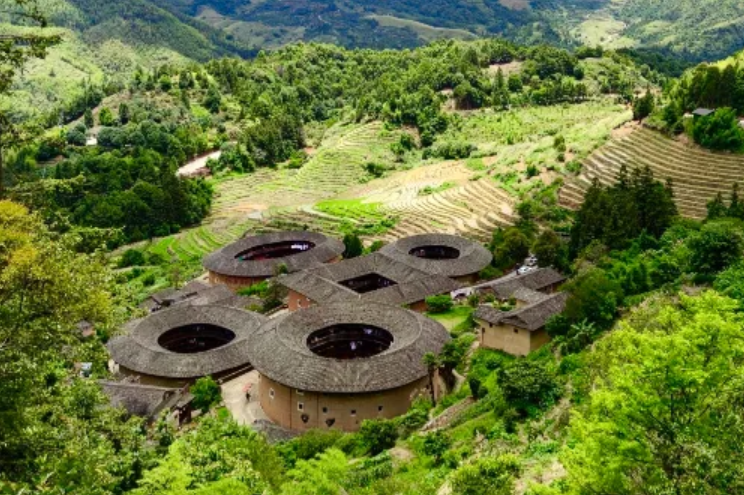
Located in Shangban Village, Shuyang Town, Nanjing County, on a hillside 787.8 meters above sea level, this cluster was first built in the late Yuan and early Ming dynasties and completed in the 1960s, spanning over 600 years of construction. It consists of the square-shaped Buyun Lou, the circular Zhenchang Lou, Ruiyun Lou, and Hechang Lou, and the oval-shaped Wenchang Lou, popularly known as "Four Dishes and One Soup." It is considered the most beautiful ensemble of tulou and a landmark of Fujian tulou. It is a key national cultural heritage site, one of the first Chinese historical and cultural villages, and one of the first Chinese landscape villages. It was inscribed on the UNESCO World Heritage List in 2008.
Yuchang Lou
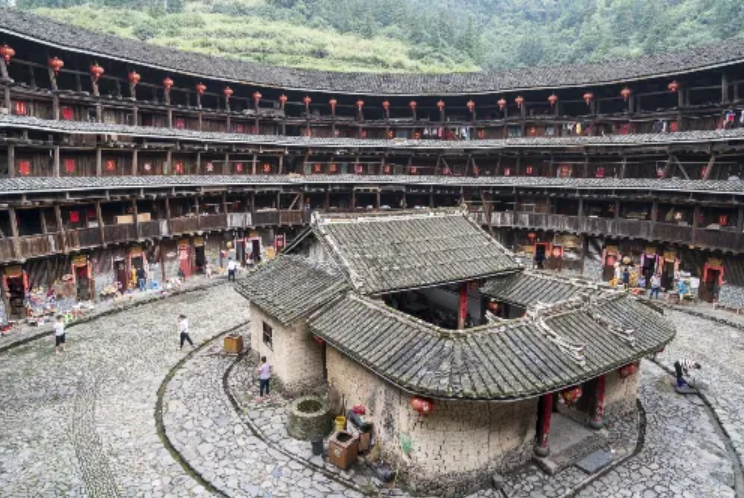
Located in Shuyang Town, Nanjing County, Yuchang Lou was built in 1308, making it the oldest existing tulou in Fujian. It was jointly funded by five clans—Liu, Luo, Zhang, Tang, and Fan. The building has five stories, reaching 18.2 meters in height, with 270 rooms. It features five staircases and is divided into five sectors. On the ground floor, there are 22 wells in the kitchens—the highest number of wells in any Fujian tulou. Its most striking feature is its tilted pillars, leaning at angles up to 15°. Despite 700 years of erosion and numerous earthquakes, the structure remains stable, earning it the title of a "living specimen" of ancient vernacular architecture.
Taxia Village
A National 5A-Level Tourist Attraction, one of China's Best Landscape Villages, and a provincial-level historical and cultural village, Taxia is often called "a water town in the mountains, the Zhouzhuang of southern Fujian." A winding stream, bamboo groves, and curling smoke from chimneys create a picturesque scene, dotted with "apron-shaped" tulou, stilted buildings, the Deyuan Tang ancestral hall, and stone dragon flagpoles. The Zhang clan ancestral hall, Deyuan Tang, is a key national cultural heritage site, with 24 stone flagpoles erected in front of it.
Yunshuiyao Ancient Town
Originally known as Changjiao Guanyang Village, this town has a history of over 600 years. It features a cobblestone ancient plank road stretching more than 10 kilometers. The town is home to two World Heritage sites—Hegui Lou and Huaiyuan Lou—as well as the largest and densest cluster of thousand-year-old banyan trees in Fujian, a century-old street, and a millennium-old road. The town preserves 53 tulou in good condition, built from the mid-Yuan dynasty onward, including square, circular, stilted, bamboo-pole, and mansion-style tulou, each with unique charm.
Hegui Lou
Located in Pucun Village, Meilin Town, Nanjing County, Hegui Lou was built in 1732 (the tenth year of the Yongzheng reign of the Qing dynasty). It is a corridor-style timber-and-earth structure, five stories high at 21.5 meters, with a wall height-to-thickness ratio of 13:1. Built on a 3,000-square-meter marshland using a floating foundation of pine piles and a raft foundation, it is the tallest square tulou ever built on soft ground, resembling a "Noah's Ark" on land.
Huaiyuan Lou
Located in Kanxia Village, Meilin Town, Nanjing County, Huaiyuan Lou was built in the late Qing dynasty (1905–1909). It is the best-preserved and most exquisitely crafted double-ring circular tulou among those inscribed on the UNESCO World Heritage List. Constructed with the mature "inclined-wall" technique, it is a drum-shaped tulou that represents the pinnacle of rammed-earth civilization, accumulating millennia of Chinese earth-construction technology. The carved couplets and decorative beams inside convey the ethos of "loyalty and filial piety, farming and study."
Hekeng Tulou Cluster:
This area features the densest concentration of tulou in Fujian. Seven square tulou built during the Ming and Qing dynasties and seven circular tulou built in modern times form two groups that mirror the "Big Dipper" (Beidou Qixing) asterism on the ground. In July 2008, the Hekeng Tulou Cluster was inscribed on the UNESCO World Heritage List.
Suggested Itinerary (Two Days):
Day 1 – Tianluokeng Zone
Morning:Visit the Tianluokeng Tulou Cluster to admire the "Four Dishes and One Soup" and learn about its history and culture.
Afternoon:Head to Yuchang Lou to see the fascinating "leaning" pillars, then visit Taxia Village for a stroll along the creek, enjoying the ancient houses and the stone flagpoles at Deyuan Tang.
Day 2 – Yunshuiyao Zone
Morning:Explore Yunshuiyao Ancient Town, walking along the ancient plank road and viewing the thousand-year-old banyans, the century-old street, and the tulou.
Afternoon:Visit Hegui Lou and Huaiyuan Lou to appreciate their architectural features and stories. If time permits, go to the Hekeng Tulou Cluster to see the "Big Dipper" layout.
Travel Tips:
The scenic area is large; plan your route in advance and allocate time wisely to avoid rushing.
Many paths are cobblestone; wear comfortable sports or casual shoes and watch your step.
Mosquitoes are common; bring insect repellent.
Entering upper floors of some tulou may require an additional fee (about ¥10), depending on your interest.
For local food, choose restaurants frequented by residents for authentic flavors and reasonable prices.
Important Notes:
Tulou are scattered in mountainous areas of southern Fujian. Transportation mainly includes private cars, vans, and motorbikes, which can be costly; consider sharing a chartered vehicle with others to save time and money.
Check the weather forecast before departure and bring rain gear; in summer, protect yourself from the sun with sunscreen, hats, sunglasses, and protective clothing.
Respect local customs and cultural traditions; do not make loud noises or behave inappropriately inside tulou.
Do not touch or damage cultural relics; keep the tulou clean and tidy.
Transportation:
External access:First reach Nanjing County, then take the special tourist road (Shanmei Highway) to the scenic area. Alternatively, take the high-speed train to Nanjing Station, then transfer to a tourist bus, public bus, or taxi to the site.
Internal transport:Within the scenic area, travel is mainly by vehicle or on foot. Roads include paved cement, cobblestone, and a few gravel and dirt paths. Shuttle buses run between attractions for visitor convenience.
Opening Hours:
Open year-round from 08:30 to 17:00.
Admission:
¥90 per person.