Tianmen Mountain National Forest Park is located 8 kilometers south of the urban area of Zhangjiajie City, Hunan Province. It is a mountain-type natural scenic area. It is a Global Geopark, a National Forest Park, and a National 5A-level Tourist Attraction. The park covers a total area of 96 square kilometers, with the mountaintop area reaching 2 square kilometers and the main peak at an altitude of 1,518.6 meters. Its primitive secondary forest coverage rate reaches 90%, and it is rich in germplasm resources. Tianmen Mountain is named after the natural wonder Tianmen Cave. The mountain body is at an altitude of 1,350-1,500 meters. Geologically, it is a complete syncline structural unit, with typically developed mid-mountain karst platform peak forest and canyon landforms. On the mountain are karst platform cliff landscapes, and at the foot of the mountain are karst peak forest and canyon landscapes. Throughout the mountain, karst hills, stone buds, depressions, funnels, and karst caves are widely distributed. It is distinguished from the sandstone peak forest landscape of Wulingyuan by its relatively complete development of karst landforms, and it is a platform-shaped isolated mountain. This area has a subtropical mountain-type monsoon humid climate. The daily temperature is about 6-8 degrees lower than that of the urban area, and the sunshine duration is 12-14 hours. Due to differences in altitude and temperature, the four seasons on Tianmen Mountain have become two seasons.
Historical Culture
Tianmen Mountain was called Songliang Mountain in ancient times. During the Three Kingdoms period, the cliff of Songliang Mountain suddenly opened into a cave, bright and clear like a gate, forming the rare world wonder to this day — Tianmen Cave. Emperor Sun Xiu of Wu considered this an auspicious sign, so he renamed Songliang Mountain Tianmen Mountain and established Tianmen Commandery at the foot of the mountain, which is today's Zhangjiajie City.
According to records, from the 18th year of the Qianlong reign of the Qing Dynasty (1753) to the 5th year of the Republic of China (1916), over a period of 163 years, Tianmen Mountain was repaired and renovated 7 times. It was the center of Buddhism in western Hunan and the highest-altitude Buddhist architectural complex in Hunan Province. In 2002, Tianmen Mountain Temple was rebuilt and opened to the public on June 9, 2009.
For thousands of years, the successive emergence of six unsolved mysteries — "Tianmen Cave Opening, Tianmen Water Turning, Tianmen Turning Direction, Yefu Hiding Treasure, Ghost Valley Manifesting Shadow, and Tianmen Auspicious Beast" — has added mysterious and extraordinary interest to this place.
Main Attractions
Tianmen Cave
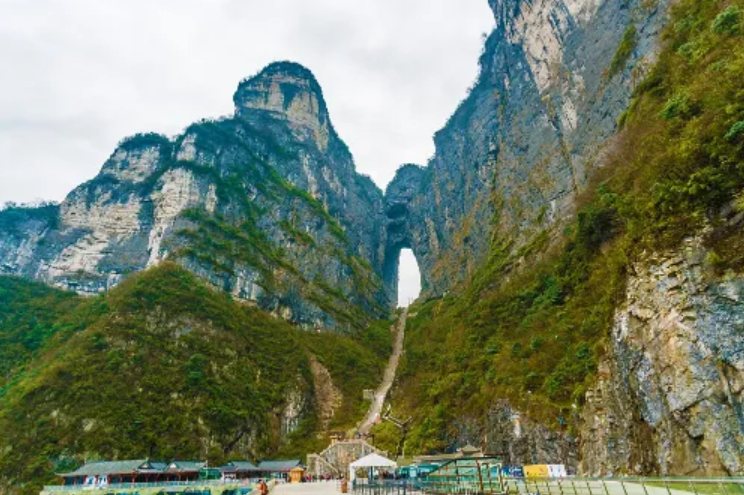
Tianmen Cave is the world's highest-altitude natural mountain-piercing karst cave, located in the middle-upper part of the Tianmen Mountain massif at an altitude of 1,300 meters. It runs through from north to south, with a gate height of 131.5 meters, a width of 57 meters, and a depth of 60 meters. Standing tall against the sky, it is like a gateway to heaven. On clear days, "Tianmen Spitting Mist" can be seen; in winter, clouds and mist swirl around it like "Tianmen Spitting Mist"; in summer, waterfalls pour down forming "Plum Blossom Drifting Rain." Historical records also mention natural wonders such as "Tianmen Spiritual Light," and local chronicles record that Tianmen Cave has the "Ten Scenes of Tianmen." The Heaven-Climbing Ladder leading to Tianmen Cave consists of 999 steps in total. It is the path to reach Tianmen and also a spiritual place for making wishes and praying for blessings.
Tongtian Avenue
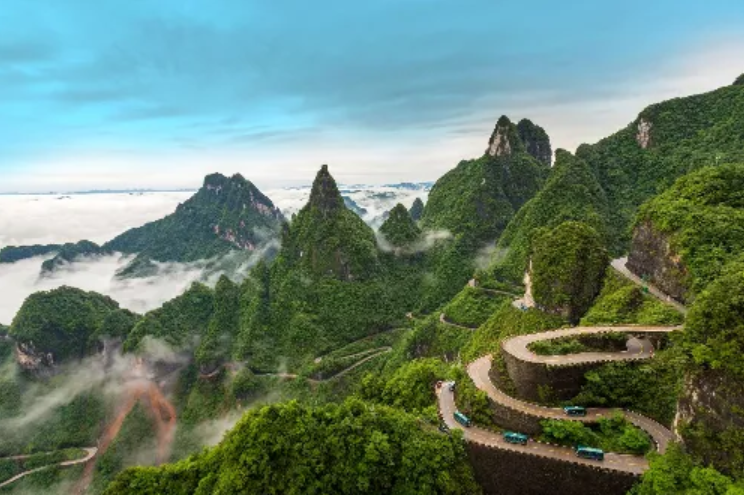
Tongtian Avenue is named because it leads to Tianmen Cave. It has a total length of 10.77 kilometers and winds through ninety-nine bends. Every ninth bend has a stone tablet as a marker, implying "Nine Heavens." The altitude rises sharply from 200 meters to 1,300 meters, and it is praised as "the world's number one wonder of highway engineering." Construction of this road began in 1998. Due to the unique geological and climatic conditions of Tianmen Mountain, the construction process was extremely difficult, and it was not fully opened until 2005.
Glass Skywalk
The Glass Skywalk in the Mixian Wonderland Scenic Area has a total length of 1,600 meters and an average altitude of 1,400 meters. The entire walkway stands in the middle of sheer cliffs. Visitors walking on it can experience the thrill of walking in midair. At present, the West Line, East Line, and Panlong Cliff have also each opened glass skywalks about 60 meters long. Among them, the West Line is more thrilling, while the East Line has fewer people. Visitors walking on the glass skywalk need to rent shoe covers.
Ghost Valley Skywalk
The Ghost Valley Skywalk is located in the Mixian Wonderland Scenic Area and is named because it hangs along the cliff line above Ghost Valley Cave. The skywalk has a total length of 1,600 meters and an average altitude of 1,400 meters. Its starting point is Yihong Pass, and its ending point is Small Tianmen. Unlike other skywalks, the entire Ghost Valley Skywalk is neither at the top of the cliff nor at the side of the cliff, but stands entirely in the middle of sheer cliffs, giving people the feeling of rising and falling together with the cliff.
Tianmen Mountain Cableway
Tianmen Mountain Cableway, also known as "Hongsuo Longxiang," connects the urban area of Zhangjiajie with the summit of Tianmen Mountain. It has a total length of 7,455 meters and is one of the longest high-mountain cableways in the world. The horizontal height difference of the cableway is 1,279 meters, and it is also the cableway with the largest local inclination and the most supports in China. Tianmen Mountain Cableway has a total of 98 cabins and 57 cableway supports (including 3 rescue supports). A one-way trip by cableway takes about 28 minutes. Visitors can cross urban areas, farmland, and canyons, enjoying a spectacular experience.
Tianmen Mountain Temple
Tianmen Mountain Temple is located in the southern part of the summit and is the core area of Tianmen Mountain's "Buddhist culture." The temple was first built in the Ming Dynasty and once had very prosperous incense offerings. It was the Buddhist center of western Hunan.
Biyie Yaotai Scenic Area
Biyie Yaotai Scenic Area has a complete primitive secondary forest, with a forest coverage rate of 90%. It preserves many rare plant species, such as dove trees and Chinese tulip trees, and is called an "aerial bonsai garden." Within it, ancient trees reach the sky, vines intertwine, moss is everywhere, and stone bamboo shoots and stone buds can be seen at every step. Everywhere is like a naturally formed bonsai.
Tour Route:
Visitors can first take the Tianmen Mountain Cableway up the mountain. After reaching the summit, they can choose to first walk the West Line and visit attractions such as the Glass Skywalk and Ghost Valley Skywalk to experience the thrilling cliff experience. This takes about 2-3 hours in total. After that, go to the Middle Line to visit Tianmen Mountain Temple, staying for about 1 hour. Then go to the East Line to view the primitive secondary forest landscape of Biyie Yaotai Scenic Area, with a visit time of about 1-2 hours. Finally, take the mountain-piercing escalator down to Tianmen Cave, climb the 999-step Heaven-Climbing Ladder, and then take the environmental protection bus down the mountain along Tongtian Avenue. The entire tour is recommended to be arranged for 5-7 hours.
Travel Suggestions:
In spring (March-May), you can view azaleas covering the mountains and plains. At the same time, the temperature is suitable and good for outdoor activities. It is recommended to wear comfortable sports shoes and light clothing.
In summer (June-August), Tianmen Mountain is a summer resort, and the temperature is lower than in the urban area. However, ultraviolet rays are relatively strong, so sunscreen, sunglasses, and other sun protection items should be carried.
In autumn (September-November), you can enjoy the red leaves all over the mountain, and the scenery is very beautiful. At this time, the temperature difference between morning and evening is relatively large, so it is best to bring a coat.
In winter (December-February), if it snows, Tianmen Mountain is covered in silver, and you can view rime scenery. However, attention should be paid to keeping warm, and thick down jackets, snow boots, etc. should be worn. At the same time, because Tianmen Cave and Tongtian Avenue may be closed in winter, plan your itinerary in advance.
Book tickets online in advance to avoid long queuing times during the peak tourist season.
When walking on the Glass Skywalk and Ghost Valley Skywalk, if you have symptoms of acrophobia, you can slow down and hold the railings beside you while moving forward.
Notes:
Open flames are strictly prohibited in the scenic area, and smoking is prohibited in non-smoking areas.
When taking the Tianmen Mountain Cableway, follow the arrangements of the staff and do not shake or play around in the cabin.
When walking on the Glass Skywalk and Ghost Valley Skywalk, proceed in order according to the signs and do not crowd or push.
Tianmen Mountain is at a relatively high altitude, and some tourists may experience mild altitude sickness. If you feel unwell, inform the scenic area staff promptly.
During the peak tourist season, there are many visitors at various attractions, so take good care of your personal belongings.
Do not feed wild animals at will in the scenic area, and maintain the ecological environment of the scenic area.
Transportation:
By plane: You can first arrive at Zhangjiajie Hehua International Airport, which is about 8 kilometers from Tianmen Mountain National Forest Park. It takes about 20 minutes by taxi to reach the lower station of the scenic area cableway.
By train/high-speed rail: Zhangjiajie has Zhangjiajie Station and Zhangjiajie West Station. From Zhangjiajie Station to the lower station of Tianmen Mountain Cableway, it takes about 30 minutes by bus and about 15 minutes by taxi; from Zhangjiajie West Station to the lower station of Tianmen Mountain Cableway, it takes about 1 hour by bus and about 30 minutes by taxi.
City transportation: Within the urban area of Zhangjiajie, you can take buses such as No. 1, No. 4, No. 5, No. 6, No. 7, and No. 10 to reach the lower station of the Tianmen Mountain Cableway Company. You can also choose to take a taxi to the scenic area.
Opening Hours:
The scenic area is open from 07:30 to 19:00 (last entry at 16:00). However, it should be noted that Tianmen Cave is not open all year round. Every winter, due to snow and icy roads, Tianmen Cave and Tongtian Avenue (the 99-bend winding mountain road) leading to Tianmen Cave are closed.
Tickets:
The ticket price is 278 yuan per person.