Guangdong Museum is located at No. 2 Zhujiang East Road, Tianhe District, Guangzhou, Guangdong Province, on the east side of Huacheng Square, south of the central axis of Zhujiang New Town. It is the only provincial-level comprehensive museum in Guangdong Province, rated as a National First-Class Museum, and is among the first batch of national study-travel practice education bases for primary and secondary school students. It implements a free-admission policy. The foundation stone of the new museum was laid in December 2004, and it was officially opened on May 18, 2010. Its architectural design adopts the concept of a Lingnan ivory openwork treasure box, with the overall form of a hollow treasure box. It is one of the landmark cultural buildings of Zhujiang New Town in Guangzhou. The new museum covers a total site area of 41,027 square meters, with a total floor area of 69,724 square meters, of which the exhibition area is 21,000 square meters. The building has five floors above ground and one underground floor. It is equipped with functional spaces such as collection storage, an academic lecture hall, a youth activity center, and a cultural and creative service area. The storage area is 8,873 square meters, and the dedicated space for educational activities is 4,726 square meters. The museum’s total collection exceeds 260,000 items (sets), including 20,843 precious cultural relics (items/sets). The collection covers Lingnan historical relics, export artworks, Duan inkstones, Chaozhou wood carvings, ceramics, paleontological fossils, animal, plant, and mineral specimens, and other categories. It fully serves the functions of displaying Guangdong’s regional history, maritime trade, traditional crafts, and natural ecology, while combining historical research, science popularization education, and cultural exhibitions. It receives more than 3 million visitors each year.
History and Culture
Guangdong Museum began preparatory work in June 1957. Its initial site was on Wenming Road, Guangzhou. The original site included Qing-dynasty Guangzhou Gongyuan, the former site of the First National Congress of the Kuomintang, and other cultural heritage protection units. It officially opened to the public on October 1, 1959, and simultaneously managed and operated the Guangzhou Lu Xun Memorial Hall. The old museum covered an area of 43,000 square meters, and the initial exhibition building had a floor area of about 14,000 square meters. In the early years, exhibitions focused on local Guangdong archaeology and local revolutionary history. It successively launched special exhibitions such as the Xisha Islands Cultural Relics Exhibition and the Guangdong Archaeological Achievements Exhibition, forming an exhibition system rooted in the Lingnan region. After reform and opening up, the old museum could no longer meet the needs of expanding collections and public visitation. Exhibition space and artifact storage facilities were seriously insufficient, and Guangdong launched planning and approval work for a new museum.
In 2004, the new Guangdong Museum was included in Guangdong Province’s ten key cultural projects. In December of the same year, construction began on the Zhujiang New Town plot. It took six years to complete and officially opened on May 18, 2010, International Museum Day. Its overall hardware facilities, exhibition hall scale, and artifact preservation conditions achieved leapfrog improvements. The new museum established four permanent exhibition sections, integrating history, nature, traditional crafts, and temporary special exhibition spaces. It is equipped with professional constant-temperature and constant-humidity cultural relic storage, multimedia digital exhibition systems, and youth study classrooms, while also improving accessible access, storage, guided tours, and other public service facilities. After 2020, the museum continued to update its digital display methods, adding AR artifact restoration and online panoramic exhibition halls, expanding a cultural dissemination model that combines online and offline. It has become a core cultural and museum window for displaying Lingnan culture and Maritime Silk Road civilization.
The collection system comprehensively covers Guangdong’s million-year human development history. From Maba Man fossils and Nanyue Kingdom bronzes to Tang-Song export porcelain, Ming-Qing Guangzhou craftsmanship, and modern commercial and revolutionary relics, it fully links the origins of Guangdong, maritime trade, the cultures of the three major sub-ethnic groups, and modern revolutionary history. The museum’s collections of Lingnan intangible cultural heritage crafts such as Chaozhou wood carvings, Duan inkstones, Guangzhou ivory carvings, and Shiwan ceramics rank among the leading numbers in China. A large number of artifacts recovered from the Nanhai No. 1 shipwreck, export wallpaper, and Western custom-made Canton porcelain directly confirm Guangdong’s core location along the Maritime Silk Road for more than 2,000 years. At the same time, the museum’s paleontological, marine animal, and plant specimens comprehensively record Lingnan’s geological evolution and ecological characteristics. It serves the dual cultural functions of humanistic history and natural science popularization, and is a core physical database for studying the history and culture of the Guangdong-Hong Kong-Macao Greater Bay Area.
Main Attractions
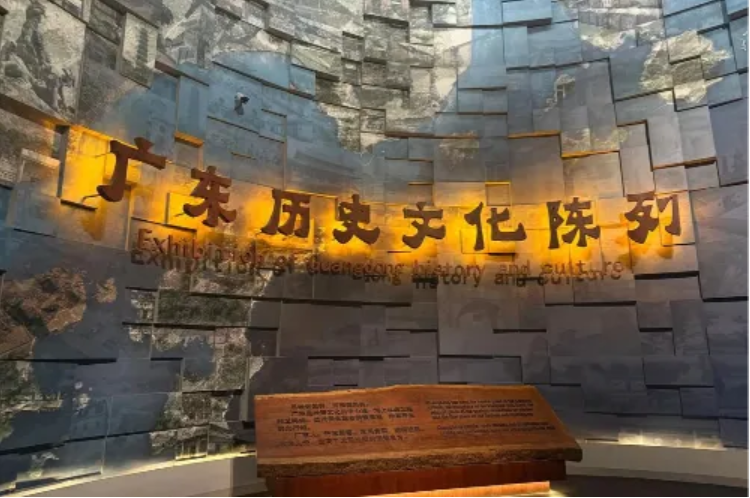
Guangdong History and Culture Exhibition Hall
The hall is located on the fourth floor of the museum, with an area of more than 4,000 square meters. It displays more than 1,500 cultural relics (items/sets) and is accompanied by more than 300 historical photographs. It is the museum’s core permanent exhibition. The exhibition is organized chronologically into four chapters: Origins of Guangdong, Sailing the World, Carrying Forward the Past and Opening Up the Future, and Beacon Fires over Guangdong. It comprehensively presents the complete history of Guangdong from the primitive civilization of Maba Man to the founding of New China. Highlights include a complete 40-meter Liede dragon boat, the only complete set of Qing-dynasty Guangzhou export wallpaper in China, a Western Zhou bronze he with an animal-mask pattern, gold ornaments unearthed from Nanhai No. 1, and a photo album autographed by Zhan Tianyou. Complemented by large land-and-sea themed murals, reconstructed folk scenes, and multimedia interactive exhibits, it clearly presents the integration of the Cantonese, Hakka, and Teochew groups and the development of maritime trade.
Guangdong Natural Resources Exhibition Hall
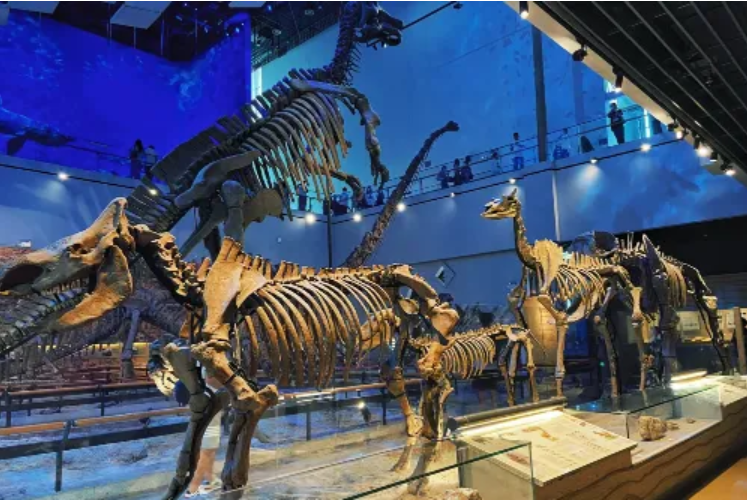
The hall is located on the fourth floor, adjacent to the History and Culture Exhibition. It is divided into seven thematic exhibition areas, including geology and landforms, minerals and gems, Chinese herbal medicine, terrestrial wildlife, marine animals, and paleontology. The total area of the hall exceeds 4,000 square meters and houses tens of thousands of mineral, animal, plant, and paleontological specimens. The exhibition area features a complete giant Mamenchisaurus skeleton and an adult fin whale skeleton specimen. The internet-famous Guangning jade carving “White Cut Chicken” is displayed here. The gem area focuses on Lingnan-characteristic crystals, jade, and mineral ores. The marine area uses an immersive blue-light setting to display hundreds of deep-sea fish, coral, and shellfish specimens. It has a strong science popularization character and is a popular exhibition area for family visits, fully showing Guangdong’s geological changes and the complete picture of its terrestrial and marine ecological resources.
Essence of Lacquer and Wood—Chaozhou Woodcarving Art Exhibition Hall
The hall is located on the third floor and displays more than 200 woodcarving artifacts, including gold-lacquered shrines, longevity screens, openwork crab baskets, traditional wedding utensils, and other fine Chaozhou woodcarvings. Among them, the Qing-dynasty Yongqing Hall gold-lacquered woodcarving grand shrine is a national-treasure-level artifact of the museum. The hall recreates the actual scenes of traditional Chaoshan residence halls, studies, and bedrooms, showing the application of woodcarving in folk sacrifices and daily life. The exhibits feature multi-layer openwork, gold tracing, and polychrome painting techniques. It clearly traces the development of Chaozhou woodcarving from folk practical objects to top-level arts and crafts, fully presenting the traditional Chaoshan carving intangible cultural heritage.
Purple Stone Condensing Essence—Duan Inkstone Art Exhibition Hall
The hall is located on the third floor next to the Chaozhou Woodcarving Hall. It focuses on displaying fine Duan inkstones from successive dynasties, including products made from stone from various pits such as Laokeng, Kengzaiyan, and Maziyan. Representative ancient inkstones in the collection include the Thousand Gold Monkey King Inkstone. It also displays inkstone-making tools and raw Duan inkstone specimens. The exhibition is divided by era, inkstone pit, and craftsmanship, explaining Duan inkstone mining, carving processes, and Lingnan stationery culture. It systematically reviews the development history of Duan inkstones from the Tang dynasty to the present and showcases the unique stationery craft culture of Zhaoqing, Guangdong.
Art of Earth and Fire—Permanent Collection of Ceramics Through the Ages Exhibition Hall
The hall is located on the third-floor mezzanine and displays nearly 300 ceramic objects, spanning from the Neolithic Age to the Qing dynasty. It is divided into four sections: the origin of pottery, the development of ceramics nationwide, the heyday of ceramics, and Guangdong kilns and export porcelain. Exhibits include Shiwan kiln pottery sculptures, Chaozhou kiln porcelain, a Yuan blue-and-white pear-shaped vase with figures, and Ming-Qing Canton export porcelain. It fully restores the development of the ancient maritime porcelain trade and compares the craft characteristics of Guangdong’s local kilns with major porcelain kilns across the country, intuitively presenting the history of Lingnan ceramic exports.
Temporary Special Exhibition Hall
The museum has an independent large temporary exhibition space on the third floor, regularly changing themed special exhibitions. Exhibition content includes borrowed artifact exhibitions from cultural and museum institutions nationwide, calligraphy and painting art exhibitions, marine archaeology special exhibitions, intangible cultural heritage exchange exhibitions, and more. The opening periods of temporary exhibitions vary and are subject to official museum announcements. They supplement the permanent exhibition halls with diverse cultural display content.
Museum Atrium and Treasure-Box Building Exterior
The exterior of the museum as a whole is shaped like an openwork ivory treasure box. The facade adopts a gray stone openwork design and is a popular photo spot. Inside, the center features a multi-story high atrium, complemented by ring corridors and large floor-to-ceiling viewing windows. Visitors can look out at the Pearl River, Canton Tower, Huacheng Square, and other urban scenery. It can be visited and photographed without entering the exhibition halls, and is an iconic architectural landscape of the museum.
Suggested Routes:
Efficient Highlights Route (3-Hour Highlights Tour): Enter through West Gate security check → 4F Guangdong History and Culture Exhibition Hall → 4F Guangdong Natural Resources Exhibition Hall → 3F Chaozhou Woodcarving Art Hall → 3F Duan Inkstone Art Hall → 3F Mezzanine Ceramics Through the Ages Hall → 1F Cultural and Creative Service Hall → Exit from West Gate.
In-Depth Full-View Route (4–5 Hour Complete Tour): Enter through West Gate security check → 4F Guangdong History and Culture Exhibition Hall → 4F Natural Resources Exhibition Hall → 3F Chaozhou Woodcarving Hall → 3F Duan Inkstone Hall → 3F Temporary Special Exhibition Hall → 3F Mezzanine Ceramics Hall → 2F Rest and Cultural/Creative Service Area → 1F Youth Activity Center and Academic Lecture Hall exterior visit → Exit from West Gate.
Visit Tips:
Recommended duration: 3 hours for the highlights tour, 4–5 hours for the complete in-depth tour. Families with children are advised to allow more than 4 hours.
Time selection: Weekdays have fewer visitors, offering a better photo and viewing experience. On Fridays, the museum is open late until 20:30, and the soft evening light is suitable for photographing exhibits. On weekends and statutory holidays, tickets are in high demand, so be sure to book in advance.
It is recommended to view from top to bottom, from the fourth floor to the first floor, to avoid repeated backtracking and save energy.
Pick up a paper guide map before entering and mark the locations of the museum’s treasures to improve viewing efficiency. Audio guides can be rented for detailed background information on exhibits.
The air conditioning inside the museum is cold year-round. It is recommended to bring a light jacket throughout the visit to avoid catching a chill.
Those who enjoy cultural and creative stamping can bring a blank notebook. The first-floor cultural and creative shop provides free stamping.
Families with children should prioritize the fourth-floor Natural Resources Exhibition Hall. The dinosaur and marine specimens are more interactive and suitable for science popularization for younger children.
After the visit, you can walk to Huacheng Square, Guangzhou Opera House, and the Pearl River for a connected cultural tourism route.
Important Notes:
The museum implements real-name, timed reservation for all visitors, including infants. No entry is allowed without a reservation. Reservation slots for the next 7 days open at 22:00 every night. Within 14 days, the same account can make only one reservation order, with a maximum of 5 people per order.
If a visitor fails to show up on 2 consecutive days or accumulates 3 no-shows, the account cannot reserve museum tickets or study activities for 90 days. If you cannot attend, you must cancel the reservation online in advance.
All reserved visitors must bring the original ID cards of all reserved persons. Electronic ID cards can be used as auxiliary proof. Enter through the West Gate individual channel by swiping your ID and passing security check. The reservation is valid only for a single entry on the same day and cannot be used for re-entry after leaving.
Eating and drinking are prohibited in the exhibition halls. Snacks and drinks can be stored in the free lockers at the West Gate. There is an independent rest area and dining area on the second floor; food may only be eaten in the rest area.
Photography in the exhibition halls may not use flash, tripods, or selfie sticks. Do not touch display cases, artifacts, or scene reconstruction installations, and do not cross protective barriers.
Keep quiet throughout the visit. Running and shouting are prohibited. Minors must be accompanied and supervised by parents or guardians at all times.
Large luggage and suitcases cannot be brought into the exhibition halls and must be stored. Flammable and explosive materials, sharp objects, and other prohibited items are not allowed in the museum.
The museum is regularly closed on Mondays and open normally on statutory holidays. On Fridays, it offers extended opening hours, with the last entry time postponed to 19:30. On other days, the last entry is at 16:00. No entry is allowed near the last entry time, so please do not arrive at the last minute.
Special group privileges: Seniors aged 65 and above and persons with disabilities may bring one companion and register on site for entry. Active-duty military personnel and veterans may enjoy priority passage with valid identification.
Transportation:
Metro: APM Line, Opera House Station Exit B, walk 3–5 minutes directly to the museum’s West Gate; Metro Line 3 or Line 5, Zhujiang New Town Station Exit B1, walk 10 minutes; Line 5, Liede Station Exit D, walk 15 minutes.
Bus: Get off at Xiancun Road South Station or Guangzhou Opera House West Gate bus stop, then walk 5 minutes to the museum’s West Gate.
Driving: Navigate to the Guangdong Museum East Gate parking lot. The parking lot opens at 8:50. On-site parking spaces are limited; on holidays, it is recommended to park in the nearby Huacheng Hui underground parking lot.
Cycling: Shared bicycle parking areas are set up at both the West Gate and East Gate, suitable for short-distance cycling arrivals.
Opening Hours:
Regular opening hours are Tuesday to Sunday, 9:00–17:00, with last entry at 16:00. The museum is regularly closed every Monday. If Monday is a statutory holiday, it opens normally, and the closure is postponed to the first working day after the holiday. Every Friday, the museum offers extended opening hours, 9:00–20:30, with last entry at 19:30. In special circumstances such as equipment maintenance or large events, the museum may temporarily adjust its opening hours and will issue advance announcements through its official service account. The service hours of exhibition halls, the cultural and creative shop, and the cloakroom follow the museum’s overall opening hours.
Tickets:
Free admission. Some special exhibitions require paid tickets.