Anshun Longgong Scenic Area is located in the southern suburbs of Anshun City, Guizhou Province, about 27 kilometers from downtown Anshun, in Longgong Town, Xixiu District. It is a national 5A-level tourist attraction, integrating karst geological and geomorphological landscapes such as caves, gorges, waterfalls, peak forests, cliffs, streams and rivers, stone forests, funnels, and underground rivers. It is one of the scenic areas that most comprehensively and intensively displays karst landforms, and is praised as “All the karst in the world is in Longgong.” The total area of the scenic area is 60 square kilometers, of which the core touring area is about 18 square kilometers. The scenic area boasts many world records, such as being the place with the lowest electromagnetic radiation in the world and the world’s largest and most concentrated area of water and dry karst caves. It has unique natural landscapes and extremely high scientific value.
History and Culture
Longgong Scenic Area has a long history and profound cultural heritage. The area where it is located is a multi-ethnic settlement, mainly inhabited by ethnic minorities such as the Bouyei and Miao. These ethnic groups have their own unique cultures and traditional customs. During traditional festivals such as the Bouyei “Liuyueliu” (Sixth Day of the Sixth Lunar Month) and the Miao “Siyueba” (Eighth Day of the Fourth Lunar Month), grand celebrations are held, displaying rich ethnic customs.
According to legend, Longgong was named because the Dragon Pool was guarded by the Dragon King; it was originally called Xiangshui Dragon Pool. Since officially opening to the public in 1984, the scenic area has gradually become a famous tourist destination in Guizhou. In 1988, it was designated as one of the second batch of China’s national-level scenic and historic areas; in 2000, it was rated among the first batch of national 4A-level tourist attractions; and in 2007, it was rated among the first batch of national 5A-level tourist attractions, bearing witness to its continuous development and upgrading.
Main Attractions
First and Second Entries into Longgong
The First and Second Entries into Longgong are praised as China’s longest and most beautiful water cave. They are the core attractions of Longgong Scenic Area and one of the three wonders of Longgong. The First Entry into Longgong is 840 meters long and consists of five parts: the Hall of Dragons Welcoming Guests, the Hall of Relief Murals, the Hall of Five Dragons Guarding the Treasure, the Crystal Palace, and the Palace of High Gorges and Deep Valleys. Inside the cave, karst landscapes such as stalactites and stalagmites take various forms. Under the illumination, they are colorful, like a fairyland. The Second Entry into Longgong is 400 meters long and is divided into four large halls. The scenery is rugged and bizarre; boating through it feels like traveling through a time tunnel, bringing a wonderful experience.
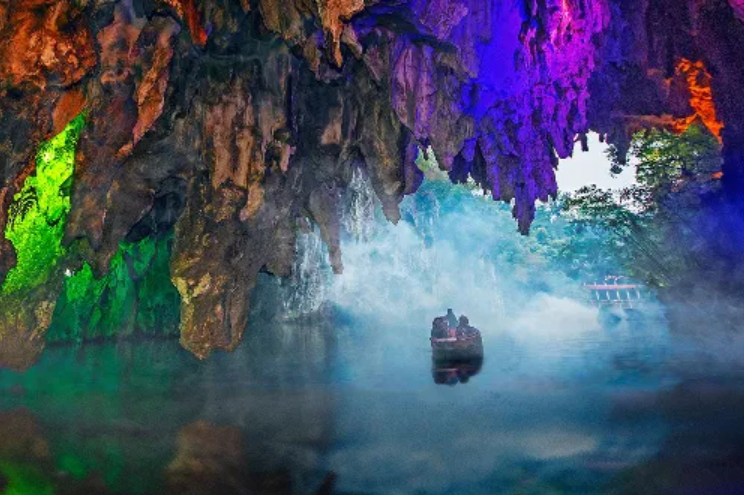
Longmen Flying Waterfall
Longmen Flying Waterfall is the largest in-cave waterfall in China, more than 50 meters high and 26 meters wide. The water pours down with a force that seems to bore through the mountain and split the rocks, creating a magnificent momentum. The huge stream cascades from the top of the cave like ten thousand galloping horses, giving off a deafening roar, with mist filling the air—a truly spectacular sight.
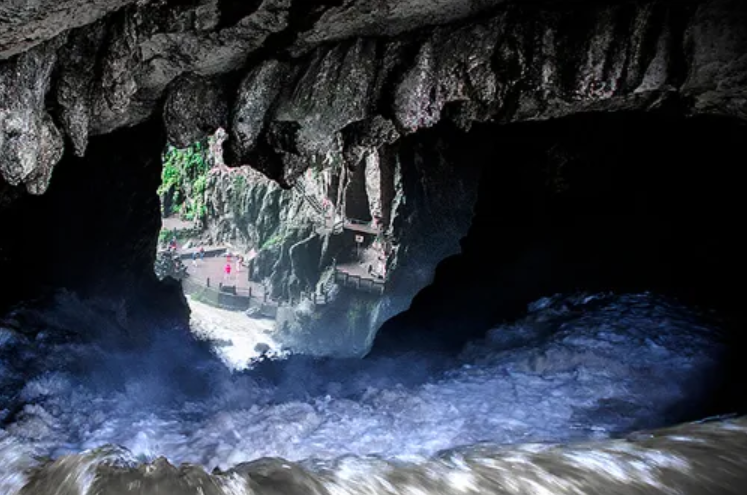
Xuantang
Xuantang, or Whirlpool Pond, is a typical karst funnel landform, 101 meters in diameter and 8,012 square meters in area. It is connected to the Tongxuan short river. Without relying on wind, the pond water turns day and night, rotating clockwise along the tangent direction of the pond. It sinks through a natural funnel at the bottom into an underground river and, due to the difference in elevation, flows out from Shuizhuyuan, splitting into left and right branches. This forms the Longgong wonders of “the mountain does not turn, but the water does” and “one water divides into two sides.”
Guanyin Cave
Guanyin Cave, China’s largest Buddhist hall in a cave, enjoys the reputation of “The First Buddhist Cave under Heaven.” Its main hall is spacious, with an area of more than 1,000 square meters. Enshrined in the cave is a statue of the White-Robed Compassionate Mother Guanyin. It is 12.6 meters tall, with a 1.8-meter lotus pedestal, making it the largest Guanyin statue in Southwest China. On both sides are a 9.6-meter-tall Dragon Girl and a 6.5-meter-tall Sudhana, popularly known as the Golden Boy and Jade Girl.
Qunfang Valley
Qunfang Valley, also known as Medicine Valley, is a canyon covering 2 square kilometers. It is famous for its many varieties of natural, high-quality Chinese medicinal herbs. Legend has it that it was a place where Sun Simiao, the King of Medicine, gathered herbs.
Tongxuan River
With a total length of 2,600 meters, it is the longest of the three short rivers. It originates from Chaoyin Cave above Tiaoshuiyan Waterfall upstream and ends at Xuantang, so locals call it Tongxuan River.
Recommended Tour Route:
Recommended route: Visitor Center → Longmen Flying Waterfall → First Entry into Longgong → Second Entry into Longgong → Xuantang → Guanyin Cave → Qunfang Valley → Tongxuan River (boat ride) → exit the scenic area. This route covers the main attractions of Longgong Scenic Area. Visitors can first view the spectacular Longmen Flying Waterfall, then take a boat through the mysterious First and Second Entries into Longgong to experience the charm of karst caves. Next, they can visit Xuantang and Guanyin Cave to appreciate the unique geological landscape and Buddhist culture. Finally, they can stroll through Qunfang Valley and take a boat along Tongxuan River to enjoy the scenery on both banks, ending the pleasant journey. The entire tour is expected to take 4–6 hours.
Travel Tips:
It is recommended to check the scenic area’s opening hours and ticket policies in advance. Tickets can be booked through the official website or online travel platforms to avoid delays.
Some attractions require boat rides. Please follow staff instructions, wear life jackets, and pay attention to safety.
During the tour, it is recommended to carry an appropriate amount of drinking water and snacks to replenish energy. There are also dining and shopping places in the scenic area, but prices may be relatively high.
Because the scenic area is large and involves long walks, it is recommended to wear comfortable sneakers or flat shoes for convenience.
In summer, take sun protection measures to avoid heatstroke; in winter, keep warm.
Notes:
Protect the scenic area’s environment. Do not spit or litter, and follow the scenic area’s hygiene regulations.
When touring the caves, do not touch stalactites or stalagmites, so as not to damage these precious natural landscapes.
Follow the scenic area’s safety regulations. Do not enter unopened areas or engage in dangerous behavior such as climbing or playing in water.
Respect local ethnic culture and customs, and do not disturb the lives of local residents.
In an emergency, call the scenic area’s emergency rescue number or ask staff for help.
Transportation:
Public transport: Take the special bus to Longgong at Anshun East Bus Station. The fare is about 15 yuan, and the journey takes about 40 minutes.
Self-driving: From downtown Anshun, drive west along Guihuang Highway (G320) and follow the road signs to Longgong Scenic Area. The total distance is about 27 kilometers, and the driving time is about 40 minutes.
Chartered tourist vehicle: You can book a chartered tour vehicle service at a travel agency or hotel in Anshun. It is convenient and fast, and you can freely adjust the time according to your itinerary.
Opening Hours:
Longgong Scenic Area is open all year, from 08:30 to 17:00 (ticket sales and entry stop at 16:00). During statutory holidays or peak tourist seasons, the opening hours may be adjusted according to actual conditions. Visitors can check the scenic area’s official information in advance and arrange their itinerary reasonably.
Tickets:
Admission (including sightseeing bus and boat ticket): 150 yuan per person.