Dunhuang Yardang National Geopark is located in Dunhuang City, Jiuquan Prefecture, Gansu Province, about 160 km from downtown Dunhuang. It is a national 4A-level tourist attraction, a national geopark, and one of the core areas of the Dunhuang UNESCO Global Geopark. The park covers a total area of 398.4 km2, with its main landforms formed during the Late Pleistocene. The elevation ranges from 70 to 120 meters above sea level, making it one of China’s largest and most typical yardang landform complexes shaped by wind erosion. There are no traditional man?made ancient structures; the entire landscape consists of natural wind?eroded ridges and mounds, formed by fluviolacustrine deposits sculpted over millions of years by wind and intermittent water flow. The terrain is generally flat with gentle undulations, set against a stark desert background. The park is renowned for three core scenic features: desert yardang landforms, Gobi sunsets, and Gobi starry skies. It also holds significant value for geological research, desert sightseeing, and film location shoots—movies such as Hero and Chronicles of the Ghostly Tribe were filmed here.
History and Culture
In terms of geological evolution, this area was a large inland freshwater lake millions of years ago, with continuous deposition of thick silt, clay, and sandy sediments. The uplift of the Qinghai?Tibet Plateau altered regional atmospheric circulation and hydrology, causing the lake to gradually dry up. The exposed sedimentary layers were then subjected to long?term strong northwesterly winds and torrential floods, carved over hundreds of thousands of years to form the extensive yardang mounds. The site preserves a complete record of arid?zone aeolian landform evolution and serves as a natural laboratory for studying dry?land geomorphology and palaeoclimate change.
On the cultural?historical side, the area lies close to the northern route of the ancient Silk Road. Traders and garrison soldiers travelling to and from the Western Regions often passed through this Gobi wilderness. Ancient texts do not have a specific name for yardang landforms; the local Uyghur term for steep wind?eroded mounds is "Yardang," later transliterated and simplified into "yardang," which has become the international scientific name for such landforms. In modern times, Chinese and foreign geologists have conducted multiple surveys here. At the end of the 20th century, formal geological protection planning began, and in 2001 the Dunhuang Yardang National Geopark was established, initiating a model of regulated conservation combined with tourism development.
In recent years, the park has built a geological museum and an interpretation system, opened field study channels for geology students, and, thanks to its unique desert scenery, has become a signature “Instagram?worthy” destination in northwest China. Its unpolluted night skies also make it a well?known stargazing spot along the Hexi Corridor.
Major Attractions
Golden Lion Greeting
This is the first iconic yardang mound visitors see upon entering the park on the sightseeing road. The mound resembles a crouching lion facing the entrance, standing about 20 meters tall. Due to iron oxide impurities in the rock, it glows golden?reddish?brown under sunrise and sunset light, making it a prime photo spot. Clear bedding lines reveal the layered fluviolacustrine sedimentary structure.
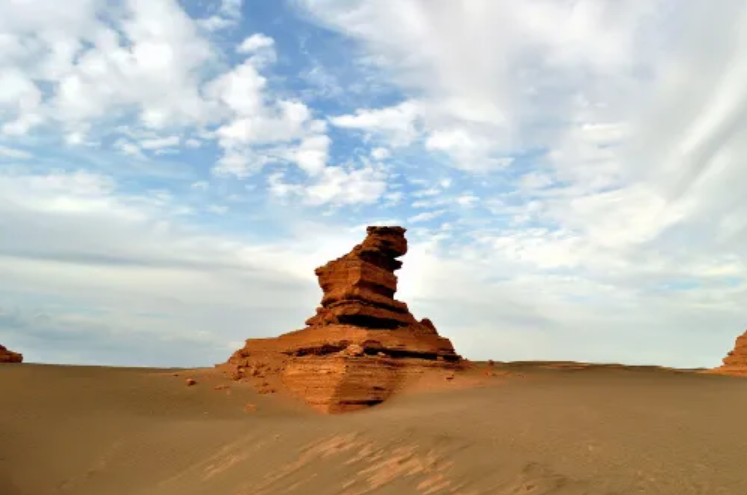
Sphinx
This yardang formation closely resembles the Egyptian Sphinx, with a raised head and sprawling body. It is nearly 30 meters high and over 60 meters long. Entirely shaped by differential wind erosion with no artificial carving, its side profile offers the best resemblance. It is one of the park’s most recognisable natural sculptures, and the sightseeing bus stops briefly here for visitors to view and photograph.
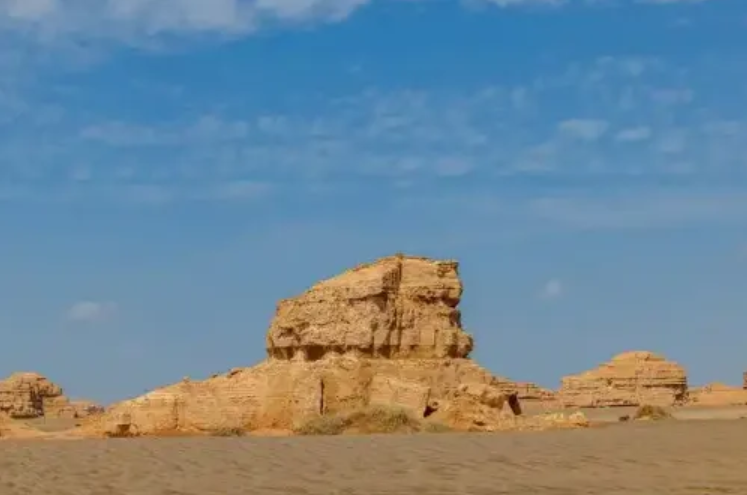
Peacock Standing
This mound looks like a peacock with its tail spread, with a slender main pillar about 25 meters tall and flanking ridges resembling an open fan. The rock is pale greyish?white, and backlit views highlight its layered texture. Scattered smaller eroded mounds around it create a striking contrast against the yellow Gobi sand.
West Sea Fleet
This is the largest continuous yardang ridge group in the park. Dozens of elongated parallel ridges stretch for several kilometres, rising and falling like a fleet of ships sailing in formation. The ridges are mostly 10 to 25 meters high. This area exemplifies the classic yardang structure of alternating wind?eroded grooves and ridges, and offers the widest panorama in the deeper part of the park.
Yardang Geological Museum
The museum is an educational building covering about 1,500 m2. It displays sediment cores, geomorphic evolution models, and fossil specimens, along with illustrated panels and video equipment. It systematically explains the formation of yardang landforms, regional geological changes in Dunhuang, and desert ecology conservation, making it an important stop for study?oriented visitors.
Sightseeing Route:
Park entrance ticket check → Sightseeing bus boarding point → Golden Lion Greeting viewing platform → Sphinx viewing platform → Peacock Standing viewing platform → West Sea Fleet core viewing area → Yardang Geological Museum → Park exit.
Travel Tips:
It is best to enter the park at sunrise or sunset. The soft light at those times enhances the colour layers of the yardang mounds; under harsh midday light, the colours appear pale and less photogenic.
Take the official sightseeing bus throughout the tour. The yardang formations are widely scattered; long?distance walking can easily lead to disorientation and exhaustion. Only short walks are allowed at designated viewing platforms.
Allow at least 2?3 hours for a complete visit, including museum time and photo stops. A rushed one?hour tour is not recommended.
For stargazing, choose the latest entry slot, stay in designated safe areas after the tour, and wait for darkness. The park has very low light pollution at night.
Bringing geological reading materials can enhance the learning experience, especially for families and student groups, when combined with museum exhibits.
Important Notes:
The temperature difference between day and night in the Gobi is extreme. Summer daytime temperatures can exceed 38°C, dropping to around 15°C at night; winter lows can reach ?10°C. Bring layered clothing for warmth and cooling.
Wind and sand are frequent. Wear sunglasses, a mask, and a neck gaiter for protection; seal cameras and phones in dust?proof covers, as fine sand can easily damage electronic devices.
There are no convenience stores or restaurants inside the park—only small supply shops at the entrance. Bring enough drinking water and snacks; it is recommended that each adult carry at least 1 litre of water.
Do not leave the sightseeing road or the railings of the viewing platforms to venture deep into the Gobi. Most areas have no mobile signal, and rescue would be extremely difficult if lost; the open desert offers no shelter against heatstroke or hypothermia.
The yardang soil is soft and fragile. Climbing, stepping on, or carving the mounds is strictly prohibited; man?made damage cannot be naturally restored. Violators will be fined according to park regulations.
Desert insects, lizards, and other wildlife are occasionally present. Do not touch or disturb them. Avoid walking on loose sandy slopes to prevent slips.
Mobile phone signal is generally weak throughout the park, with only faint reception at the entrance and the West Sea Fleet core area. Plan your trip in advance and do not rely on real?time navigation or communication.
Transportation:
Public Bus: Daily tourist shuttle buses run from Dunhuang Bus Station to the geopark, with departures concentrated between 7:00 and 9:00 am. The one?way journey takes about 2.5 hours.
Chartered Car: 5?seater sedans and 7?seat MPVs are available for charter in Dunhuang city, ideal for families or small groups who want flexible sunrise/sunset schedules. The one?way distance is 160 km.
Self?driving: Navigate to “Dunhuang Yardang National Geopark.” The road is paved all the way, passing the Yumen Pass ruins. Private vehicles must park in the large lot outside the park; visitors must then transfer to the park’s sightseeing buses.
Carpooling: Many hostels and travel agencies in Dunhuang offer carpool packages at a lower cost than private charters, with schedules agreed upon by the group.
Opening Hours:
The park is open year?round. Regular hours are 07:00–19:30 daily. In summer, closing time is extended according to sunset, with the last entry allowed at 20:00. In winter, the park closes earlier at 18:00. Sightseeing buses run in rotation every 15–20 minutes. The last return bus departs 30 minutes before closing—visitors should allow enough time to get back. In extreme windy/sandy weather, the park may temporarily suspend operations, with on?site notices posted.
Tickets:
Admission starts from 60 RMB per person.