The Suoyang City Ruins are located in the Gobi desert zone of southeast Suoyang Town, Guazhou County, Jiuquan City, Gansu Province. They are a Major National Historical and Cultural Site, a component of the UNESCO World Heritage "Silk Roads: the Routes Network of Chang'an–Tianshan Corridor," and a National 4A-level Tourist Attraction. The total site area is approximately 1.06 million m2. The city proper comprises an outer city and an inner city; the inner city covers 210,000 m2, the outer city about 150,000 m2, and the remaining rammed?earth walls total over 7 km in length. The site’s core feature is the best?preserved Tang?dynasty military defensive city system in China, supplemented by remains of garrison?farming irrigation, ancient tomb clusters, and Gobi desert landscapes. It preserves a complete chain of ancient military administration, garrison farming, and border defense in the Western Regions. The city walls were all built with rammed?earth techniques: the inner wall base is 7.5 m wide, with surviving heights up to 18 m; the outer wall is more heavily eroded, with remaining heights mostly between 3 and 8 m. Around the site, an intact ancient canal irrigation network and extensive farmlands remain, making it a physical specimen for studying the Tang?dynasty system of military?civilian integration and oasis agriculture development in the Hexi region.
History and Culture
Suoyang City was first established in the Western Jin dynasty as the seat of Jinchang Commandery. In the Sui dynasty it was renamed Changle County, and in the Tang dynasty it became the administrative city of Guazhou—a key military stronghold guarding the northern route of the Silk Road at the western end of the Hexi Corridor. During the Wude and Zhenguan reigns of Tang, it served as a critical throat linking central China with the Western Regions, with a large garrison and a military?farming system. By digging canals to divert water from the Shule River to irrigate Gobi farmlands, the garrison achieved self?sufficiency. The folk tale of General Xue Rengui being trapped at Suoyang City during his western campaign is widely told and has become a signature cultural story here.
After the An Lushan Rebellion, the Hexi region fell into turmoil; the Tubo forces occupied Guazhou, causing partial damage to the city. During the Five Dynasties and Western Xia periods, the city continued to be used as a local military?administrative post. In the Yuan dynasty, changes in Silk Road traffic patterns shifted the political?military center of Guazhou, and Suoyang City was gradually abandoned, thereafter buried under desert sands for a long time.
In the Ming and Qing dynasties, because of the abundant growth of the Chinese medicinal herb suoyang (Cynomorium) in the area, locals began to call it Suoyang City. On November 20, 1996, it was listed as the fourth batch of Major National Historical and Cultural Sites; on June 22, 2014, it was inscribed on the World Heritage List as part of the Silk Roads. Subsequent conservation projects—including wall reinforcement, security monitoring, and display boardwalks—were completed, and the site was officially opened to tourists. Numerous relics have been unearthed, such as Tang pottery shards, coins, weapons, farming tools, and fragmentary documents, all attesting to a thousand years of garrison farming and border defense history.
Main Attractions
Inner City
The inner city is the core of Suoyang City. It is roughly irregularly square, about 560 m east–west by 480 m north–south. The rammed?earth walls have gates on all four sides, each with a barbican (wengcheng) defensive structure. Inside, multiple rammed?earth platforms remain, corresponding to the foundations of official buildings, barracks, and granaries; street patterns are still faintly distinguishable. Surviving horse?ramparts and corner?tower remains show evenly spaced horse?ramparts, typical of Tang standard military wall construction. Successive layers of rammed earth from different dynasties are clearly visible, illustrating repair and reinforcement work over time.
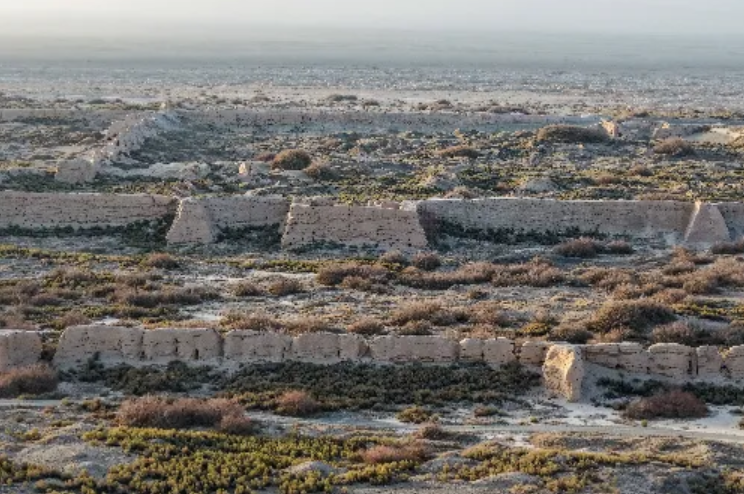
Outer City
The outer city surrounds the inner city on its outer side, with an irregular shape following the terrain. It is larger than the inner city and mainly served as a defensive buffer zone, garrison encampment, and market area. The outer walls are heavily weathered and collapsed, with intermittent sections. Scattered tiles and pottery shards on the ground indicate ordinary dwellings, workshops, and temporary farming structures. To the north of the outer city, extensive outlines of ancient cultivated fields can be seen.
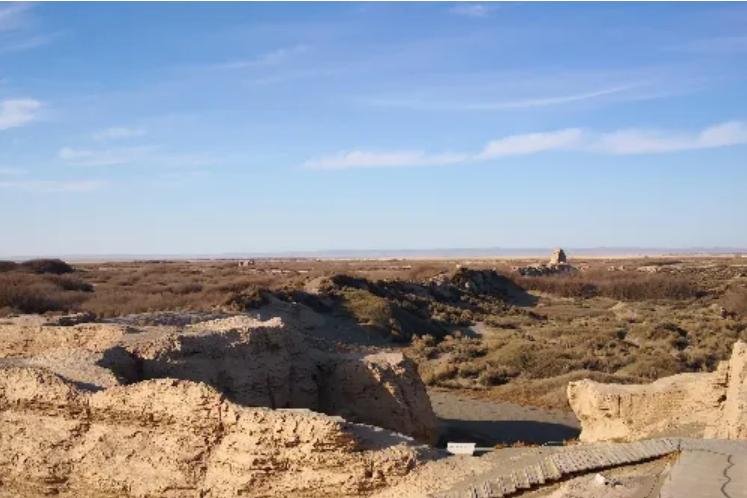
Tar Temple (Ta’er Si) Ruins
Located about 1 km northwest of Suoyang City, Tar Temple was a large Buddhist monastery from the Western Xia to Yuan dynasties. The temple layout is rectangular, covering about 27,500 m2. At the center stands a stupa?shaped pagoda, 14.5 m high, surrounded by the rammed?earth foundations of several small monastic cells and side halls. Fragments of Western Xia painted sculptures, sutra scroll pieces, and tiles have been found on the ground. This site was an important Buddhist center in ancient Guazhou and bears witness to the religious integration along the Silk Road.
Ancient Canal Irrigation System
The canal system spreads across dozens of li (miles) of Gobi around Suoyang City, with clear hierarchies of main canals, branch canals, and furrows. The main canals are 8–12 m wide, and the total remaining canal length exceeds dozens of kilometers. The canals diverted water from the Shule River to irrigate extensive farmlands, with neatly divided field plots. This fully reconstructs the Tang military?farming water?conservation system and is a typical relic of ancient oasis water engineering; about 246,000 m2 of cultivated fields remain clearly distinguishable.
Tomb Clusters
Large clusters of Jin? and Tang?dynasty tombs, numbering over a thousand, are distributed across the Gobi around the site. The tombs are of two types: earthen?cave tombs and brick?chambered tombs, some with sloping tomb passages. Excavated items include bronze mirrors, pottery, gold and silver ornaments, and epitaphs. The tombs span from the Western Jin to Tang dynasties, providing important material for studying burial customs, social stratification, and ethnic integration in Hexi during that period.
Suggested Tour Route:
Visitor Center at the entrance → sightseeing bus stop → Tar Temple ruins → Outer City wall viewing platform → Inner City east gate barbican → Inner City core rammed?earth platforms → Inner City northwest corner?tower ruins → ancient canal display area → peripheral tomb viewing points → return to Visitor Center.
Tour Tips:
Allow 3–4 hours for the full visit. The site has little shade; it is best to visit between 8:00–11:00 AM or after 4:00 PM to avoid midday heat.
Strong Gobi winds; stay on the wooden boardwalks and do not step on unconsolidated walls or ground surfaces.
Bring binoculars to view distant canals and tombs; for detailed wall weathering features, follow the on?site guide for professional interpretation.
No food or beverage shops on site—bring your own water and light meals. Do not dig or pick suoyang herbs, as they are protected by cultural?relic and ecological regulations.
Drone photography is prohibited without prior approval from the site administration and cultural?relic authorities; applications are required.
You may combine this with other Guazhou County sights; a one?day itinerary can include both Suoyang City and Yulin Caves.
Important Notices:
As a World Heritage site and protected cultural?relic area, climbing walls, carving on walls, or picking up pottery shards is strictly forbidden. Violators will be penalized under the Cultural Relics Protection Law.
Desert temperatures vary greatly between day and night—bring a light jacket even in summer. UV levels are high; bring a sun hat, sunscreen, wind?proof sunglasses, and a wind?proof scarf.
No medical facilities on site. Visitors with heart, lung, or high?blood?pressure conditions should assess their fitness. Mobile phone signal is not fully covered across the Gobi; travel with companions and do not stray from the boardwalks.
Open flames and fire?starters are prohibited throughout the site. Due to sparse vegetation, fire prevention is strictly enforced; smoking is allowed only in designated areas at the Visitor Center.
Private vehicles are not allowed into the core protection zone. All outside vehicles must park in the external lot and transfer to the site’s sightseeing bus.
Protect the Gobi ecology: do not chase or disturb wildlife, nor damage native vegetation or suoyang plants.
Transportation:
Self?driving: from Guazhou County, take Guasuo Road south for about 38 km (40?minute drive). Free open?air parking is provided.
Public bus: no direct bus from Guazhou County bus station; you can book a local shared ride at the station.
Long?distance transfer: from Jiuquan city, drive about 260 km (3 h 10 min); from Dunhuang city, 130 km (1 h 40 min)—suitable for the Dunhuang?Guazhou Silk Road loop.
On?site transport: electric sightseeing buses are available within the core area. The distance between Tar Temple and the city is considerable; visitors with limited energy are advised to take the bus.
Opening Hours:
The site operates on a seasonal schedule:
Peak season (April 1 – October 31): 8:30–18:00, last admission 17:30.
Off season (November 1 – March 31): 9:00–17:00, last admission 16:30.
In cases of extreme wind, sandstorms, or conservation construction, the site may temporarily close. Check with the administration before your visit. Public holidays are open as usual; no weekly closure.
Ticket Price:
CNY 20 per person.