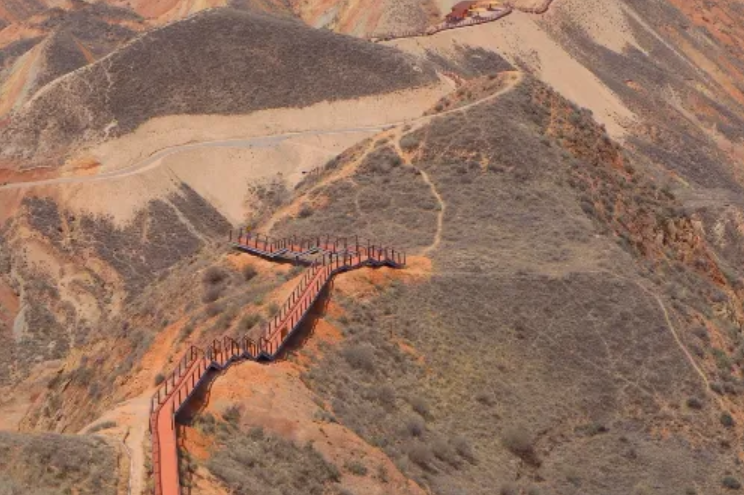
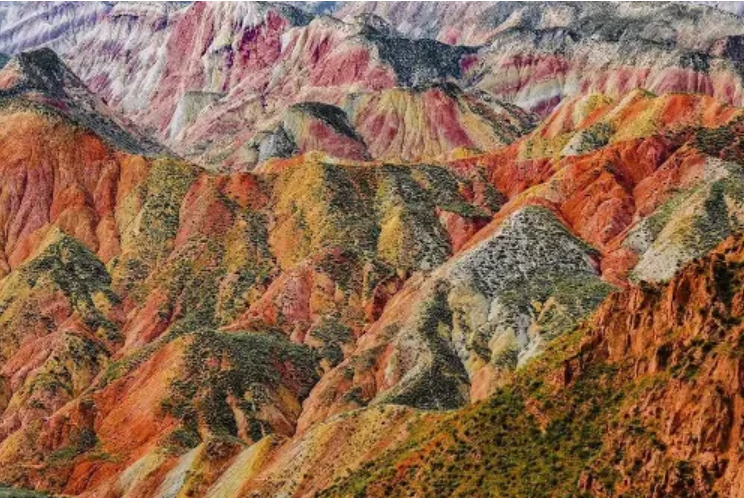
Lanzhou Shuimo Danxia Tourist Attraction is located in Xinghua Village, Shuping Town, Yongdeng County, Lanzhou City, Gansu Province. It lies to the northwest of Lanzhou's urban area, near the Yellow River to the south, the Zhuanglang River to the west, and the Dahongshan area to the north. As a national 4A-level tourist attraction, it is a key geological and cultural tourism site developed by Lanzhou. The total planned area of the scenic area is 400 square kilometers, with the first-phase core tour area covering 25 square kilometers open to the public. It is about 13 kilometers from downtown Lanzhou and about 30 kilometers from Lanzhou Zhongchuan International Airport, making it the closest red-hill Danxia landform group to the provincial capital among domestic attractions. Unlike traditional colorful Danxia, its core landform is a unique red-hill Danxia, with striking color contrast between the sunny and shady slopes: the shady slopes are covered with grayish?green and light?green soil layers, while the sunny slopes display vermilion and orange?red hues. The gentle texture of the mountains and waters resembles a traditional Chinese ink?wash painting, hence the name “Shuimo Danxia” (Ink?wash Danxia). The scenic area is well?equipped: wooden plank roads wind through the core tour zone, multiple tiered viewing platforms have been built, and a dedicated parking lot covers 103,023 square meters with 1,462 parking spaces. Additional facilities include a visitor center, sightseeing bus stops, a folk custom experience street, and a geological science exhibition hall, integrating functions of geological sightseeing, educational study tours, leisure photography, and folk culture experiences.
History and Culture
The rock strata of Shuimo Danxia were formed in the Mesozoic Cretaceous period, over 100 million years ago. Influenced by the Himalayan orogeny, the regional red clastic sedimentary layers underwent uplift, folding, and faulting, followed by tens of millions of years of temperature weathering, water erosion, and wind abrasion, gradually forming the rugged, clearly layered hilly Danxia landform. The dual?colored layering of the hills is the result of long?term interaction between the region's special climate and shallow vegetation, representing a rare composite colorful hill geological relic in northwest China, with significant geological research value.
The Shuping valley where the scenic area sits was a vital passage along the northern route of the ancient Silk Road, serving as the eastern gateway to the Hexi Corridor. During the Han and Tang dynasties, caravans, monks, and envoys traveling between the Central Plains and the Western Regions all passed through here. The gentle Danxia valleys provided resting and water?collecting conditions, leaving behind numerous historical traces of Silk Road activity. The local areas of Xinghua Village and Shajing have long been places where farming and nomadic peoples intermingled, preserving a blend of northwestern frontier folk customs and Silk Road trade culture.
In modern times, the scenic area remained largely untouched by large?scale human modification, preserving its original landform. In 2019, development commenced with a priority on geological protection, planning sightseeing, study, and folk culture zones. It officially opened to the public in 2021, and since then supporting facilities have been continuously improved, making it a representative geological tourism landmark of Lanzhou.
Main Attractions
Silk Road Ancient Trail Viewing Platform
This is the first viewpoint after entering the park, at the lowest elevation along the route, adjacent to the remnant ancient Silk Road trail, with replica ancient?style walkways. From here, you can overlook the continuous Danxia hills horizontally; the gullies stretch gently, allowing a full panoramic view of the Danxia landscape, recreating the perspective of ancient caravans traveling through the mountains. It is an ideal spot for entry?level panoramic photography, with flat terrain suitable for the elderly and children.
Silk Road Glow Viewing Platform
Located on the west side of the tour route, this platform faces due west and is the designated sunset viewing point. In the evening, the setting sun slants across the hills, casting vermilion rock layers with pink?orange and light?purple hues, bathing the entire hills in glowing light. The layered colors are soft and rich, making it a prime spot for photographers to capture Danxia sunsets, and it is particularly crowded at dusk.
Nine?Color Danqing Viewing Platform
As the highest viewing platform in the scenic area, this site offers a 360?degree panoramic view of the core Danxia zone. The rock layers are clearly stratified, displaying multiple colors including vermilion, ochre, dark green, and off?white, with color bands stretching for dozens of miles, fully showcasing all the characteristics of the red?hill Danxia landform. Most official promotional materials are shot here, making it a landmark for full?landscape viewing.
Danxiu Yingtian Viewing Platform
This platform features steep Danxia cliffs and narrow, deep ravines. The surrounding vertical red rock walls display clear bedding planes, and a short suspended plank walk allows close observation of the rock structure. On clear days, the crimson cliffs contrast sharply with the azure sky, offering both sightseeing and geological education. The walkway is safe and gently graded, suitable for close?up viewing of the mountain textures.
Shajing Tribe
Built upon the local ancient Shajing folk heritage site, this cultural attraction recreates traditional northwestern frontier courtyard residences, offering intangible cultural heritage handicraft workshops, Silk Road folk displays, and northwestern specialty snack stalls. The area showcases the blended farming?nomadic lifestyle, with a small performance venue where visitors can experience northwestern intangible heritage such as paper?cutting and clay sculpture. It is the only cultural experience point within the scenic area.
Tour Route:
Visitor Center → Sightseeing Bus Boarding Point → Silk Road Ancient Trail Viewing Platform → Danxiu Yingtian Viewing Platform → Nine?Color Danqing Viewing Platform → Silk Road Glow Viewing Platform → Shajing Tribe → Sightseeing Bus Return Point → Visitor Center
Travel Tips:
It is best to visit in the early morning or late afternoon when the light is soft and the mountain colors are most vivid for photography.
The entire tour relies on sightseeing buses for transfers; the distances between viewpoints are considerable, so full walking is not recommended.
Allow 3 to 4 hours for a complete visit, including sightseeing, photography, and folk experience at Shajing Tribe.
Bring sunglasses and a sun hat, as there is little shade in the mountains and UV intensity is high.
For geology enthusiasts, the science exhibition hall at the visitor center offers free geological brochures.
During sunset, the viewing platform gets crowded; arrive early at the Silk Road Glow Viewing Platform to secure a good spot.
Important Notices:
The Danxia rock layers are fragile and loose. Climbing, stepping on, or carving the rock faces is strictly prohibited; violators will be charged ecological restoration fees.
Drone flights are prohibited throughout the scenic area. Unauthorized drones will be confiscated and the operator may be asked to leave.
Temperatures vary greatly between day and night; strong winds are common in summer afternoons, and in spring, autumn, and winter, bring an extra light jacket.
All areas outside the plank walks are undeveloped primitive ravines. Do not leave the designated trails to avoid slips or getting lost.
Open flames, barbecues, and littering are forbidden. All waste must be carried to designated trash bins.
Wheelchairs are available for rent at the visitor center for the elderly or those with limited mobility; all sightseeing buses have accessible seats.
In rainy or snowy weather, the plank walks may become slippery, and high?altitude viewpoints may be temporarily closed. Check the official announcements before your visit.
Transportation:
Self?driving: From downtown Lanzhou, take the North Binhe Road and Shuiqin Expressway; the journey takes about 20 minutes. The scenic area offers a large free parking lot.
Public bus: Take Bus No. 605 from Lanzhou West Railway Station to Shuping Town, then take a taxi for about 3 kilometers to the entrance.
Intercity travel: From Lanzhou Zhongchuan Airport, it is a 30?minute drive; there is no direct bus, so you may take a rideshare car directly to the scenic area.
Tourist shuttle: On holidays, direct tourist buses are available from Lanzhou Xiguan Shizi and Lanzhou Railway Station.
Opening Hours:
The opening hours vary by season:
April 1 – October 31: 8:30 – 18:00, with last entry at 17:00.
November 1 – March 31: 9:00 – 17:00, with last entry at 16:00.
In case of heavy rain, strong winds, snow, or other extreme weather, the hours may be shortened or the park closed temporarily; notices will be posted on the official platform. Sightseeing bus operation matches the opening hours, with the last bus departing one hour before closing.
Ticket Price:
Entry ticket: from 40 RMB/person.