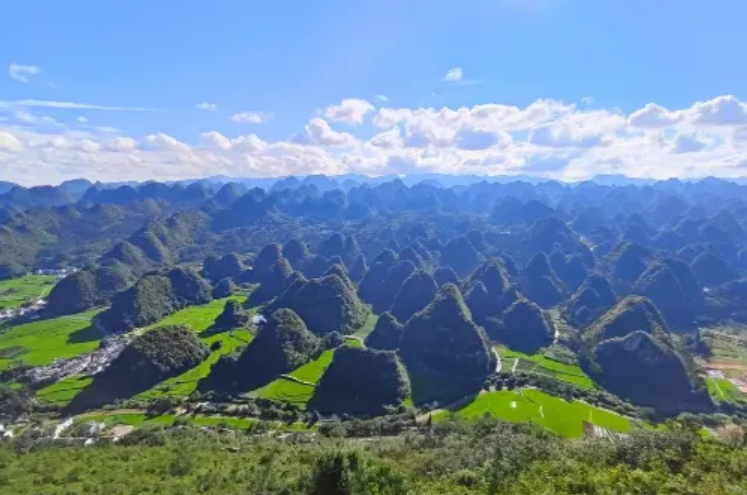
Wanfenglin Scenic Area is located in Xingyi City, Qianxinan Buyi and Miao Autonomous Prefecture, Guizhou Province. It is a national 5A-level tourist attraction. The scenic area covers a total area of 2,000 square kilometers and is composed of peak forests, fields, rivers, villages, and other elements. Its distinctive feature is its peak forest landscape, one of the three major karst landforms in southwestern China. The peaks are dense and unusual, grand and magnificent, and perfectly shaped; it is known as China’s museum of cone karst. Within the scenic area there are many ethnic minority villages, including Buyi and Miao villages. The buildings are mostly traditional stilt-style structures and stone-slab houses, with strong ethnic characteristics. At present, the main tourist facilities in the scenic area include a visitor service center, viewing platforms, and boardwalks, providing convenience for tourists.
Historical Culture
The karst landform of the Wanfenglin area was formed about 280 million years ago during the Carboniferous Period. Through long geological changes and water erosion and dissolution, the unique peak forest landscape gradually took shape. It has witnessed the long process of Earth’s geological evolution and is an important area for studying karst landforms.
Xingyi City, where Wanfenglin is located, has a rich ethnic culture. Ethnic minorities such as the Buyi and Miao have lived here for generations and have preserved unique ethnic customs and traditional skills. For example, during traditional Buyi festivals such as “Sanyuesan” and “Liuyueliu,” activities such as antiphonal singing and sacrifices are held; the Miao’s lusheng dance, batik craftsmanship, and so on are also very distinctive. These ethnic cultures blend with Wanfenglin’s natural landscape, making the scenic area even more attractive.
Historically, the Wanfenglin area was once an important transportation route and military location. In ancient times, horse caravans passed through this area, leaving behind many ancient post roads and legends. These historical stories and cultural relics add profound historical deposits to Wanfenglin.
Main Attractions
East Peak Forest
The East Peak Forest is dominated by towering peak forest landscapes. The peaks have various shapes: some are like swords piercing the sky, some resemble camels lying on the ground, and some look like a sleeping beauty lying across the mountains. The East Peak Forest covers a vast area, with fields, streams, and villages interspersed among the peaks. Visitors can appreciate the uncanny workmanship of nature here and feel the grandeur of the peak forest. During the visit, they can also see local ethnic minorities working in the fields and experience a rich pastoral atmosphere.

West Peak Forest
Compared with the East Peak Forest, the West Peak Forest has a touch more delicate beauty. The peaks here are relatively denser, and below them are stretches of flat farmland and scattered Buyi villages. Nahui Village is located at the foot of the West Peak Forest and is a typical Buyi settlement. The houses in the village are mostly stone-slab houses, simple and elegant. The pastoral scenery and the peak forest landscape complement each other, forming the unique beautiful scene of “peaks within fields, fields within peaks, villages below peaks, and a river in front of the villages.” Visitors can stroll along field paths, enjoy the pastoral scenery, and experience Buyi folk culture.
Wanfo Temple
Wanfo Temple is located within the Wanfenglin Scenic Area and is a temple formed from a natural karst cave. The cave is spacious and bright and can accommodate thousands of people. Many Buddha statues are enshrined in the cave, including a reclining Buddha 32.6 meters long, which is the largest indoor reclining Buddha in southwestern China. Wanfo Temple has abundant incense and worshippers; on Buddhist festivals, many believers come to pay homage. Here visitors can not only feel the solemnity and sanctity of Buddhist culture but also appreciate the unique karst landscape inside the cave.
Viewing Platforms
There are several viewing platforms in the scenic area, which are excellent places to view the panorama of Wanfenglin. For example, at the Bagua Field Viewing Platform, visitors can overlook farmland shaped like a bagua, or eight-trigrams, pattern, with fields layered one upon another and a small patch of water in the middle, just like the center of the bagua. The General Peak Viewing Platform offers a view of a mountain shaped like a general, mighty and upright. These viewing platforms are equipped with complete facilities, making it convenient for visitors to stop, enjoy the view, and take photos.
Suggested Tour Route:
Recommended tour route: After entering the scenic area, visitors first take a sightseeing bus to tour the West Peak Forest. The bus stops at several viewing platforms along the way, where visitors can get off to enjoy the scenery of the West Peak Forest, such as Bagua Field and General Peak. After touring the West Peak Forest, they can go to Nahui Village to experience Buyi folk culture and taste local food. Then they go to Wanfo Temple to experience Buddhist culture and the cave landscape. After that, they take the sightseeing bus to the East Peak Forest to enjoy its majestic peak forest landscape. The entire tour takes about 4–5 hours. If time permits, they can also stay longer in the villages around the scenic area to further experience local life.
Tour Tips:
It is recommended to go to the scenic area in the morning, when the light is better, so you can enjoy the peak forest landscape more fully and take more beautiful photos.
There are many mosquitoes and insects in the scenic area, so remember to bring mosquito repellent to avoid bites.
Wear comfortable shoes and light clothing, because there are some walking sections in the scenic area and some physical stamina is required.
When visiting villages such as Nahui Village, respect local ethnic minority customs and habits, such as asking the owner’s permission before entering a residence.
When tasting food, try more local specialty dishes, such as chicken tangyuan and Gangzi noodles, but pay attention to food hygiene and choose regular restaurants and snack stalls.
Precautions:
Observe the various regulations of the scenic area, follow the instructions of staff, and do not enter unopened areas without authorization.
Protect the scenic area’s environment, do not spit or litter, and keep the scenic area clean and hygienic.
When enjoying the scenery at viewing platforms, do not climb over safety railings; pay attention to your own safety and avoid accidents.
When taking the sightseeing bus, fasten your seat belt and do not extend your body out of the window to avoid danger.
If you encounter an emergency, you can call the scenic area’s emergency rescue phone number or ask nearby staff for help.
Transportation:
Public transport: From Xingyi city area, you can take Bus No. 19 to Wanfenglin Scenic Area. The journey takes about 40 minutes and the fare is 2 yuan. You can also take a special line bus to Wanfenglin from Xingyi East Passenger Station; the journey takes about 30 minutes and the fare is 5 yuan.
Self-driving: From Xingyi city area, drive via Guichun Road, Wanfenglin Avenue, and other roads to reach Wanfenglin Scenic Area. The total distance is about 10 kilometers, and the driving time is about 20 minutes. The scenic area has a parking lot. Parking fees are charged according to parking duration; generally, the parking fee for a small vehicle is 10 yuan/day.
Opening Hours:
Wanfenglin Scenic Area is open all year round, with opening hours from 07:30 to 18:30 (ticket sales and entry stop at 18:00). On statutory holidays or during peak tourist seasons, the scenic area may adjust its opening hours according to actual conditions. Visitors can check the scenic area’s official information in advance and arrange their itinerary reasonably.
Tickets:
Admission: 70 yuan/person.