The Wuling Mountain Grand Rift Valley is located in Fuling District, Chongqing, and is a national 5A-level tourist attraction. The scenic area features distinctive karst landforms and pristine natural landscapes. Covering approximately 29.96 square kilometers, it boasts high forest coverage, rich vegetation, fresh air, and high negative oxygen ion content, making it a natural "oxygen bar." Within the area are numerous unique geological features such as cliff-face fissures, ground fissures, canyons, and karst caves. The elevation difference from the valley floor to the peaks is considerable, with the highest point reaching about 1,980 meters above sea level and the average elevation around 1,300 meters. The site also has well-developed tourist facilities, including a visitor center (with a floor area of about 18,000 m2), an ecological parking lot (accommodating approximately 1,600 vehicles), walking trails, electric cart paths, suspended plank roads, and more.
History and Culture
The Wuling Mountain Grand Rift Valley has a profound historical and cultural heritage. In the late primitive society, this was an important area for the Ba people, who thrived here and gave rise to the distinctive Ba culture. This culture merged with local farming traditions, creating a unique regional cultural identity. At the same time, the rift valley has a long geological history; the rocks in the canyon record hundreds of millions of years of Earth’s changes, making it a significant site for studying ancient geography and paleoclimate. The scenic area also incorporates local historical legends and cultural stories into large-scale theatrical performances, allowing visitors to experience local culture while enjoying the natural scenery.
Major Attractions
Bodao Ridge
Bodao Ridge is one of the key attractions—a huge cliff wall about 1,000 meters long and averaging 90 meters high. It drops straight from the peak to the valley floor and is composed of limestone from the Changxing Formation of the Late Permian (about 260 million years ago). Visitors can clearly see ancient seabed remains and marvel at nature's craftsmanship.
Qingtian Gorge Ground Fissure
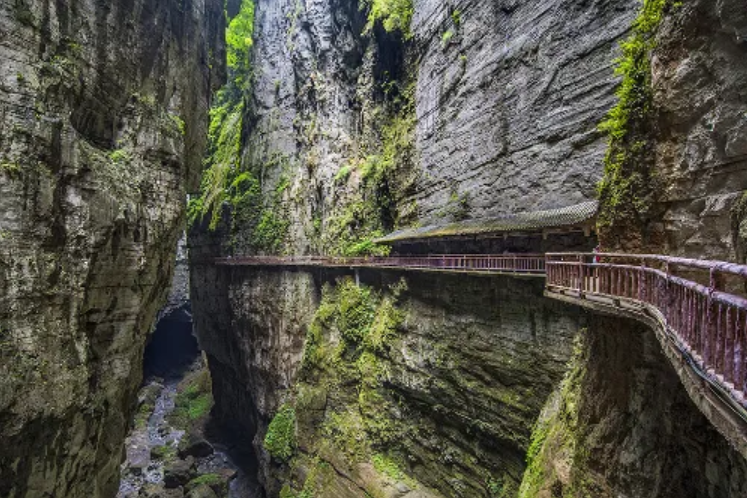
Located in the lower section of the canyon, this fissure is 1,500 meters long and only 2 to 5 meters wide, earning it the name "natural ground crack." The sheer cliffs on both sides rise 200 to 300 meters high; looking up, one can only see a sliver of sky. The fissure is filled with grotesque rocks and stalactites in various shapes, presenting a spectacular view.
Wuling Mountain Grand Rift Valley Cableway
Named "Wuling Taidou," this cableway is renowned as "Asia's steepest," with a gradient of 42.6 degrees, a vertical drop of about 360 meters, an inclined length of 634 meters, and a horizontal length of 539.88 meters. It is a double-line, double-carry, reciprocating 45 1 passenger cabin type, with a one-way capacity of 700 persons per hour. It has three speed settings, with a maximum speed of 8 m/s, completing the trip in about 3 minutes.
Little Kuimen Gate
Located in the eastern part of the scenic area at an elevation of about 1,200 meters, Little Kuimen was formed by long-term wind and rain erosion of limestone. The rock faces appear cut by knives and axes; the windward cliffs display rich colors, making it a paradise for photography enthusiasts.
Python Mountain
Situated in the middle section of the canyon at elevations between 1,200 and 1,500 meters, the mountain resembles a giant python. Due to differential rock hardness, softer mudstone and argillaceous limestone eroded first to create concave features, while harder limestone remained, forming convex shapes—ultimately creating a python?like peak that is strikingly unique.
Cockscomb Ridge
Located in the upper section, Cockscomb Ridge is a typical karst peak cluster. It is a vertical cliff formed by intense crustal movement, composed of limestone from the Permian Changxing Formation (about 250 million years ago). It gets its name from a section that resembles a rooster’s comb and is one of the area’s iconic sights.
Buddha's Palm (Rulai Shenzhang)
Situated below Cockscomb Ridge, this feature is about 200 meters high and 80 centimeters thick, shaped like the "fearless mudra" of the Buddha. It formed because different strata have varying thicknesses: thin layers collapsed under rainfall erosion on both sides, while thicker, more resistant layers remained, creating a wall-like landform.
Lotus?Seated Guanyin
Also below Cockscomb Ridge, this rock formation resembles Guanyin (Avalokite?vara) sitting on a lotus throne, with hands clasped, a serene expression, and detailed headdress and robes, as if guarding the land—giving it a sacred and mystical feel.
Tianmen Cave Suspension Bridge
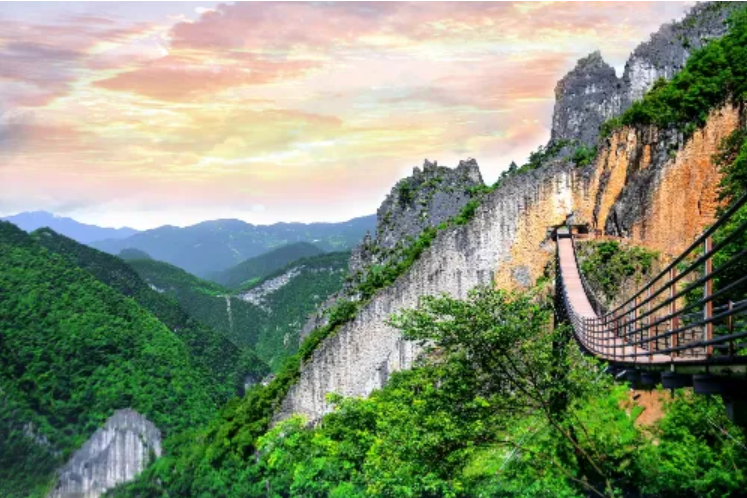
The bridge is 180 meters long (main span 140 meters), 2.5 meters wide, with a safety level of Grade II and a capacity limit of 350 people. It starts at the "Copper Wall and Iron Bastion" and sweeps across from "Tianmen Cave" to the scenic spot "Fengyako" (Wind Gap).
Tianmen Cave (Heavenly Gate Cave)
Located in the middle of Bodao Ridge, the cave entrance is about 3 meters high and 4 meters wide, shaped like a gateway connecting the human world to the celestial realm. The cave has a unique environment; passing through it feels like entering another world, full of fantasy.
Copper Wall and Iron Bastion
East of Bodao Ridge, this is a fault scarp in karst terrain. The cliff face is rust?colored and glows golden in sunlight. It stands thousands of meters long, sheer and smooth, with a knife?edge shape. Marine shell fossils can be seen on the wall, bearing witness to geological changes.
Male and Female Giant Apes
Located in Happy Valley, these rocks resemble two apes sitting at the bottom of the canyon—different in size, distinguishable as male and female. They were formed by surface water erosion causing rock layers to collapse along cracks, creating a vivid and visually striking image.
Time?Space Tunnel
About 400 meters long, this unique passageway uses lighting and sound effects to create a fantastical atmosphere. Walking through it feels like a mysterious journey through time; within 5 minutes, visitors can learn about the rift valley’s 250?million?year history, from its origins to the present and future, experiencing the passage of time as if shuttling between history and reality—a novel and memorable experience.
General's Rock
Located on the right?bank cliff below the plank road, this rock resembles the profile of General Ba Manzi, a hero of the ancient Ba Kingdom. Legend says the general turned to stone here to guard Wuling Mountain. It was formed by water erosion along joints, causing the rock to tilt under gravity, and holds significant historical and cultural value.
Cloud?Mist Pavilion
This is a viewing platform built against the mountain at about 1,100 meters elevation, with a total area of about 60 m2. It is named for being frequently shrouded in clouds and mist. The wooden structure blends with the natural landscape; visitors can lean on the railing to watch sea of clouds rolling through the canyon and mountains appearing and disappearing in the mist. Especially in the early morning or after rain, when mist rises, it feels like a fairyland—an excellent spot for viewing the rift valley's cloud spectacle.
Tuyu Square (Graphic Language Square)
Located near the entrance, covering about 800 m2, this square integrates geological culture and folk customs. The ground features stone carvings showing the rift valley's geological evolution and ancient Tujia graphic symbols, recording the canyon's formation and local ethnic wisdom—both educational and decorative. Benches and cultural display boards around the square explain the meanings and stories behind the symbols. Visitors can stop to decipher these mysterious marks and gain cultural context before entering the canyon, serving as an important cultural node connecting the entrance to the core attractions.
Tour Routes:
Half?Route: Starting from the visitor center, take the Tangyako upper cableway station to the lower station, then visit Denggan Stone, Lover’s Valley, Shentan Cliff, Qingtian Gorge Ground Fissure, Kaimen Stone, Zhengtian Seal, General’s Rock, and Laojun Cave, finally passing through the Time?Space Tunnel to the secondary visitor center, then take the Ping'an Pavilion cableway—total about 4 km.
Full Route: From the visitor center, pass through Tuyu Square, visit Little Kuimen, Zhangzi Fort, Cloud?Mist Pavilion, Python Mountain, Cockscomb Ridge, Lotus?Seated Guanyin, Buddha's Palm, Turtle?Rabbit Race, Tianmen Cave, Tianmen Cave Suspension Bridge, Copper Wall and Iron Bastion, Fengyako, Yunmeng Stream, Crystal Lake, Guyue Workshop, Male and Female Giant Apes, Happy Valley, and Journey to the West rock formation, then reach the electric cart starting point; continue to Biyun Divine Seal, Heart Rock, Shijia Gate, Haohan Slope, Ten Thousand Books, and Wangyou Valley, then arrive at Tangyako lower cableway station; continue to Denggan Stone, Lover’s Valley, Shentan Cliff, Qingtian Gorge Ground Fissure, Kaimen Stone, Zhengtian Seal, General’s Rock, and Laojun Cave, finally pass through the Time?Space Tunnel to the secondary visitor center and take the Ping'an Pavilion cableway—total about 9 km, almost entirely downhill.
Travel Suggestions:
Check the opening hours and ticket discount policies in advance to plan your visit and ticket purchase.
Some sections are steep; wear comfortable sports shoes and appropriate clothing, and watch your step.
The scenic area is large; choose the half?route or full?route based on your time and physical condition. The half?route suits those with limited time or less stamina, while the full route offers a more comprehensive experience but requires good physical preparation.
Protect the environment—do not litter, and do not damage natural landscapes or vegetation.
For meals, choose restaurants inside or nearby, sample local specialties, but pay attention to food hygiene.
Large?scale theatrical performances are available; arrange your schedule according to show times to enjoy local history and culture.
Important Notes:
Some attractions may close temporarily due to weather or maintenance; check official announcements and adjust your route accordingly.
Follow safety rules for cableways, electric carts, and other transport, and listen to staff instructions.
In summer, protect against sun and heatstroke; in winter, keep warm.
On suspended plank roads and similar spots, stay away from edges to prevent accidents.
Flammable, explosive, or controlled items are strictly prohibited; comply with all park regulations.
In case of emergency, seek help from staff or call the park’s rescue hotline.
Transportation:
Self?driving: From downtown Chongqing, take the G50 Shanghai–Chongqing Expressway and Chang–Fu Expressway to Fuling District, then follow GPS to the scenic area. The ecological parking lot holds about 1,600 vehicles.
Public transport: Take a bus from Fuling’s passenger transport center to Wuling Mountain, then transfer to local transport to the scenic area. Alternatively, from Fuling high?speed rail or railway stations, take a tourist shuttle (check operating hours and schedules).
Opening Hours:
Off?season: 9:00 – 15:30
Peak season: 8:30 – 16:00
Tickets:
Package ticket: from 145 RMB.