Fuxi Temple is located at No. 110 Fuxi Road, Xiguan, Qinzhou District, Tianshui City, Gansu Province. It is a national 4A-level tourist attraction and a key national cultural relic protection site. It is also the largest, best-preserved, and earliest surviving Ming and Qing dynastic ancestral temple complex dedicated exclusively to the worship of Fuxi, the legendary ancestor of the Chinese nation, earning it the reputation of "China's Number One Temple." The scenic area covers a total of 35,000 square meters, with the ancient architectural complex having undergone multiple renovations. The core ancient buildings that survive today occupy more than 6,600 square meters. The overall layout follows a north-facing, imperial palace-style architectural plan, forming a regular four-courtyard, four-entry system, with 88 ancient structures of various sizes. The layout is rigorously symmetrical and well-proportioned, with corridors and verandas surrounding the courts, and courtyards progressing in layers, presenting a majestic, simple, and solemn atmosphere. As the core cultural landmark of the "Hometown of Fuxi," the temple is the sacred center for preserving Fuxi culture and hosting Chinese ancestral root-seeking rituals. It bears significant value in tracing the origins of ancient Chinese civilization and preserving the legacy of the Book of Changes (Yijing), and is also a highly representative Ming-Qing ancient architectural complex in northwest China.
History and Culture
The history of Fuxi Temple can be traced back to the Yuan Dynasty. In the seventh year of the Zhizheng era (1347), a preliminary structure was built as a folk shrine to Fuxi. The Ming Dynasty was a crucial period for large-scale construction; during the 19th–20th years of the Chenghua era (1483–1484), the local government led a major expansion and renovation, establishing the temple's main layout and formally creating an official ritual site for state sacrifices to Fuxi.
After taking shape in the Ming Dynasty, the temple underwent nine major renovations during the Ming and Qing dynasties. The ninth renovation, carried out from the 11th to the 13th year of the Guangxu era (1885–1887), was the largest and most comprehensive, perfecting the four-courtyard, four-entry layout. The core ancient buildings that survive today largely follow the form established by this renovation. In 1963, Fuxi Temple was designated a key cultural relic protection site of Gansu Province, and later elevated to national-level protection. Around 2021, it successfully became a national 4A-level tourist attraction, achieving a dual upgrade in cultural preservation and tourism development.
The temple's core cultural essence is rooted in Fuxi culture. As the birthplace of Fuxi, Tianshui has preserved the tradition of offering sacrifices to Fuxi for thousands of years. Fuxi, regarded as the ancestor of the Chinese people, is credited with creating the Eight Trigrams, inventing early writing, weaving nets, and establishing marriage customs, thereby initiating the source of Chinese civilization. Fuxi Temple is not only a ritual architectural site for venerating the sage but also a tangible carrier of Fuxi culture. The annual public sacrifice ceremony to Fuxi is a major national folk cultural activity, attracting Chinese descendants from home and abroad to seek their roots and strengthen their cultural identity.
Major Attractions
Paifang (Memorial Archway)
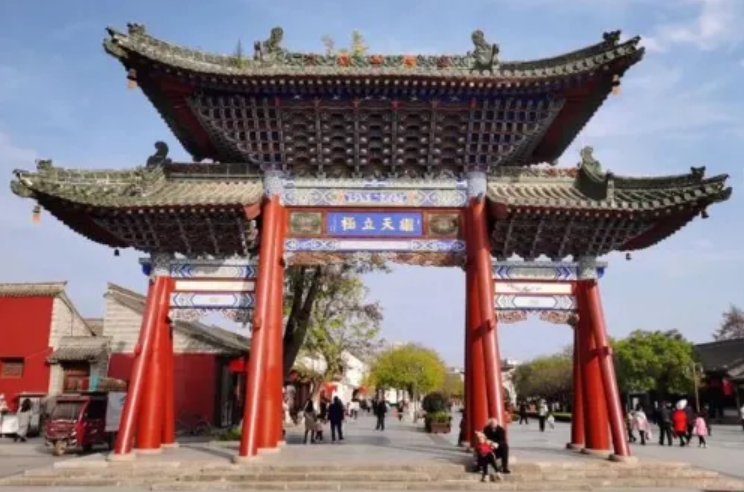
Located at the southernmost end of the scenic area, the Paifang is the front landmark of the temple, built in the typical Ming-Qing stone-and-wood archway style. It is simple and grand, with exquisite carvings featuring dragons, phoenixes, cloud patterns, and auspicious beasts on the beams and pillars, symbolizing good fortune and the continuity of culture. As the first gateway, it defines the ritual boundary of the sacrificial space, highlighting the solemn and respectful atmosphere of the temple, and is the first photo-worthy spot for visitors.
Main Gate
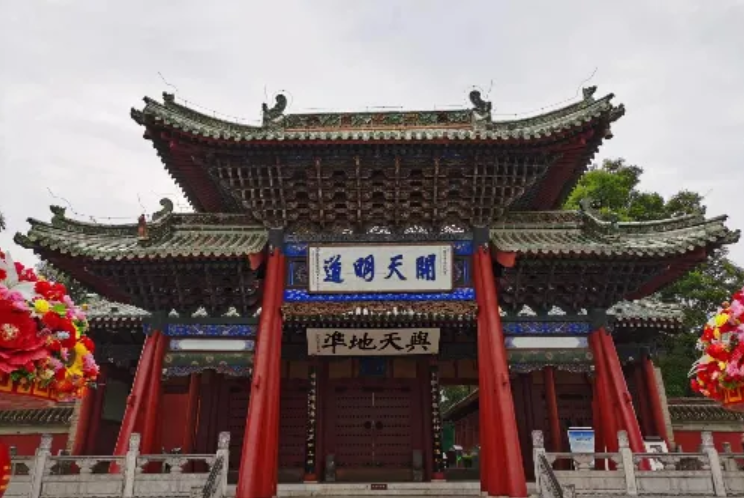
The Main Gate is the primary entrance, a typical Ming Dynasty official-style building facing south, with a broad front, glazed cylindrical tiles on the roof, sweeping eaves, and a dignified appearance. Its wooden structure preserves the original craftsmanship of the Ming and Qing dynasties. The door panels and lintels are simply decorated, in line with the ritual style of an ancestral temple. Connecting the outside street to the inner courtyards, it serves as the ritual entrance, demarcating the secular from the sacred space.
Yi Gate (Ritual Gate)
Located north of the Main Gate, the Yi Gate is a transitional structure in traditional ritual architecture, used exclusively for official ceremonies and grand sacrifices in ancient times. For daily visits, side passages are used; only during major rituals is the central gate opened, emphasizing the hierarchical solemnity of the rites. The gate is exquisitely designed, harmonizing with the overall style, and links the front courtyard with the main hall area, completing the layered spatial progression.
Xiantian Hall (Hall of Primal Heaven)
Xiantian Hall is the central main hall of the temple, the core building of the entire complex and the principal place enshrining the statue of Fuxi. Originally built in the Ming Dynasty and renovated in the Qing Dynasty, it retains its full original form. It measures seven bays wide, with a double-eaved, hip-and-gable roof covered in glazed tiles, massive beams and columns, and richly painted decorations. It is the best-preserved Ming Dynasty ancestral main hall in northwest China. Inside, a huge painted clay seated statue of Fuxi sits in a solemn and majestic posture, depicting the classic image of the legendary ancestor. The walls, beams, and pillars bear painted murals and inscriptions from successive dynasties, carrying profound historical and cultural significance. This is the core spot for visitors to pay homage and experience Fuxi culture. In front of the hall is a broad stone terrace, where ancient sacrificial kneeling and rituals were performed.
Taiji Hall (Hall of the Supreme Ultimate)
Located north of Xiantian Hall, Taiji Hall serves as the rear hall, with a scale secondary to the main hall. Its architectural style is elegant and dignified, complementing the main hall in a harmonious primary-secondary relationship. It is used for supporting sacrificial rites and displaying related cultural exhibits, including materials on Fuxi's Eight Trigrams culture and ancient civilization history. Visitors can gain an in-depth understanding of Fuxi's contributions, especially the creation of the Eight Trigrams, making it an important venue for studying Fuxi culture and Yijing studies.
Ancient Cypress Grove
Within the temple grounds, many thousand-year-old cypress trees survive, all planted during the Ming and Qing dynasties. Despite centuries of weathering, they remain lush and vigorous. Scattered on both sides of the terrace in front of Xiantian Hall and along the courtyard corridors, their ancient, gnarled forms contrast beautifully with the old buildings, creating a serene and reverent atmosphere. These ancient cypresses are living witnesses to the temple's history and a distinctive natural-cultural landscape, adding a profound sense of time to the ancient site.
Stele Pavilions and Stele Forest
Scattered throughout the courtyards are several stele pavilions and a stele forest, preserving dozens of stone stelae from the Yuan, Ming, Qing, and modern periods. These include records of temple renovations, sacrificial poems, inscriptions by famous literati, and historical accounts of Fuxi culture. The inscriptions provide detailed documentation of the temple's construction and repair history, as well as sacrificial traditions and nostalgic reflections of scholars, making them invaluable physical materials for researching the temple's history, northwest Chinese architecture, and Fuxi folk customs.
Suggested Tour Route:
Scenic Entrance Paifang → Main Gate → Yi Gate → Front Courtyard Ancient Cypress Area → Stele Pavilions and Stele Forest → Xiantian Hall (Main Hall) → Terrace → Taiji Hall → Rear Courtyard Cultural Exhibition Area → Scenic Exit
Travel Tips:
Suggested visit duration: 2 to 3 hours, allowing ample time to visit all attractions and appreciate Fuxi culture and ancient architecture without rushing.
Best seasons: Year-round. The public sacrifice ceremony to Fuxi is held around the 13th day of the fifth lunar month, offering a festive ritual atmosphere. Spring and autumn are especially comfortable for sightseeing.
Prioritize visiting Xiantian Hall and Taiji Hall, and study the stele inscriptions to understand the temple's history and the cultural essence of the Chinese ancestors.
It is highly recommended to use guided tours (either human guides or QR-code audio guides) for precise insights into architectural craftsmanship and Fuxi cultural stories, enhancing your experience.
Take a leisurely pace; the serene courtyards are ideal for quietly appreciating architectural details, ancient cypress views, and immersing yourself in traditional culture.
Important Notices:
As a cultural relic protection site and religious ritual venue, touching ancient building components, stelae, statues, or any cultural relics is strictly prohibited. Do not carve, graffiti, or climb on any structures.
The ancient cypresses are protected old trees; do not break branches, shake trunks, or trample vegetation. Please help preserve the natural and cultural landscape.
Loud noises, running, and horseplay are not allowed. Maintain a respectful and quiet atmosphere for both sightseeing and rituals, honoring traditional etiquette.
No open flames, flammable, or explosive items are permitted inside; smoking is prohibited throughout the site to eliminate fire hazards.
Photography with drones is forbidden; do not use flash in the main halls to protect painted murals and statues.
Strictly observe the opening hours; the site stops admitting visitors at 17:30. Do not linger beyond closing time, and follow staff instructions.
During holidays and sacrificial ceremonies, crowds may be heavy; consider off-peak visits and comply with on-site order for smooth touring and worship.
Transportation:
Public transit: Take Tianshui city buses No. 5, 7, 21, 22, or 24 to the Fuxi Temple bus stop, then walk directly to the entrance. Convenient.
Self-driving: Navigate to "Tianshui Fuxi Temple Scenic Area Parking Lot"; dedicated parking is available. Road conditions within the city are good.
Intercity travel: Visitors from other cities can arrive at Tianshui Railway Station or Tianshui South Station, then transfer by city bus, taxi, or ride-hailing service directly to the scenic area.
Opening Hours:
Fuxi Temple is open year-round. Daily hours: 08:00–18:00, with last admission at 17:30. There are no regular closed days. It remains open during statutory holidays and folk ritual events; some adjustments to admission rules or routes may occur during special festivals.
Ticket Price:
20 RMB per person.