Ayi River Scenic Area is located at No. 500, Group 6, Ayi River Community, Shaoqing Street, Pengshui Miao and Tujia Autonomous County, Chongqing. The scenic area stretches 21 kilometers in length, integrating mountains, water, forests, springs, and gorges, and embodying majesty, wonder, danger, beauty, and seclusion. It is a national 5A-level tourist attraction. The geology here is ancient, and the area boasts unique flora and fauna resources: 1,354 plant species across 161 families and 625 genera, including 908 medicinal plants, 115 wild edible species, and 266 industrial-use species. It also harbors 16 rare and endangered plants such as Distylium chinense, Taxus chinensis, and Davidia involucrata, including 11 first- and second-class protected plants and 5 third-class protected plants. There are 298 animal species belonging to 33 orders and 81 families, accounting for more than half of the species in the Three Gorges Reservoir area. The scenic area is divided into 3 sightseeing zones (Canyon Sightseeing Zone, Hiking Sightseeing Zone, and Bamboo Raft Sightseeing Zone), 2 leisure resorts (Reception Center Ethnic Style Leisure Resort and Niujiaozhai Ethnic Style Leisure Resort), 2 experience zones (Rafting Experience Zone and Outdoor Experience Zone), 1 white-water rafting zone, and 1 specialty merchandise service area.
History and Culture
Ayi River was originally named Changxi River. It originates in Fenshui Township, Wuchuan County, Guizhou Province, winds northeastward into Pengshui County, Chongqing, and finally flows into the Wu River. The Miao people call kind, beautiful, and intelligent women "Jiao Ayi," hence the river's name.
Ayi River has a long-standing historical tradition, a rich and colorful ethnic culture, and distinctive regional customs. Zhubanqiao (Bamboo Plank Bridge) preserves traditional papermaking techniques, inheriting Cai Lun's papermaking process and showcasing the primitive charm of one of China's "Four Great Inventions." The Liu family of Zhubanqiao moved from Jiangxi into Sichuan and has lived along the Ayi River for over 250 years, using local bamboo to handmade coarse paper, passed down through generations. The papermaking process is complex, reportedly requiring 72 procedures to produce a single sheet, all done by hand. The main steps include cutting bamboo, soaking and rinsing, fermenting, pulping, sheet forming, and packaging.
There are also many ancient legends and beautiful myths, such as the stories of Bamboo Raft Bridge, the two brothers Dajingbang and Xiaojingbang who sacrificed themselves to capture a tiger, the burnt giant stone pillar and the half-city fire in Chongqing prefecture, and the Immortal's Footprint.
Major Attractions
Thousand-Step Stairway
Over 800 meters long, this stairway was first built in the 1920s by local Peng Guoliang and later renovated in the 1990s with funds raised by Peng Yunkai. It served as a convenient passage for locals and is now a must-see spot for visitors seeking the thrilling and spectacular scenery of Ayi River.
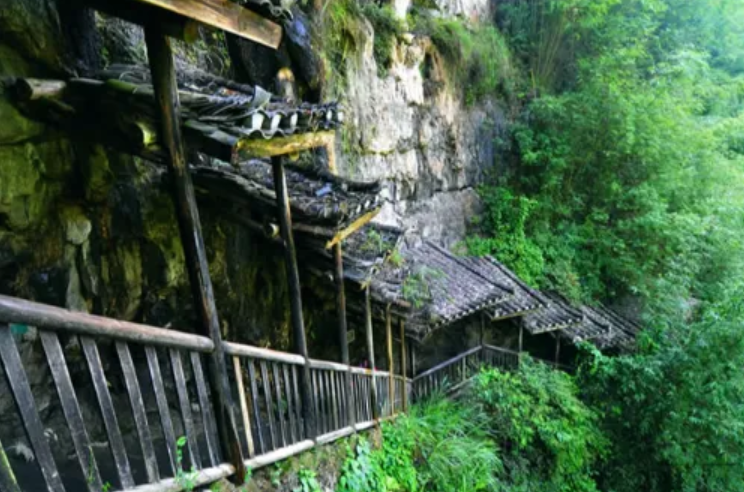
Zhubanqiao (Bamboo Plank Bridge)
The main entrance to the Ayi River Scenic Area. It was named because locals once used bamboo to build a bridge across the river. This is also the confluence of Muzi Stream and Ayi River. From here, visitors can go upstream to Qilitang, downstream by raft to Niujiaozhai, venture into Muzi Stream for exploration, or cross to see the traditional papermaking workshop.
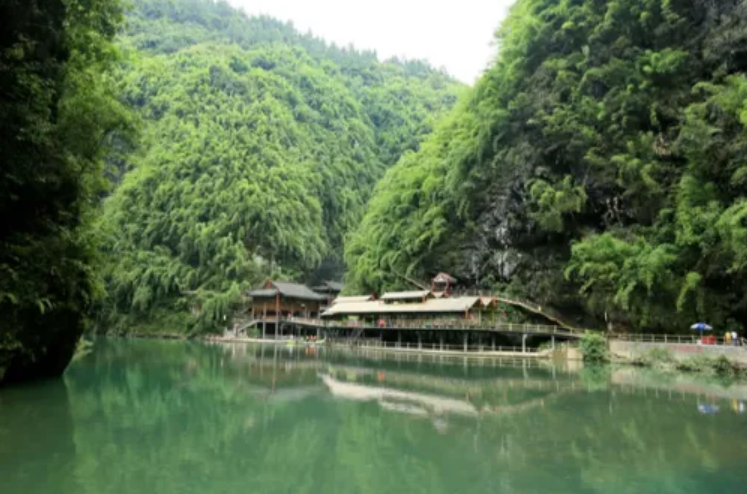
Qinglong Valley (Azure Dragon Valley)
The valley is about 300 meters high and 1,600 meters long, winding and secluded like a giant azure dragon. At the entrance, twin dragons welcome visitors with clouds; inside, there are Dragon Gall Blossom, Dragon Egg Shoal, and Nine-Dragon Pavilion. In the Hidden Dragon Cave, visitors can see the Time Vortex, small Jiangnan-style bridges and flowing water, and a crescent-shaped sky crevice, all presenting the quiet, magnificent, and grand atmosphere of cave and river landscapes. At the valley's end, the Dragon King Temple with gushing sweet springs and the Qinglong Waterfall roaring for miles showcase the dragon's benevolence and grandeur.
Playing in the Azure Pools
From Zhubanqiao Pier, board a rubber raft and drift gently through shallows and deep pools, leisurely reaching Niujiaozhai while enjoying nature's tranquility. If you continue downstream, wildflowers bloom on the banks, birds and butterflies flutter over the water, and green mountains and clear waters accompany you all the way. On the suspended plank walkway, hikers enjoy panoramic views; in colorful rafts, visitors splash water and engage in playful "water fights," creating a lively scene amid the emerald pools.
Wave-Conquering Rapids
This is the lower half of the Ayi River rafting experience, starting at Niujiaozhai. The currents are much swifter and the terrain more dangerous, with a total drop of about 60 meters.
Qinglong Sky Ladder
With a vertical depth of about 180 meters and an operating height of 148.8 meters, this is the largest sightseeing elevator in Asia (in terms of viewing length). Rising from the Muzi Stream canyon, it can carry 23 passengers at a speed of 2.5 m/s. In an instant, riders can take in the panoramic views of Zhubanqiao and Muzi Stream, truly feeling "once on top, you look down on all the lesser peaks."
Bamboo Raft Singing
At Zhubanqiao Pier, board a handcrafted bamboo raft. Using bamboo poles, visitors drift through the green mountains and clear waters, pointing at the riverbanks or paddling along, indulging in nature's serenity. Towering cliffs line both sides, dense bamboo groves sway, birds and butterflies flit about, and the sounds of flowing water, birdsong, laughter, folk songs, and the melodious voices of "Jiao Ayi" echo through Qilitang, forming a heavenly chorus that washes away the dust of the mundane world.
Qinglong Bridge (Myanmar Bridge)
Made of steel cables and wooden planks, this bridge allows 3–5 people to cross at a time. Participants can stretch their limbs and experience the feeling of tightrope walking, building courage and overcoming fear of heights and timidity.
Niujiaozhai (Ox Horn Village)
A Miao village surrounded by mountains on three sides and facing water on one, covering an area of over 3,000 square meters and integrating Miao folk customs. The surrounding peaks exude primitive wild beauty. The village offers inns, newly built Miao-style wooden buildings, and hotels with modern bathing facilities. There is also a barbecue area and a campsite with bonfire space on the sandy beach for outdoor camping. Visitors can enjoy wooden architecture, barbecue, bonfire nights, and folk performance shows.
Qinglong Cave (Azure Dragon Cave)
The loop trail is 1.5 kilometers long. The cave is extremely rich in chemical deposits, with densely distributed stalactites, stalagmites, stalactite flowers, drapes, flags, and rimstone dams—among the best in Chinese caves. Rare wonders like Dragon-Scale Stone Waterfall, Chang'e's Colorful Canopy, Five-Colored Jade Pools, and Cave Sky Waterfall make it known as an "underground geological museum."
Longyin Cave (Hidden Dragon Cave)
This cave was formed by millions of years of flood erosion at the junction where two mountains collide. The cave is several tens of meters high and over 400 meters long. Inside, there are the Time Vortex, small Jiangnan bridges and flowing water, and a moon-shaped skylight. Legend has it that Tao Yuanming passed through this cave and discovered the Peach Blossom Spring; others say that nine azure dragons dwelled here, governing the nine provinces of China. The truth of these tales is known only to the stone ducks in the stream before the cave—but when they will speak remains a mystery.
Suggested Itinerary:
Start by entering the Canyon Sightseeing Zone to enjoy the gorge scenery; then proceed to the Hiking Sightseeing Zone to admire rare flowers, ancient vines, and old trees; next, take a bamboo raft in the Bamboo Raft Sightseeing Zone to experience the clear and serene river. If you want to raft, you can take the "No. 1 Thrilling Rafting in Chongqing" from Niujiaozhai to Wanquan Pier. Alternatively, you may first explore Qinglong Valley via the suspended plank walkway, then visit Qinglong Cave to marvel at its wonders. You can also join folk experience activities, such as experiencing Miao village life at Niujiaozhai.
Travel Tips:
Check the weather in advance and choose a sunny day for your visit. When rafting, take waterproof measures and bring a change of clothes.
If you wish to experience folk activities, check the scenic area's event schedule in advance. For example, during the Miao Spring Outing Festival on the eighth day of the fourth lunar month, you can participate in the "Pange" (antiphonal singing) activities.
Wear comfortable sports shoes for hiking to better enjoy the scenery along the way.
When tasting local food, choose according to your preference. If you like sour and spicy flavors, try the local specialty sour and spicy dishes.
Precautions:
Respect the religious beliefs and customs of the local Miao and Tujia ethnic groups. For example, follow local customs when visiting Miao villages.
Protect the scenic environment—do not litter or damage plants and trees.
During rafting, follow the staff's instructions and properly wear life-saving equipment to ensure safety.
Mobile signals may be weak in some parts of the scenic area; inform family or friends of your itinerary in advance.
In case of bad weather, adjust your plans promptly to ensure personal safety.
Transportation:
Self-driving: From downtown Chongqing, take the Baomao Expressway – Pengshui West – Pengshui County – Ayi River. The journey takes about 2.5 hours.
Public transport: At Chongqing Longtousi or Sigungang bus stations, take a bus to Pengshui County Waiheba Bus Station, or take a train from Chongqing North Railway Station to Pengshui County. A secondary road connects the urban area to the Ayi River Reception Center, and the Pengyou Secondary Road links to the scenic area exit. Buses and scenic shuttle buses run throughout the day.
Opening Hours:
Open year-round. Peak season: 08:30–18:00; Low season: 09:00–17:30.
In case of severe weather, the park may close. Please check weather conditions before departing.
Admission:
Full-price ticket: 70 RMB
Half-price ticket: 35 RMB
Additional Paid Items
Elevator one-way: 35 RMB
Elevator round-trip: 50 RMB
Bamboo raft singing: 80 RMB
Qinglong Bridge: 30 RMB
Playing in the Azure Pools (upper rafting half): 80 RMB
Wave-Conquering Rapids (lower rafting half): 180 RMB
Sightseeing bus (Niujiaozhai – Exit): 50 RMB
Sightseeing bus (Zhubanqiao – Niujiaozhai): 30 RMB
Important Note: Visitors taking the Wave-Conquering Rapids (lower half) must arrive at Niujiaozhai Pier before 14:30.