Yumen Pass Scenic Area is located 90 kilometers northwest of Dunhuang City, Jiuquan City, Gansu Province. It is part of the Dunhuang World Cultural Heritage site, a national 4A-level tourist attraction, and a key national cultural relic protection unit. The overall managed area of the scenic area is about 60,000 square meters, with the core pass ruin covering 0.16 million square meters, and supporting facilities including walking trails, exhibition halls, and viewing platforms occupying approximately 0.145 million square meters. Yumen Pass was a key pass on the northern route of the ancient Silk Road. Its core features are the Gobi Desert frontier landscape and the Han Dynasty military garrison site cluster, with remains including the pass city, beacon towers, Hecang City, and other Han architectural ruins. The existing Yumen Pass city presents a square rammed-earth wall structure with thick base walls. Despite over two millennia of wind and sand erosion, it still retains its original city layout, serving as a tangible carrier for studying the Han Dynasty's northwestern defense system and Silk Road trade.
History and Culture
Yumen Pass was first built in the 6th year of the Yuanding era of Emperor Wu of the Western Han Dynasty (111 BC). After defeating the Xiongnu, the imperial court expanded the four commanderies of Hexi. To secure the Western Regions passage, control Silk Road merchants, and resist nomadic incursions, it successively built two frontier fortresses, Yumen Pass and Yang Pass. It was named Yumen Pass because fine jade from the Western Regions entered the Central Plains through this pass. During the Western Han, it was permanently garrisoned by soldiers and farming troops, with a complete military system including grain storage, beacon warning posts, and relay stations. Envoys, caravans, and monks all had to present their customs documents here, making it the first gateway from the Central Plains to the Western Regions.
During the Wei and Jin dynasties, the central government's control weakened, and the northern Silk Road route shifted slightly. Yumen Pass gradually reduced its large?scale military presence but maintained its commercial transit function. In the Sui and Tang dynasties, Yumen Pass flourished again. Frequent frontier battles brought many soldiers here, and numerous literati and poets passed through, composing enduring frontier poems. Wang Zhihuan's line from Liangzhou Ci—"Beyond Yumen Pass no spring breeze ever blows"—became a classic eternal verse, endowing Yumen Pass with a rich literary and frontier imagery.
After the Song and Yuan dynasties, with the rise of the Maritime Silk Road, the overland Silk Road declined. Yumen Pass was completely abandoned, and the city was half?buried by desert sand, long hidden in the wilderness. It was not until modern archaeological surveys and excavations that the site gradually became clear. In 2014, Yumen Pass was inscribed on the World Heritage List as an important node of the "Silk Roads: the Routes Network of Chang'an?Tianshan Corridor." Today, it is open to the public as a cultural relic scenic area for protection and display.
Main Attractions
Yumen Pass City Ruin
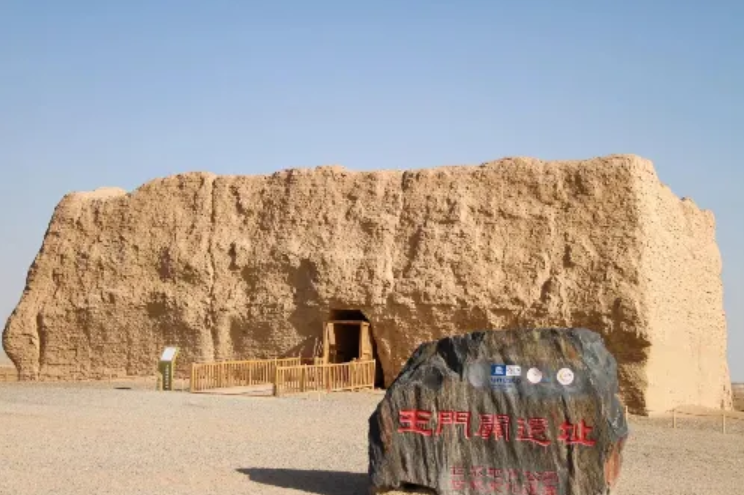
The Yumen Pass city is the core landmark of the scenic area. The city plan is square, with sides 40 meters long. The extant wall height is about 9.7 meters. The walls are built of rammed loess, with two city gates on the east and west. Inside remain house foundations and horse?track relics. In ancient times, this was where garrison officers and soldiers worked, lived, and examined merchants. A protective moat once surrounded the outer wall, and its traces are still identifiable. The entire city vividly demonstrates the construction style and military defense layout of Han?period frontier passes.
Hecang City Ruin
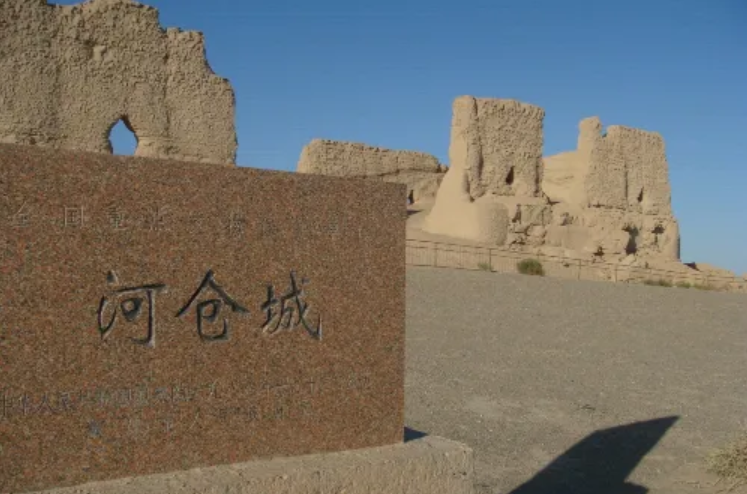
Hecang City is located about 11 kilometers northwest of Yumen Pass City. It was a large?scale grain depot supporting Yumen Pass during the Han Dynasty. The overall structure is a rectangular rammed?earth building, consisting of northern and southern storage cities. In ancient times, it relied on the Shule River for water transport to supply grain to Yumen Pass and surrounding beacon troops. The walls are now heavily damaged, but the foundations of partitioned grain?storage compartments are clearly visible. It is an important relic of the northwestern garrison logistics system of the Han Dynasty.
Dafangpan Beacon Tower
Adjacent to Hecang City, the Dafangpan Beacon Tower was part of the Han?era early?warning beacon system. It is a rammed?earth raised platform. In antiquity, in case of enemy activity, smoke and fire signals would be lit to transmit military intelligence. The beacon tower, pass city, and granary city cooperated to form a complete frontier defense warning line, serving as a typical physical specimen of the Han beacon system.
Yumen Pass Exhibition Hall
At the entrance of the scenic area, an indoor exhibition hall displays cultural relics unearthed from Yumen Pass, including wooden slips, pottery shards, ironware, and silk fragments. With graphic panels and scene restorations, it provides detailed explanations of Han defense systems, Silk Road trade, daily life of garrison soldiers, and the archaeological excavation process, helping visitors fully understand the historical background of the site.
Gobi Viewing Boardwalk
A wooden boardwalk encircles the pass city and extends to a high?ground viewing platform on the Gobi. From the platform, visitors can overlook the boundless desert and distant Yardang landforms, vividly experiencing the "lonely smoke in the desert" frontier scenery. The boardwalk is lined with protective barriers to prevent visitors from stepping on the original relic soil layers.
Suggested Tour Route:
Visitor Center → Exhibition Hall → Viewing Boardwalk → Yumen Pass City Ruin → Sightseeing Bus Transfer Point → Hecang City Ruin → Dafangpan Beacon Tower → Return to Visitor Center.
Travel Tips:
The best time to visit is from April to October. In winter, the Gobi is extremely cold with strong winds, reducing comfort.
The full tour includes two distant sites; it is recommended to take the sightseeing bus, as walking the round trip is too long and tiring.
Allow 2?3 hours for the visit. Carefully reading the exhibition and visiting the two sites will give a sufficient historical experience.
The noon sun on the Gobi is intense; avoid visiting during the high?temperature period from 12:00 to 15:00.
Bring binoculars to observe the beacon tower and distant Gobi landforms clearly.
Use guided tour services (human or audio guides) to gain a deeper understanding of the history behind the ruins.
Important Notices:
The ruins are fragile rammed?earth cultural relics. Climbing walls, stepping on foundations, carving on the site, or picking up soil and gravel are strictly prohibited.
The Gobi area has no large shaded areas; be sure to bring sun hats, sunglasses, high?SPF sunscreen, and windproof scarves.
Drinking water supply points are scarce; bring enough water for yourself. You may carry a small amount of high?calorie snacks for energy.
The temperature difference between day and night is large. Even in summer, bring a light jacket; in spring, autumn, and winter, wear thick windproof and warm clothing.
The scenic area is deep in the desert with no medical emergency stations. People with hypertension or cardiopulmonary conditions should exercise caution when traveling long distances.
Dust storms are frequent. In case of strong winds and blowing sand, follow staff instructions and suspend outdoor site visits.
Unauthorized drone flights are prohibited. Aerial photography requires prior application to the scenic area management office.
Do not leave the boardwalks or designated tour routes. The outer Gobi has no signal and no roads; it is very easy to get lost.
Transportation:
Self?driving: Follow S303 provincial road from Dunhuang city for about 90 km, about 1.5 hours by car. There is a free open?air parking lot at the scenic area.
Shuttle bus: Designated hotels and the tourist distribution center in Dunhuang city offer daily round?trip shuttles to Yumen Pass, with a basic package including round?trip fare.
Chartered car: Local 5?seat or 7?seat private cars in Dunhuang can be chartered for a one?day tour combining Yumen Pass, Yardang Devil City, and Hecang City.
Public bus: No regular city bus service directly reaches the site; only temporary tourist bus lines are added during the peak season.
Opening Hours:
The scenic area adjusts its hours between peak and off?peak seasons. Peak season (April 1 – October 31): 8:00–18:00 daily. Off?season (November 1 – March 31): 9:00–17:00 daily. In extreme wind, rain, or snow, the opening hours may be shortened or the site may temporarily close. Check real?time announcements before traveling. The exhibition hall and outdoor ruins are open concurrently. Ticket admission stops 30 minutes before closing.
Tickets:
Yumen Pass site admission: 40 RMB per person. Sightseeing bus fare: 50 RMB per person.