Jindaoxia Scenic Area is located in Jindaoxia Town, Beibei District, Chongqing, adjacent to the Huaying Mountain range. It is a national 4A-level tourist attraction and a municipal-level scenic spot in Chongqing. Centered on canyon landscapes, it combines the splendor of karst landforms with the agility of streams, earning it the reputation of "the First Gorge of Eastern Chongqing." The scenic area is canyon-shaped, stretching about 10 km in length, with a total area of 6.2 km2, of which the core area covers roughly 3.5 km2. Structures within the site are built along the canyon terrain, including a visitor center, plank walks, pavilions, and suspension bridges. The suspended plank walks total about 3 km, and there are 7 suspension bridges. These facilities meet visitor needs while blending into the natural landscape without harming the canyon’s primitive character. Jindaoxia features steep gorges, majestic mountains, clear waters, numerous waterfalls, emerald pools, and fantastic caves. Towering cliffs flank the canyon, lush vegetation abounds, streams gurgle, and cascading waterfalls are found everywhere. The area also contains karst cave groups formed over hundreds of millions of years, making it an eco-scenic spot that integrates exploration, sightseeing, and leisure.
History and Culture
The name "Jindaoxia" (Golden Knife Gorge) carries deep folklore and historical significance. Legend has it that during the late Ming Dynasty, the peasant rebel leader Zhang Xianzhong campaigned in the Sichuan-Chongqing region. His general Zhang Dingguo lost a golden knife in a battle here, and later generations named the place Jindaoxia in commemoration. This tale adds rich legendary color and forms an important part of local folk culture.
Geologically, Jindaoxia was formed during the Permian period about 260 million years ago, shaped by crustal movements and water erosion over time. The rocks are mainly limestone, and after eons of dissolution, they have produced karst features such as caves, stalactites, and stalagmites. These geological relics are not only natural treasures but also bear witness to Earth’s evolutionary history, holding significant research value. Additionally, Jindaoxia Town has long been an important settlement in the Ba-Yu region, preserving local folk culture like the Chuanjiang boatmen’s chants and Ba-Yu woodcarving. These cultural elements combine with the natural scenery to form a distinctive regional cultural system.
Major Attractions
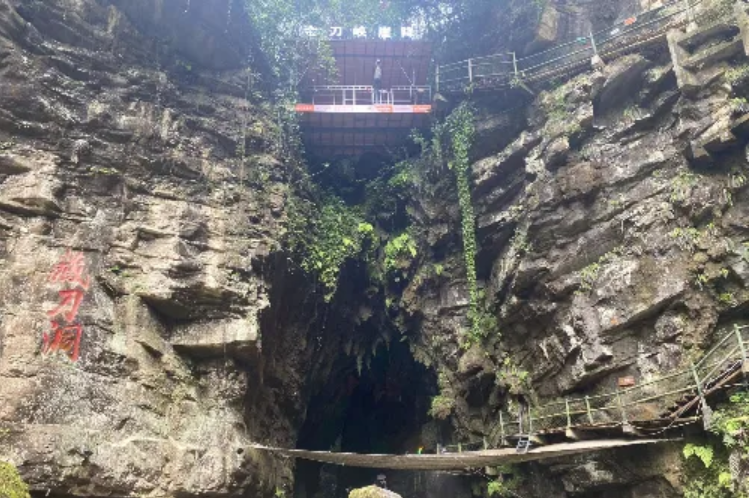
Zangdao Cave (Hidden Knife Cave)
A signature attraction in the middle section of the gorge. The cave mouth is about 5 m high and 3 m wide, with a depth of over 20 m. Legend says this is where General Zhang Dingguo lost his golden knife. Inside, stalactites and stalagmites of various shapes have formed over millennia, creating such wondrous sights as "Golden Knife on the Cliff" and "Monkey Viewing the Knife," beautifully illuminated. A stream flows right outside, complementing the cave’s interior.
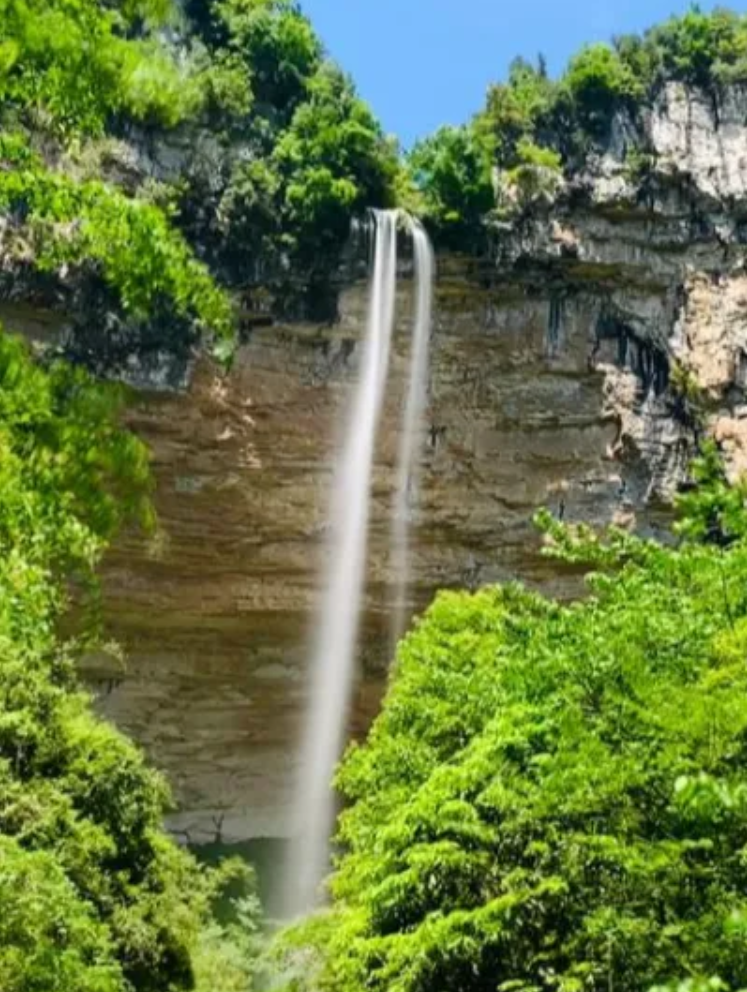
Xuantian Waterfall (Hanging Sky Waterfall)
Located on the right side of Rizhao Cliff at the upper entrance of the gorge. The cliff is towering and sheer. A silver-white cascade plunges from the sky beside the majestic mountain, about 150 m high and 10 m wide. On the left side of the waterfall mouth, there is a square stone cavity, but its origin and builder remain unknown.
Shenying Gorge (Divine Eagle Gorge)
Situated in the upper section, about 1.5 km long, this is the most precipitous part of the canyon. Cliffs on both sides rise over 100 m with near-vertical slopes, hosting many birds, especially eagles, hence the name. The stream drops sharply here, forming several waterfalls; the Shenying Waterfall drops about 30 m, crashing into a deep pool below with great force. A suspended glass plank walk about 200 m long and 80 m above the ground allows visitors to overlook the magnificent canyon scenery.
Shitou Gorge (Lion Head Gorge)
Less than 200 m from Shenying Gorge, this is the second remarkable sight in the upper section. The gorge walls jut out, creating a narrow and deep ravine. The plank walk follows the stream, which sometimes murmurs softly and sometimes roars. At a sharp bend, a huge rock protrudes into the gorge like a lion’s head, beneath which lies a green deep pool with jade-like shimmering water.
Maitreya Buddha
Located in the lower section, this natural rock formation was shaped by weathering and dissolution over eons. The stone statue is about 10 m high and 8 m wide, closely resembling a seated Maitreya Buddha, with a benevolent and lifelike expression. Below it is a clear pool about 50 m2 in area and 2 m deep, with pebbles visible at the bottom. Surrounded by dense greenery, it is an ideal spot for rest and enjoying this natural wonder.
Old Drunkard (Laojun Zuijiu)
After passing a series of deep, twisting pools, in the middle of the lower section there is a 50?m-long stone niche, wide at the bottom and narrow at the top, shallow above and deep below, capable of holding over 100 people. A silver veil of water falls from the niche top, scattering like pearls and spraying mist, as if it were celestial wine that has intoxicated the immortals, giving rise to the legend of their mounts descending to enjoy earthly pleasures.
Tour Routes:
There are mainly two routes: full hiking and half-day leisure, depending on your stamina.
Full hiking route: Enter from the South Gate (Visitor Center), visit Shenying Gorge, Zangdao Cave, Maitreya Buddha, etc., and exit from the North Gate. The total length is about 10 km, taking 4–5 hours on foot. This covers all core attractions and is suitable for fit visitors.
Half-day leisure route: Enter from the North Gate, take the sightseeing bus to Zangdao Cave, then hike to visit Zangdao Cave, Maitreya Buddha, and other lower-section sites, then return the same way to the North Gate. About 5 km, taking 2–3 hours, suitable for seniors, children, and those with average stamina.
Additionally, there is an adventure route starting beside the glass plank walk in Shenying Gorge, following a trail along the stream to get close to waterfalls and pools. It takes about 3 hours and is for outdoor enthusiasts, but requires caution and is only open during designated times.
Travel Tips:
Suggested duration: 5–6 hours for the full route, 3–4 hours for the half route; add 1–2 hours for photography, rest, and entertainment.
Best seasons: April–May and September–October, when temperatures are pleasant, vegetation lush, and waterfalls abundant. Summer is also good for escaping heat, though hot outside the gorge; winter can be icy—watch your step.
What to bring: A light backpack with at least 2 bottles of water (about 1000 ml), snacks, sunscreen, rain gear (weather changes quickly), non-slip sports shoes (many stone steps and slippery sections), and a trekking pole if hiking the full route.
Entertainment: A canyoning (stream descent) activity is available from May to October, lasting about 1.5 hours; book in advance at the visitor center and wear quick?dry clothing. Folk performances are held near the North Gate at 10:00 and 14:00 daily, each about 30 minutes.
Dining: Three dining spots—at the South Gate entrance, near Zangdao Cave, and at the North Gate exit—offer local Chongqing snacks and simple meals at moderate prices; you may also bring your own snacks.
Important Notes:
Some sections are narrow and slippery; running and roughhousing are strictly forbidden. Elderly and children must be accompanied by adults and stay away from cliff edges and stream banks.
Canyoning and adventure activities have certain risks; participants must meet physical requirements (age 12–60, no heart disease, hypertension, etc.) and strictly follow instructors’ guidance.
No smoking or littering except in designated areas; help protect the environment.
Do not touch stalactites or stalagmites in caves—they are fragile and can be damaged.
In case of heavy rain, thunderstorms, etc., some sections or the entire scenic area may be temporarily closed; follow official notices and staff instructions.
Plank walks and suspension bridges have limited capacity; queue and cross orderly when crowded.
Transportation:
Public transit: From Jiefangbei in Yuzhong District, take Metro Line 6 to Beibei Station, then transfer to the Beibei–Jindaoxia bus (7:30–16:30, hourly, about 1.5 hours). Arrive at Jindaoxia Town, then take the scenic shuttle (about 10 minutes) to the South Gate.
Self-driving: From central Chongqing, take the G93 Yuwu Expressway to the Beibei interchange, then follow the Beijin Highway. Total about 80 km, about 1.5 hours. Both South and North Gates have parking lots with about 500 spaces; fees: 10 CNY/day for small cars, 20 CNY/day for large vehicles.
Tour buses: Many travel agencies in Chongqing offer day tours, usually departing at 8:00 and returning at 17:00, about 1.5 hours each way; book through agencies.
Opening Hours:
Peak season (Mar 1 – Oct 31): 8:00–17:00, last entry 16:00.
Low season (Nov 1 – Feb 28/29): 8:30–16:30, last entry 15:30.
Caves, glass walkways, etc. follow the same hours. Canyoning operates from May 1 to Oct 7, 9:00–15:00; no bookings after 15:00.
During holidays (Spring Festival, National Day, etc.), opening may be advanced to 7:30, and last entry extended (peak season to 16:30, low season to 16:00); check on?site notices.
Ticket Price:
85 CNY per person (includes one?way cable car and one?way ferry).