Nansha Tianhou Palace is located at the southeastern foot of Dajiao Mountain in Nansha District, Guangzhou City, Guangdong Province. It is a national 4A-level tourist attraction, covering an area of approximately 180,000 square meters. It is one of the larger Mazu temple complexes in South China, built along the mountain and facing the sea, integrating Mazu culture, ancient architectural landscapes, and coastal scenery. The architectural complex follows the layout style of the Forbidden City in Beijing and the mausoleum design of Dr. Sun Yat-sen in Nanjing, with halls rising layer by layer up the mountain, extending from the square at the foot to the Tianhou statue at the summit. The core features of the attraction are the传承 of Mazu belief culture, combined with seaside sightseeing and folk祈福 activities. It is a well-known Mazu cultural landmark in the Guangdong-Hong Kong-Macao Greater Bay Area, hosting annual Mazu-related folk ritual activities that attract believers and tourists from home and abroad.
History and Culture
Nansha has been a vital maritime passage since ancient times, with a long-standing folk belief in Mazu. Historically, a small Tianhou temple existed in the Nansha area but was later damaged over time. The current Nansha Tianhou Palace began construction in 1994 and was officially completed and opened to the public in 1996. The construction process incorporated architectural concepts from various Mazu temples both at home and abroad, aiming to create an important venue for Mazu cultural exchange in Guangdong, Hong Kong, and Macao.
Mazu culture originated in Putian, Fujian, and spread to the Pearl River Estuary through maritime trade. In ancient times, merchant ships and fishermen navigating the Lingding Ocean often prayed to Mazu for safe voyages. Situated at the throat of the Lingding Ocean, Nansha became a key node in the dissemination of Mazu beliefs along the Pearl River Estuary. After its completion, Nansha Tianhou Palace has continuously played a role in preserving Mazu culture, regularly holding rituals, folk exhibitions, cultural seminars, and other activities, serving as an important bridge for connecting Mazu faith practices across Guangdong, Hong Kong, and Macao.
Every year on the 23rd day of the third lunar month, the birthday of Mazu, the temple holds large-scale sacrificial ceremonies, preserving traditional ritual procedures and continuing the coastal Lingnan folk customs of honoring Mazu, vividly showcasing the characteristics of Lingnan maritime folk culture.
Major Attractions
Tianhou Holy Statue
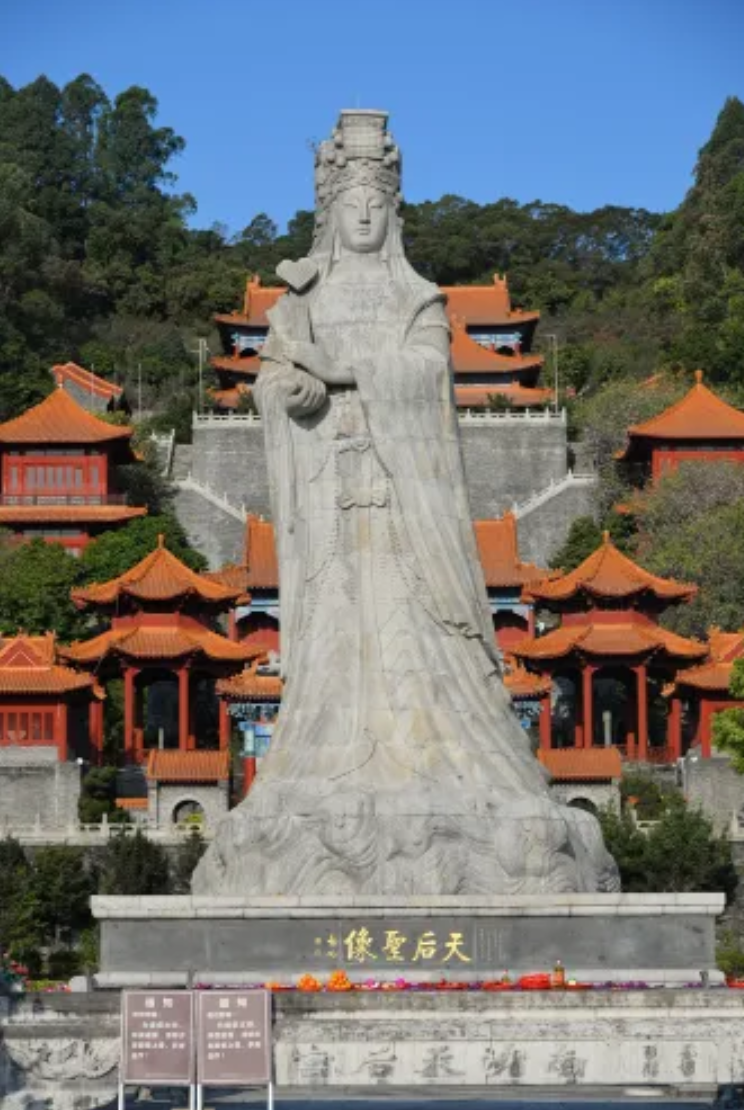
Standing atop Dajiao Mountain, the Tianhou Holy Statue is the iconic landmark of Nansha Tianhou Palace. Carved from granite, the statue is 14.5 meters tall and faces the Lingding Ocean, overlooking the Pearl River estuary. The platform at the summit offers a broad view of the Pearl River estuary and the Humen Bridge, serving both as a scenic overlook and a place for prayers. It is also the best spot for tourists to take panoramic coastal photos.
Mountain Gate Square
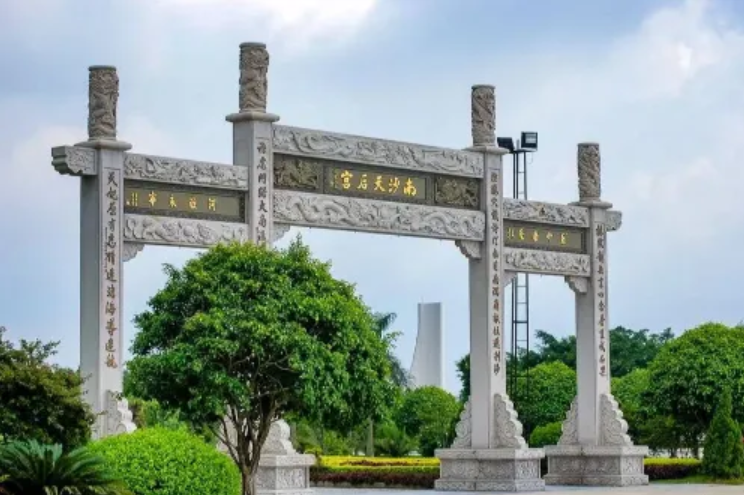
Located at the entrance of the scenic area, the square is open and level, with the Tianhou Palace mountain gate at its center, flanked by stone lions and landscaped greenery. The square serves as a visitor gathering and distribution point. On both sides, there are cultural display areas that briefly introduce Mazu's life and the history of the temple's construction, marking the starting point of the temple complex.
Main Hall
The Main Hall is the core building of the temple, situated on a terrace in the middle of the complex. Inside, it enshrines the main statue of Mazu, accompanied by statues of protective deities. The hall features a double-eaved, gable-and-hip roof in the traditional Lingnan palace style, with ornate carvings and painted beams, and displays ritual vessels. It is the primary place for believers to pray and worship. Outside the hall, there is a worship courtyard for visitors and devotees to conduct ritual activities.
Nanling Pagoda
Located on the western slope of the temple, the Nanling Pagoda is an octagonal, seven-story pavilion-style ancient pagoda, 45 meters tall. Built according to traditional Feng Shui principles, climbing the pagoda offers a panoramic view of the entire Tianhou Palace complex and the coastal mudflats. Inside, there are spiral stairs leading upward, combining architectural beauty with sightseeing functions, and it is an important ancient architectural feature of the scenic area.
Bell and Drum Towers
The Bell Tower and Drum Tower stand symmetrically in front of the Main Hall, representing traditional paired architecture. The Bell Tower houses a large bell, and the Drum Tower houses a large drum. During traditional sacrificial ceremonies, the bell and drum are sounded to enhance the ritual atmosphere. Their simple and antique design is a typical component of traditional temple layouts.
Bedchamber Hall
Located on one side of the main complex, the Bedchamber Hall primarily enshrines the ancestral statues of Mazu’s family. It is a complementary ritual building with a simple and elegant layout, fully preserving the traditional architectural norms of a Tianhou temple, allowing visitors to learn about the legends and folklore surrounding Mazu’s family.
Suggested Tour Route
Scenic entrance (Mountain Gate Square) → Bell and Drum Towers → Main Hall worship courtyard and Main Hall → Bedchamber Hall → Mountain climbing trail → Nanling Pagoda → Summit Tianhou Holy Statue viewing platform → Coastal promenade
Tour Suggestions:
It is recommended to visit in the morning or late afternoon to avoid the midday heat, as the lighting at the summit is better for photography.
The entire route involves mountain climbing, so wear comfortable, non-slip flat shoes and avoid high heels.
There are many steps leading to the Tianhou Holy Statue platform; visitors with limited stamina should pace themselves and take breaks as needed.
Please follow temple rules when praying or offering sacrifices, and purchase religious supplies from official vendors within the scenic area.
After the tour, you may walk along the coastal area outside the temple to enjoy the river view and get a close-up look at the Humen Bridge.
During the Mazu birthday festivities in the third lunar month, visitor numbers are high; plan your visit on weekdays if you wish to avoid crowds.
Important Notes:
Maintain silence inside the temple halls; do not shout or run around.
Do not touch statues or ritual objects inside the halls, and do not climb on ancient building railings or walls.
Open flames are prohibited in the forested areas of the scenic zone; do not bring fire sources or burn non-designated offerings.
The mountain trails have steep steps and can be slippery on rainy days—please watch your footing.
Respect the greenery, stone carvings, and ancient buildings; do not graffiti, carve, or pick plants.
Pets are not allowed in the core worship areas; please comply with the scenic area’s management regulations.
The wind at the summit can be strong; keep light items secure to prevent them from being blown away.
Transportation:
Public Transit: Take Guangzhou Metro Line 4 to Nanheng Station, then transfer to Nansha Bus routes Nan 4 or Nan 54 to the Nansha Tianhou Palace bus stop.
Self-Driving: Navigate to "Nansha Tianhou Palace"; the scenic area has a parking lot for visitors.
Water Transport: During certain periods, you can take a water route to Nansha Port and then transfer by bus to the scenic area. Please verify ferry schedules before departure.
Opening Hours:
Nansha Tianhou Palace is normally open daily from 08:30 to 17:30. The internal worship area of the Main Hall follows the same opening hours as the overall scenic area. During statutory holidays and Mazu birthday festivities, any adjustments to opening arrangements will be announced on-site. In extreme weather conditions, the mountain trails may be temporarily closed or the entire park may be closed.
Ticket Price:
Admission: 20 RMB/person.