The Dazu Rock Carvings Scenic Area is located in Dazu District, Chongqing, China. It is a UNESCO World Heritage Site and a national 5A-level tourist attraction. Centered on the grottoes of five mountains—Baoding Mountain, Beishan Mountain, Nanshan Mountain, Shimenshan Mountain, and Shizhuan Mountain—it represents the outstanding achievement of late-period Chinese grotto art, integrating statues of the "three teachings" (Buddhism, Taoism, and Confucianism) and showcasing the pinnacle of stone carving art from the Song Dynasty.
The site preserves over 50,000 stone statues and more than 100,000 inscriptions. Carving began in the first year of the Yonghui era of the Tang Dynasty (650 AD) and continued through the late Tang, the Five Dynasties, and the Northern Song, flourishing in the Southern Song and lasting into the Ming and Qing dynasties—spanning over 1,300 years. The core area of Baoding Mountain carvings covers about 1,100 mu (approx. 73 hectares), while Beishan Mountain carvings, begun in the first year of the Jingfu era of Emperor Zhaozong of Tang (892 AD), contain over 5,000 statues.
History and Culture
The creation of the Dazu Rock Carvings is closely tied to the socio-economic development of the Bashu region during the Tang and Song dynasties. After the An Lushan Rebellion in the Tang, populations from the Central Plains migrated southward, making Dazu an important cultural center where Buddhist rock carving began to flourish. During the Five Dynasties, with local political support, the scale of grotto construction expanded, and the content gradually integrated Confucian, Buddhist, and Taoist thought.
The Song Dynasty was the golden age of the Dazu Rock Carvings. Represented by the Baoding Mountain carvings, the project was led by the eminent monk Zhao Zhifeng and took over 70 years to complete. The statues primarily feature Esoteric Buddhist themes, combined with Confucian ethics and secular life, forming a unique "coexistence of humans and Buddhas" style. Examples include the "Six Realms of Reincarnation," the "Parable of the Parents' Kindness," and the "Ox-Herding Pictures," which not only served religious and moral functions but also reflected family ethics and scenes of daily production and life in Song society.
In 1999, the Dazu Rock Carvings were inscribed on the UNESCO World Heritage List, with the evaluation stating that they "represent the highest level of world grotto art from the 9th to the 13th centuries" and are "the last monument in the history of Chinese grotto art."
Major Attractions
Baoding Mountain Carvings
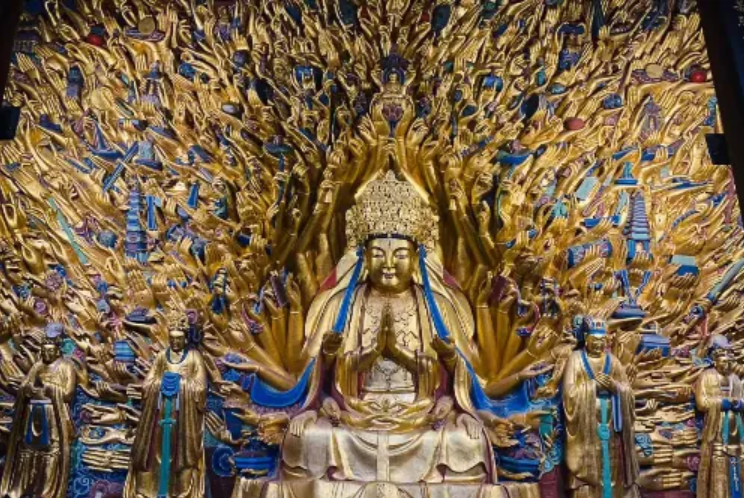
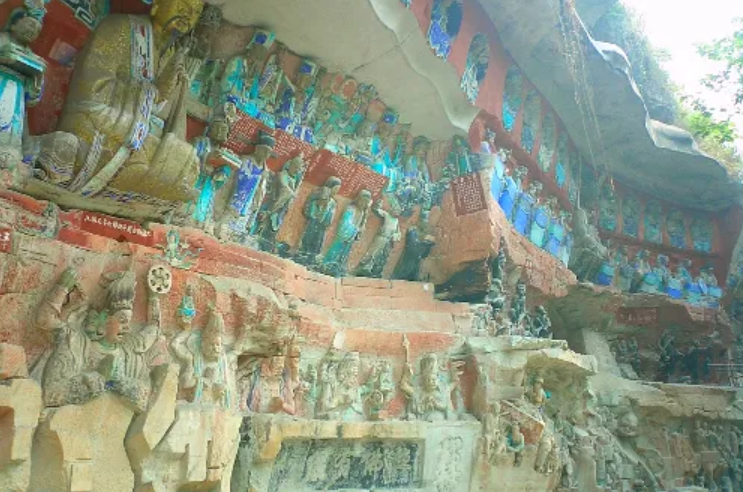
Baoding Mountain is the largest and most artistically valuable part of the Dazu Rock Carvings, carved during the Chunxi and Chunyou reigns of the Southern Song (1174–1252). The site contains 31 large cliff-side statue groups, the most famous being the "Six Realms of Reincarnation," "Three Saints of Huayan," "Nine Dragons Bathing the Prince," "Ten Great Wisdom Kings," and "Ox-Herding Pictures." Among them, the 7-meter-tall "Three Saints of Huayan" is carved against the cliff with flowing robes and majestic presence; the 30-meter-long "Ox-Herding Pictures" presents the process of taming the mind through a comic-strip style full of life.
Beishan Mountain Carvings
Beishan Mountain carvings began in the late Tang and continued through the Five Dynasties to the Southern Song, with 264 niches and shrines extant. Primarily Buddhist, they also include Taoist and Confucian subjects. The "Wheel-Turning Sutra Treasury Cave" is hailed as "the jewel in the crown of Chinese grotto art," inside which the 1.5-meter-high Samantabhadra Bodhisattva statue is renowned for its graceful face and light posture. Other notable works include the "Bead-Counting Guanyin" and the "Sun-Moon Guanyin," known for their fine carving and vivid expressions.
Nanshan Mountain Carvings
Nanshan Mountain features primarily Taoist statues, carved in the Southern Song, with 15 niches extant. Among them, the "Three Pure Ones Ancient Cave" is one of the largest and best-preserved Taoist grottoes in China, housing 42 statues including the supreme Taoist deities, the "Three Pure Ones," showcasing the artistic characteristics of Song Dynasty Taoist carving.
Shizhuan Mountain Carvings
Located 25 km southwest of Dazu District, Shizhuan Mountain carvings were begun in the Northern Song and are a typical example of "three-in-one" religious integration. Covering about 1.2 square kilometers, the site has 10 niches with nearly 300 statues, depicting Buddhist, Taoist, and Confucian figures, such as "Confucius and His Ten Disciples," "Manjusri and Samantabhadra," and "Laozi." The coexistence of three religions on one mountain reflects the social trend of "three-teachings syncretism" in the Song. The "Confucius Niche," which carves images of Confucius and ten of his disciples, is a rare Confucian statue group in Chinese grottoes and holds significant historical and cultural value.
Shimenshan Mountain Carvings
Located 21 km southeast of Dazu District, Shimenshan carvings were created from the Northern to Southern Song, primarily Taoist but also incorporating Buddhist statues. The area covers about 1.8 square kilometers, with 16 niches containing nearly 1,000 statues, distributed on two cliff walls—the left wall mostly Taoist, the right mostly Buddhist. Notable Taoist works include the "Jade Emperor Niche" and "Three Sovereigns Niche," exquisitely carved and imposing; Buddhist works like "Water-Moon Guanyin" and "Medicine Buddha" display elegant form and masterful craftsmanship. Shimenshan is an important relic for studying Song-Dynasty Taoist-Buddhist relations and carving art.
Suggested Itineraries:
One-Day Classic Route:
Morning: Baoding Mountain carvings (approx. 3 hours, focus on Dafo Bay and Xiaofo Bay statues);
Noon: Lunch within the scenic area or in Dazu city center;
Afternoon: Beishan Mountain carvings (approx. 2 hours, visit the Wheel-Turning Sutra Treasury Cave, the Contemplation of Infinite Life Sutra niche, etc.);
Evening: Return to downtown.
In-Depth Tour (2–3 days):
Day 1: Baoding Mountain Nanshan Mountain carvings;
Day 2: Beishan Mountain Shimenshan Shizhuan Mountain carvings;
Day 3: Dazu Rock Carvings Museum (to learn about the history and culture) surrounding rural attractions (e.g., Lotus Village).
Travel Tips:
It is recommended to hire a professional guide (approx. 100 RMB for Baoding Mountain) or use the smart audio guide devices to better understand the cultural stories behind the carvings.
In summer, protect against sun and heat; in winter, keep warm. Wear comfortable sports shoes as there is a lot of walking.
For in-depth visitors, book in advance to visit outlying sites like Shimenshan and Shizhuan Mountain to experience the unique charm of lesser-known carvings.
For local food, head to the "Hongguang Square" food street in Dazu city to enjoy authentic local cuisine and snacks.
Suggested visit duration: 1–2 days. Core sites (Baoding and Beishan) can be covered in one day; for a full experience of all five mountains, plan 2 days.
Best seasons: spring and autumn (March–May, September–November) with pleasant weather and less rain. Summer is hot; winter is cold—dress accordingly.
Combine with other Dazu attractions such as the Dazu Rock Carvings Museum and Lotus Village to enrich your trip.
Important Notices:
Do not touch or climb the stone statues; flash photography is prohibited.
Baoding Mountain is large; plan your route in advance to avoid missing core sites.
Shimenshan and Shizhuan Mountain are in rural areas with limited public transport; self-driving or hiring a car is recommended.
When purchasing tickets, note peak and off-peak prices; carry concession documents and present them upon request.
Do not scratch or deface the rock faces; respect cultural relics and follow site regulations.
Maintain silence during visits, respect religious beliefs, and avoid loud noises or inappropriate behavior in religious areas.
Summer UV is strong—wear hats and sunscreen; the area has many trees, so use insect repellent.
Rest areas and restrooms are available; take breaks as needed to avoid fatigue.
Transportation:
Self-driving: From downtown Chongqing, take the Yurong Expressway and Tongrong Expressway to Dazu East exit—about 1.5 hours. From downtown Chengdu, take the Chenganyu Expressway to Dazu West exit—about 2.5 hours.
High-speed rail: Take the Chengdu-Chongqing high-speed train from Chongqing West Station to Dazu South Station. From there, take the direct shuttle bus to the scenic area (about every 30 minutes, 15 RMB) or a taxi (about 30 RMB) directly to Baoding Mountain.
Long-distance bus: Buses from Chongqing Caiyuanba and Chenjiaping bus stations go directly to Dazu District. Upon arrival, transfer to bus No. 205 at Dazu Bus Station to Baoding Mountain, or take a taxi (about 20 RMB).
Opening Hours:
Baoding Mountain: 09:00–18:00
Beishan Mountain: 09:00–18:00
Beishan Mountain (night tour): 19:30–23:00
Nanshan, Shimenshan, Shizhuan Mountain: 09:00–17:30
Opening hours are subject to seasonal changes. Please check the official WeChat public account or the ticket office for the latest updates.
Ticket Prices:
Baoding Mountain (including Shengshou Temple): Peak season full price 115 RMB, half price 55 RMB; off-season full price 100 RMB, half price 55 RMB.
Beishan Mountain: Peak season full price 70 RMB, half price 35 RMB; off-season full price 50 RMB, half price 25 RMB.
Combo ticket (Baoding Beishan): Peak season full price 140 RMB, half price 70 RMB; off-season full price 120 RMB, half price 60 RMB.
Nanshan Mountain: Full price 35 RMB, half price 15 RMB.
Shimenshan Mountain: Full price 35 RMB, half price 15 RMB.
Shizhuan Mountain: Full price 35 RMB, half price 15 RMB.