Fengdu Ghost City is located on the north bank of the Yangtze River in Fengdu County, Chongqing Municipality. It is a national 4A-level tourist attraction. Renowned for its unique "ghost culture," the site integrates Confucianism, Taoism, and Buddhism, blending folklore, religious beliefs, and traditional culture. It is China's most famous ghost-culture-themed scenic area. Covering approximately 1.5 square kilometers, the attraction features a series of ancient architectural complexes associated with the underworld, including the Bridge of Helplessness, Ghost Gate, Yellow Springs Road, Home-Viewing Terrace, and Tianzi Hall. There are about 30 extant ancient buildings, most of which were first constructed during the Han Dynasty and have been renovated and expanded over successive dynasties, forming the grand and well-arranged layout seen today.
History and Culture
The history of Fengdu Ghost City can be traced back to the Eastern Han Dynasty. According to historical records, in the second year of the Yongyuan era of Emperor He of the Eastern Han (AD 90), two alchemists, Yin Changsheng and Wang Fangping, practiced Taoism and attained immortality on Pingdu Mountain in Fengdu. Later generations combined the surnames "Yin" and "Wang" into "Yinwang" (King of the Underworld), and Fengdu gradually became legendary as the seat of the "Netherworld."
Over time, many literati, such as Li Bai, Du Fu, and Su Shi, visited Fengdu and left behind poems and verses, further enhancing its fame. By the Ming and Qing dynasties, folk beliefs in ghost culture reached their peak, and numerous underworld-related buildings were constructed here, reinforcing Fengdu's image as a "ghost city."
The ghost culture of Fengdu does not promote superstition; rather, through eerie scenes and stories, it exhorts people to do good and warns them to accumulate virtue. Its underlying ideas of karmic retribution and the reward of good and evil are a unique expression of ethical and moral concepts in traditional Chinese culture.
Major Attractions
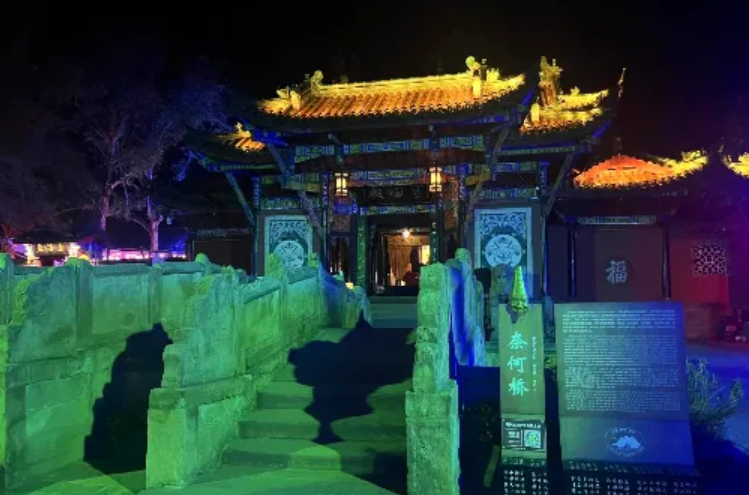
Bridge of Helplessness (Naihe Bridge)
The Bridge of Helplessness consists of three identical stone arch bridges arranged side by side. The bridge decks are narrow, and many fierce ghosts are sculpted in the Blood River Pool below. Folklore says that good people cross smoothly and steadily, while evil people will find the bridge shaking or even fall into the "Blood River Pool." The bridge is about 6 meters long and 1.5 meters wide. It is a highly symbolic attraction in Fengdu Ghost City and a must-visit spot for tourists.
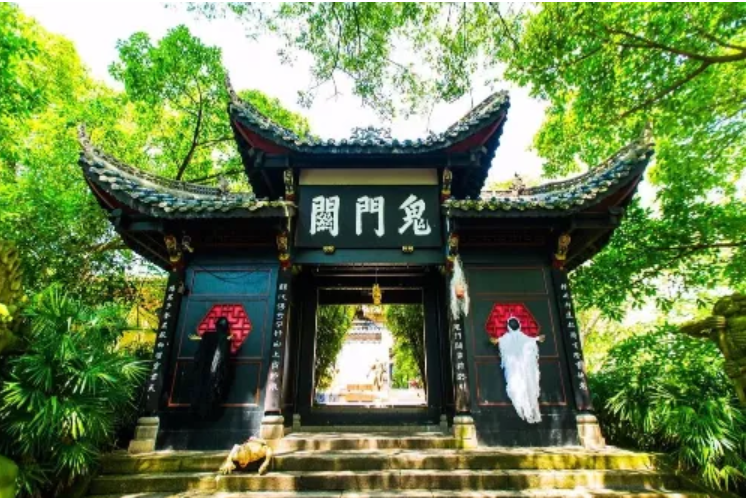
Ghost Gate (Guimen Guan)
The Ghost Gate is an ancient-style pavilion with four upturned eaves. The pitch-black mountain gate is wide and empty, exuding a sense of antiquity. A blood-rust horizontal plaque bears the terrifying words "Ghost Gate." According to legend, after death, one must pass through the Ghost Gate to enter the underworld. Its architectural style is grim and fearsome, inspiring awe in visitors.
Tianzi Hall (Hall of the Heavenly King)
Tianzi Hall is the core building of the Ghost City, covering an area of 2,431 square meters. It consists of a memorial archway, a mountain gate, and the main hall. Inside, there are statues of the six divisions of the underworld, the ten Yama kings, the four great judges, and scenes of the eighteen levels of hell—vivid, solemn, and intimidating. Here, visitors can gain insight into ancient people's imagination and construction of the underworld judicial system.
Yellow Springs Road (Huangquan Lu)
Yellow Springs Road is a bluestone-paved path about 100 meters long and 2 meters wide, with an uneven surface. Ancient trees line both sides, and the winding path is accompanied by the rustling of pines and eerie wailing sounds, creating a grim atmosphere that simulates the legendary route to the underworld after death.
Home-Viewing Terrace (Wangxiang Tai)
The Home-Viewing Terrace is about 20 meters high, with a semi-circular plan and two levels. Surrounded by carved stone balustrades and paved with blue bricks, it is said that the deceased must climb this terrace to take one last look at their homeland and family. From the top, visitors can enjoy a panoramic view of the Yangtze River.
Mengpo Village
Located beside the Bridge of Helplessness, Mengpo Village is a distinctive building based on the folklore of "Mengpo's Soup." Inside, there is a statue of Mengpo holding a ladle, with a calm expression, as if offering the soup that makes one forget past lives to passing spirits. The village is simply and quaintly furnished, with murals depicting scenes of "drinking to forget," complementing the Bridge of Helplessness and the River of Forgetfulness, vividly presenting a key link in the legendary cycle of reincarnation.
Jade Emperor Hall
The hall enshrines a 7-meter-tall statue of the Jade Emperor, the largest statue on Mount Ming. The Jade Emperor governs all heavenly gods, earthly spirits, and human ghosts, and controls the three realms, ten directions, four forms of life, and six paths of reincarnation. The hall also features statues of the Queen Mother of the West, Lord Laozi, and other deities.
Suggested Tour Route:
Upon entering the scenic area, visitors can first visit the Bridge of Helplessness to appreciate its cultural symbolism; then proceed along Yellow Springs Road to experience the eerie atmosphere; continue to the Ghost Gate to admire the mysterious ancient architecture; head to Tianzi Hall for an in-depth understanding of underworld culture; and finally ascend the Home-Viewing Terrace to overlook the Yangtze River. During the tour, you may stop for photos at various attractions according to personal interest. The entire tour takes about 2–3 hours.
Travel Tips:
It is recommended to learn about the historical and cultural background of Fengdu Ghost City in advance, by reading materials or watching documentaries, so as to better appreciate the significance of the sites during your visit.
Some scenes in the area are quite eerie; visitors who are easily frightened or traveling with children should prepare mentally in advance, or choose to visit during the earlier hours of the day.
In summer, take sun protection and heatstroke prevention measures; in winter, keep warm. There are many steps within the area, so wearing comfortable sports shoes is advisable.
For local food, head to regular restaurants or snack streets in Fengdu county town to ensure food safety and enjoy authentic flavors.
Since there are many "ghost culture" sites, some of which may be spooky, parents with children should provide proper guidance beforehand.
Important Notes:
Respect the religious and cultural customs within the scenic area; do not behave inappropriately toward statues, buildings, etc., or make improper comments.
Protect the environment; do not spit, litter, or carve graffiti on ancient structures.
Pay attention to safety during the tour, especially on stairs and in dimly lit areas; walk carefully to avoid falls.
There may be staff dressed as ghosts or gods interacting with visitors. If you do not enjoy such interactions, you may politely decline to avoid conflict.
When buying souvenirs, choose reputable shops, ask about prices in advance, and avoid unnecessary disputes.
Transportation:
By air: Visitors can first arrive at Chongqing Jiangbei International Airport. From the airport's long-distance bus center, take a coach to Fengdu (about 3 hours); or take Metro Line 3 to Chongqing North Railway Station, then transfer to a high-speed train to Fengdu Station (about 1.5 hours), and then take a taxi or bus to the scenic area.
By train: After arriving at Fengdu Station by high-speed rail or bullet train, take Bus No. 109 or 112 directly to the scenic area, or take a taxi (about 15 minutes).
By car: Use a navigation app to input "Fengdu Ghost City" and follow the G50 Shanghai–Chongqing Expressway or other routes. The scenic area has a parking lot for convenient parking.
Opening Hours:
Fengdu Ghost City is open year-round. Summer (April 1 – October 31): 08:00–18:00; Winter (November 1 – March 31): 08:30–17:30.
Ticket Price:
The admission ticket is 90 RMB per person. Students, seniors, and other eligible groups may enjoy half-price or other discounts according to relevant policies. For specific discount information, please check the official channels of the scenic area.