Located at No. 32 Mingshan Road, Dunhuang City, Jiuquan, Gansu Province, Dunhuang Museum is a National Second-Class Museum and an important comprehensive cultural landmark and public cultural service venue in Dunhuang. The museum focuses on displaying the history and culture of the Dunhuang region, the civilization of the Silk Road, and local folk customs, integrating cultural relic collection, academic research, social education, and cultural exhibition. Covering a total area of approximately 24,000 square meters, with a building area of about 7,500 square meters and an exhibition area of roughly 4,000 square meters, the museum’s architecture blends traditional Dunhuang design elements with modern concepts, presenting a well-ordered and grand layout that serves as a vital window into Dunhuang’s millennia-old civilization.
History and Culture
The development of Dunhuang Museum has always been centered on the regional history of Dunhuang and the culture of the Silk Road. As a key hub on the ancient Silk Road, Dunhuang had been a vital center for cultural and economic exchanges between the Central Plains and the Western Regions since the establishment of the commandery in the Han Dynasty. Through successive dynasties—Han, Wei, Jin, Sui, Tang, Song, Yuan, Ming, and Qing—it accumulated a profound historical and cultural heritage, leaving behind a wealth of precious artifacts and historic sites.
Dunhuang Museum was first established in 1979 as the Dunhuang County Museum. Over time, with urban development and growing cultural preservation needs, it has been continuously upgraded and expanded. Its collection system has been gradually refined, now encompassing more than 10,000 cultural relics, including stoneware, pottery, bronzes, jade, silk, manuscripts, and mural copies, which comprehensively present Dunhuang’s development from prehistoric times to the modern era.
The museum bears the important mission of preserving Dunhuang culture and promoting the spirit of the Silk Road. It serves as a key physical repository for the study of Dunhuang history, Hexi Corridor civilization, and the history of cultural exchanges between China and foreign countries, and is a core platform for disseminating Dunhuang’s history and culture to domestic and international visitors, occupying a significant position in the protection and promotion of Dunhuang’s cultural heritage.
Main Exhibition Areas
Preliminary Hall
The Preliminary Hall is the entrance area of Dunhuang Museum. Its design is simple and dignified, featuring iconic Dunhuang elements such as flying apsaras and a map of the Silk Road as key decorative motifs. The hall also provides museum introductions and wayfinding signage, serving as a transitional space for visitors entering the galleries while offering an initial glimpse into the essence of Dunhuang culture and setting the cultural tone for the visit.
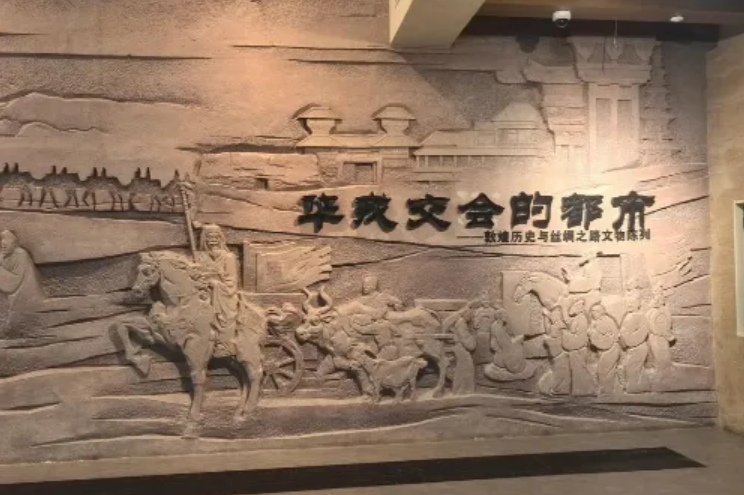
Han Dynasty Gallery
The Han Dynasty Gallery focuses on Dunhuang’s rise as a Silk Road hub following the establishment of Dunhuang Commandery by Emperor Wu of Han. Through exhibits such as Han Dynasty bamboo slips from Xuanquan Post Station, Western Han ink-on-hemp paper, beacon tower relics from the border garrisons, and a diorama of Zhang Qian’s missions to the Western Regions, it systematically presents Dunhuang’s military organization, garrison farming, and prosperous trade during the Han period. It evokes the scene of “envoys and merchants continually traveling along the road” and also attests to the early spread of Buddhism to the region.
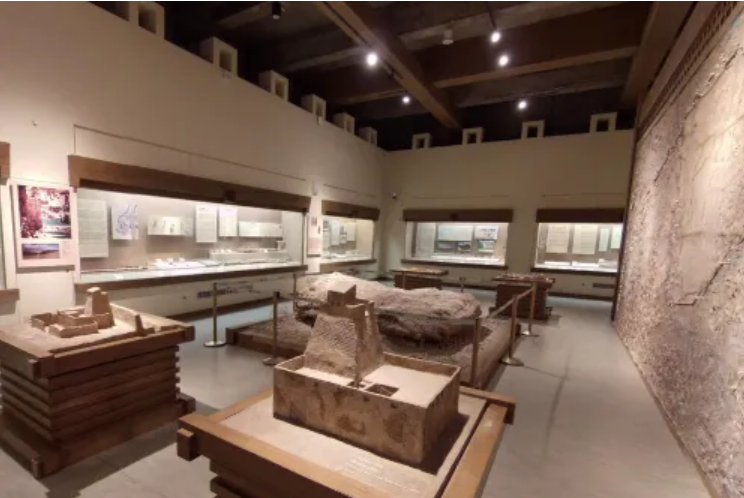
Wei and Jin Dynasties Gallery
The Wei and Jin Dynasties Gallery illustrates Dunhuang’s continued development amid frequent regime changes. Key exhibits include painted portrait bricks from the Foyemiao cemetery, a 1:1 replica of a Western Jin mural tomb, and a Northern Liang stone stupa. The portrait bricks vividly depict scenes of farming, feasting, and travel; the stone stupa integrates Confucian, Buddhist, and Taoist elements; and other artifacts such as tomb guardian jars and bronze crossbow triggers together present a comprehensive picture of ethnic integration and the early development of Buddhist art.
Tang Dynasty Gallery
The Tang Dynasty Gallery is a microcosm of Dunhuang’s golden age. Artifacts such as a pottery figurine of a Sogdian merchant leading a camel, painted pottery tomb guardians, and Tibetan-language manuscripts bear witness to the peak of Silk Road trade and cultural diversity. The gallery’s highlight is a 1:1 replica of Cave 45 of the Mogao Grottoes, faithfully reproducing the artistic charm of the High Tang painted sculptures and flying apsara murals. Through historical documents and displays, it also covers key historical episodes, including Tibetan rule and the return to Tang allegiance led by Zhang Yichao.
Yuan Dynasty Gallery
The Yuan Dynasty Gallery is part of the comprehensive “Tubo–Song, Yuan, and Ming” exhibition area. It focuses on the diverse development of Dunhuang during the Mongol-ruled Yuan period, displaying Yuan Dynasty bronze Buddhist statues, Dunhuang manuscript fragments, Western Xia stele inscriptions, and Yuan porcelain. These exhibits illustrate the flourishing of Buddhism and the coexistence of multiple religions under Mongol rule, as well as Dunhuang’s continued role as a western gateway for transportation and cultural exchange along the later Silk Road.
Suggested Tour Route:
Museum Entrance → Preliminary Hall → Han Dynasty Gallery → Wei and Jin Dynasties Gallery → Tang Dynasty Gallery → Yuan Dynasty Gallery → Cultural and Creative Products Area → Museum Exit
Visiting Tips:
A recommended visit duration is 1.5 to 2 hours. Allocate time appropriately across the galleries, with focused attention on the core historical and mural exhibition areas.
To enhance your experience, consider learning some basic Dunhuang historical knowledge in advance.
Follow the museum’s free guided tours or use the electronic audio guide to gain a comprehensive understanding of the artifacts and exhibition background.
Follow the suggested route in order to avoid missing key exhibition zones and important relics.
After the tour, you may visit the cultural and creative products area to purchase souvenir items with Dunhuang characteristics.
Important Notes:
Do not touch cultural relics, display cases, or exhibits; please comply with all cultural relic protection regulations.
Refrain from loud talking, shouting, or running, and maintain a quiet and orderly environment throughout the museum.
Flash photography is prohibited in the exhibition halls; some areas may prohibit photography entirely—please follow the on-site signage.
Dangerous items such as flammable, explosive, or controlled knives are not allowed inside the museum.
Food and beverages are not permitted in the exhibition halls; please help keep the venue clean and hygienic.
Minors must be accompanied by adults and should follow all museum regulations.
Transportation:
Within the city, take Dunhuang Bus Route 1 or Route 2 and get off at Dunhuang Museum Station.
Taxis and ride-hailing services are readily available within the city and can take you directly to the museum’s main entrance.
Self-driving visitors can navigate to Dunhuang Museum; public parking areas are available near the venue.
Pedestrians can walk from the city center along Mingshan Road, which is a short distance.
Opening Hours:
Dunhuang Museum is open to the public from Tuesday to Sunday and closed on Mondays for maintenance (except for statutory holidays). During summer, opening hours are from 9:00 AM to 6:00 PM, with last admission at 5:30 PM. During winter, opening hours are from 9:00 AM to 5:30 PM, with last admission at 5:00 PM. Opening hours on statutory holidays are subject to official announcements from the museum.
Admission:
Admission is free. Guided tours with a human docent require an additional fee.