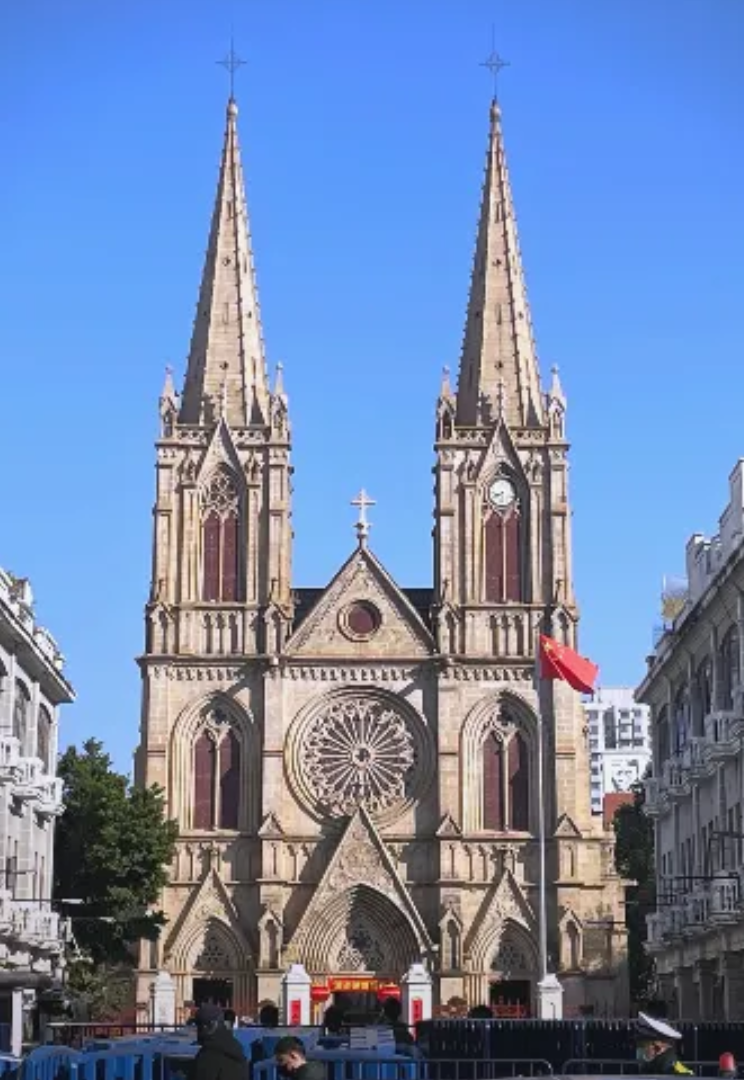
Known locally as the Stone Chamber (Shishi), Guangzhou Sacred Heart Cathedral is located at No. 56, Jiubuqian, Yide Road, Yuexiu District, Guangzhou, Guangdong Province. It serves as the cathedral of the Catholic Diocese of Guangzhou and was listed as a Major Historical and Cultural Site Protected at the National Level in 1996. The cathedral is one of only four fully stone?built Gothic churches in the world and the largest granite Gothic church in Southeast Asia, often referred to as the “Notre?Dame of the Far East.” Facing south, the building follows a Latin cross plan, with a total floor area of 2,754 square metres. It measures 78.69 metres from north to south, 35 metres from east to west, and its twin spires rise to a height of 58.5 metres. The walls and pillars are entirely constructed of granite. Designed by French architects and built by Chinese craftsmen, the foundation was laid in 1863 and the cathedral was officially completed in 1888, after a construction period of 25 years. The architecture combines classic Gothic features with local Lingnan details—for example, the drainage spouts are shaped like traditional Chinese stone lions—making it an important surviving example of modern Sino?Western architectural integration.
History and Culture
The cathedral site was formerly the office of the Governor?General of Guangdong and Guangxi during the Qing dynasty. After the Second Opium War, the French Catholic mission, relying on the unequal treaties imposed on the Qing government, obtained the land to build a church. The foundation stone was laid on 18 June 1863, the Feast of the Sacred Heart, hence the name Sacred Heart Cathedral. During the ceremony, soil brought from Jerusalem and Rome was placed beneath the foundation to carry religious symbolism.
The construction was extremely challenging. Most of the granite was quarried from Ngau Tau Kok in Kowloon, Hong Kong, and transported by water to Guangzhou. Hundreds of Chinese craftsmen quarried, carved and laid the stone by hand. Over the decades, the cathedral suffered repeated damage: parts of the structure were destroyed during the Second Sino?Japanese War, and many sculptures and stained?glass windows were damaged during the Cultural Revolution. In 2004, a major restoration project was launched and completed after two years and four months, restoring the cathedral as closely as possible to its original appearance.
For more than a century, the cathedral has not only been a place of Catholic worship but also a physical witness to Guangzhou’s modern history of foreign exchange. It has stood through the city’s changes since the late Qing period and possesses outstanding architectural, cultural and historical research value.
Main Attractions
Twin Spire Bell Towers
At the front of the cathedral stand a pair of octagonal, hollow, pointed stone spires, reaching a total height of 58.5 metres—the most eye?catching feature of the building. Inside the towers are bell lofts, which originally housed several bronze bells imported from France, though some were lost in later turmoil. The spires are complemented by flying buttresses, pointed arches and small pinnacles, typical Gothic elements that draw the eye upward and create a solemn, soaring visual effect. On the east and west walls, stone inscriptions read “Jerusalem 1863” and “Roma 1863.”
Stained?Glass Rose Windows
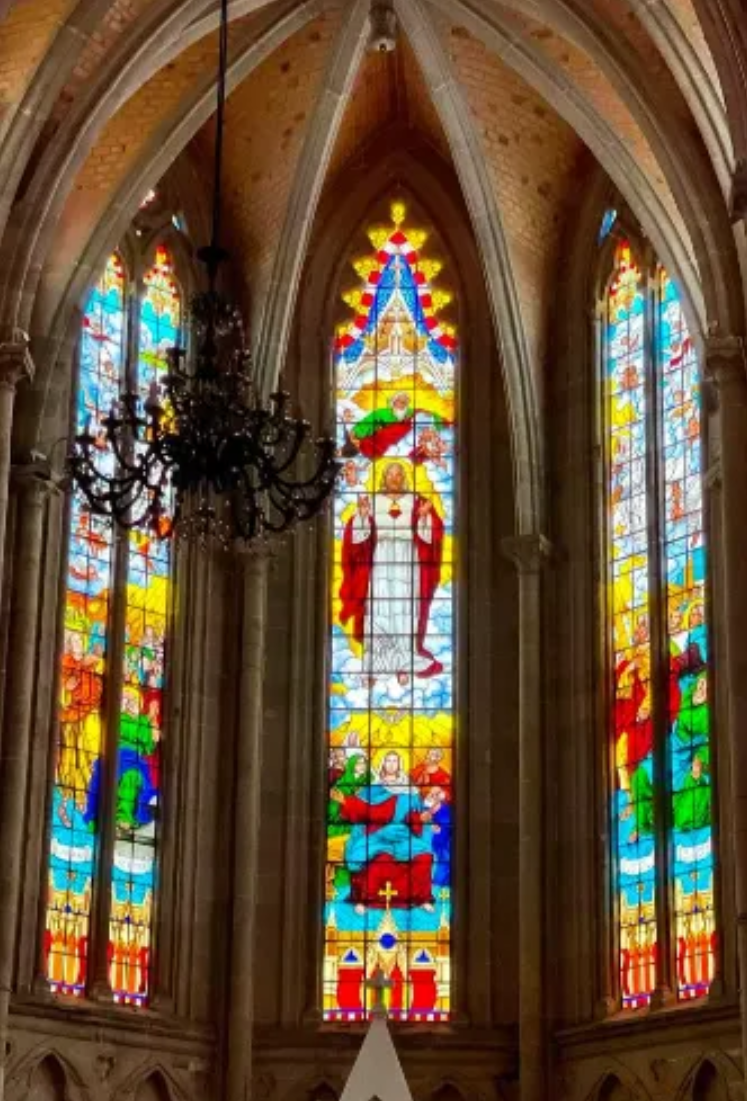
The main fa?ade and the east and west side fa?ades each feature a circular rose window seven metres in diameter, and the cathedral contains more than 600 square metres of stained glass in total. The glass was originally shipped from France, and the panels depict biblical stories and saints. When sunlight streams through the glass, it casts colourful patterns on the floor, softening the interior light and enhancing the serene, sacred atmosphere—a signature feature of Gothic cathedrals. The window mullions are designed in a shape resembling praying hands, symbolising devout prayer.
Main Nave
Inside, the nave is covered by pointed ribbed vaults without transverse beams; the highest point of the ceiling is about 28 metres. On either side, ten giant granite clustered columns guide the eye longitudinally toward the main altar. At the entrance, a large portrait of the Sacred Heart of Jesus hangs above the narthex, and on the second floor is a choir loft that can accommodate more than 100 people for choral services. The nave is furnished with wooden pews, and the main altar at the far end is the focal point for liturgical ceremonies.
Cathedral Square
The square in front of the main entrance offers an open view and is the best spot for taking full?fa?ade photographs of the cathedral. It is enclosed by railings, planted with trees, and provides a resting area for visitors. A stone tablet marking the cathedral as a Major Historical and Cultural Site Protected at the National Level stands in the square.
Suggested Route:
Security check at the entrance → Cathedral Square (exterior photos) → Main entrance narthex → Main nave → Side aisles to view stained?glass windows → Side rose window photo opportunity → Exit.
Visiting Tips:
For the best light on the stained glass, visit on a sunny day between 3:00 PM and 4:00 PM.
Avoid Mondays and the third Sunday of every month, when the cathedral is closed all day.
Weekdays are less crowded than weekends; Tuesday to Friday are recommended for a quieter visit and better photo opportunities.
Allow about 1 to 1.5 hours in total for exterior photography and interior viewing.
After your visit, take a stroll along the Yide Road arcade neighbourhood to experience the old city’s streetscape.
It may be helpful to read up a little on Gothic architecture beforehand so you can better appreciate the details and stone carving.
Precautions:
The cathedral is an active place of worship; dress appropriately. Sleeveless tops, vests, miniskirts, extremely short shorts, ripped shorts and slippers are not permitted. Shoulders and knees must be covered; visitors who do not meet the dress code will not be allowed inside.
Keep your voice down inside the cathedral and set your mobile phone to silent mode. No loud talking, running or horseplay.
Photography is allowed inside, but flash and tripods are strictly prohibited. During Mass, please do not walk around or take photographs.
Do not touch, lean on or climb the stone pillars, doors, windows, stained glass or other cultural relics.
Eating and drinking are not permitted inside, and please do not litter.
If a religious service or Mass is in progress, respect the worshippers’ faith and do not disrupt the ceremony.
Parking near Yide Road is extremely limited, so driving is not recommended.
Transportation:
Metro: Take Line 6 to Yide Road Station, Exit B, and walk about 3–5 minutes; or take Line 2 or Line 6 to Haizhu Square Station, Exit B2, and walk about 10 minutes.
Bus: Take bus routes 8, 61, 86, 823, etc., to Yide Middle Road Stop and walk about 2 minutes.
Car: The surrounding roads are mostly one?way, and parking spaces are scarce; driving is not recommended.
Opening Hours:
Closed all day on Mondays and on the third Sunday of every month.
Tuesday to Friday: 09:00 – 11:00, 15:00 – 17:00
Saturday: 09:00 – 14:30
Sunday: 13:00 – 14:30
During major religious events, opening hours may be adjusted temporarily. It is advisable to check official notices before your visit.
Admission:
Free of charge.