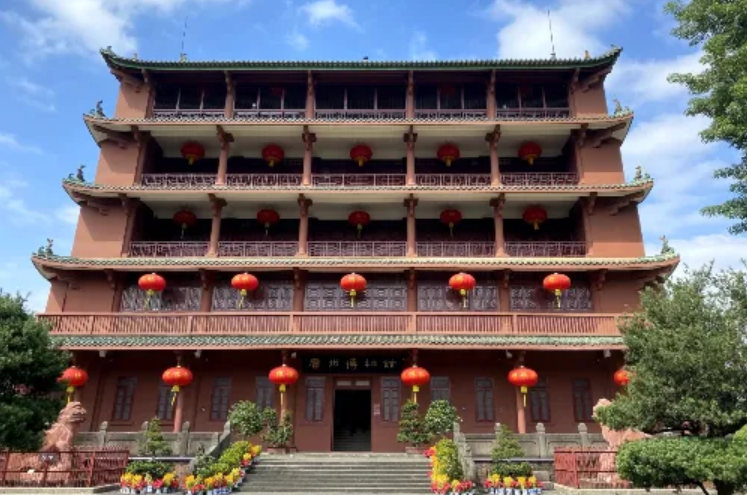
Guangzhou Museum is located at No. 99 Zhenhai Road, Yuexiu District, Guangzhou, within Yuexiu Park. It is a public welfare Class?I institution at the division?level directly under the Guangzhou Municipal Culture, Radio, Television and Tourism Bureau. It has been rated as a national first?grade museum and serves as a patriotic education base at the national, provincial, and municipal levels. It is the earliest comprehensive municipal history museum established in South China. The main exhibition hall is housed in the Zhenhai Tower, a national key cultural relic protection unit. The tower itself has a total floor area of 4,386 m2, while the entire historical site covers 7,600 m2. Built into the terrain of Yuexiu Mountain, the tower stands 28 metres high with five storeys, earning it the local nickname “Five?Storey Building”. The museum complex consists of two core exhibition areas: the Zhenhai Tower Main Exhibition Area and the Zhongyuan Tower Exhibition Area, with two branch venues: the Museum of the Guangzhou People’s Struggle against the British Invaders at Sanyuanli and the Memorial Hall of the Headquarters of the March 29 Uprising. The museum’s distinctive feature is its integration of a historic architectural setting with a chronological display of urban history. Zhenhai Tower has long been listed among the “Eight Sights of Guangzhou”; the building itself possesses both the military watchtower value of the Ming dynasty and the identity of a city landmark. Its collections systematically trace Guangzhou’s urban development over more than 6,000 years, totalling about 135,000 sets of objects, including 119 first?grade, 477 second?grade, and 2,082 third?grade cultural relics—2,693 sets of precious relics in total. It is a core institution for researching, presenting, and disseminating Guangzhou’s local history, maritime trade culture, and Lingnan folk customs.
History and Culture
The physical foundation of Guangzhou Museum—Zhenhai Tower—was first built in the 13th year of the Hongwu reign of the Ming dynasty (1380) by Marquis Zhu Liangzu when he expanded the northern city wall of Guangzhou. Initially used as a defensive watchtower, it was historically also called Wanghai Tower (“Sea?Viewing Tower”). It underwent numerous repairs and reconstructions during the Ming and Qing dynasties and long served as the tallest landmark on the northern side of Guangzhou. With its commanding panoramic views, it has been repeatedly included in the “Eight Sights of Guangzhou” and has witnessed over six centuries of urban development, commerce, and coastal defence from the Ming and Qing periods to modern times.
The modern museum system began in 1928, when the Guangzhou municipal government restored Zhenhai Tower and prepared to establish the Guangzhou Municipal Museum. It officially opened on 11 February 1929, making it one of the earliest public museums founded in modern China. In its early years, it gathered a group of文史 scholars such as Xie Yingbo and Gu Jiegang, with the original mission of enlightening the public and preserving Lingnan cultural relics, playing a pioneering role in the development of cultural heritage in South China. From 1941 to 1945 it was renamed the Guangzhou Municipal Library and Museum; from 1946 to 1949 it was called the Guangzhou Municipal Museum; and in 1950 it was officially named Guangzhou Museum, a name that has been used ever since.
After the founding of the People’s Republic of China, the museum continued its work in collecting, archaeological collation, and academic research. Through donations, archaeological excavations, transfers and exchanges, private acquisitions, and other channels, it has enriched its collections with important items such as Qin?Han bronzes, export porcelain, pith paper watercolours, Canton enamel and ivory carvings, and modern urban photographs. It has also compiled and published several scholarly works, including Han Tombs in Guangzhou and Treasures of Maritime Trade. Over more than 90 years, the museum has grown from a single hall in Zhenhai Tower into a multi?site museum cluster, undertaking the functions of collection preservation, exhibition, academic research, and public education. It preserves a complete material record of Guangzhou’s history—from the ancient Baiyue period, Qin?Han city foundation, Tang?Song trade, the Thirteen Hongs of the Qing dynasty, and modern urban transformation.
Major Attractions
Zhenhai Tower
Zhenhai Tower is the main building of Guangzhou Museum. It is a five?storey pavilion?style structure with red walls, green glazed tiles, and a brick?and?wood frame. The tower stands 28 metres high, with its first?floor base built upon the surviving Ming?dynasty city wall. In front of the tower are historical objects such as Qing?dynasty iron cannons and stone lions. Each floor has an external viewing gallery; from the top, visitors can enjoy a panoramic view of Yuexiu Park and the core area of the old city of Guangzhou. The plaques, bracket sets, and roof tiles retain the traditional Lingnan official building style after Ming?Qing restorations. The tower itself is not only an exhibition hall but also a precious Ming?dynasty architectural relic. Inscriptions by past literati can be seen on the exterior walls, giving it great value for architectural history and cultural appreciation.
“City Landmark, City History” Permanent Exhibition Hall
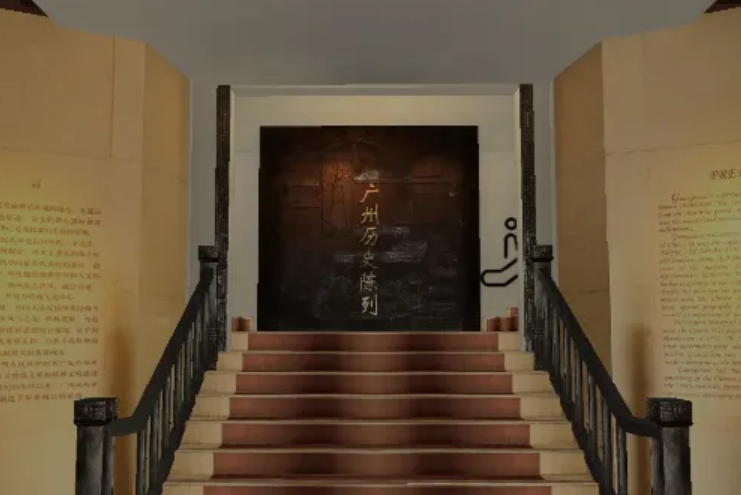
This exhibition is distributed across the first to fifth floors of Zhenhai Tower, arranged chronologically. The first floor displays cultural remains from the ancient Baiyue period of the pre?Qin era; the second floor presents artefacts from the Qin?Han to the Six Dynasties, covering the establishment of Guangzhou as a prefecture and its role as an early maritime port; the third floor exhibits materials on port commerce and urban construction from the Sui?Tang to the Song?Yuan period; the fourth floor shows the foreign trade system of the Thirteen Hongs in the Ming?Qing period and urban folk artefacts; and the fifth floor displays materials on modern revolutionary developments and urban modernisation. With nearly 1,000 excavated objects, old photographs, and documents, the exhibition fully traces the entire trajectory of Guangzhou’s origins, administrative changes, commercial rise and fall, and cultural evolution over more than 6,000 years—it is the core experience of a visit to Guangzhou Museum.
Zhongyuan Tower Exhibition Area
Located to the east of Zhenhai Tower, Zhongyuan Tower was built in memory of the revolutionary martyr Deng Zhongyuan and features a modern architectural style blending Chinese and Western elements. This area is open free of charge and houses the permanent special exhibition Treasures of Maritime Trade – Export Artworks from Guangzhou (18th to Early 20th Century), which displays export armorial porcelain, Canton ivory carvings, export oil paintings, silk textiles, and other maritime silk?road export items. It also includes a gallery on geological history and the evolution of life, displaying fossils and mineral specimens to supplement natural history content.
Xijin Pavilion
Situated on the east side of the main Zhenhai Tower building, Xijin Pavilion serves as a temporary exhibition venue. It regularly hosts short?term special exhibitions on various themes, such as Cantonese crafts, paintings and calligraphy, and maritime silk?road artefacts, enriching the museum’s exhibition programme and supplementing the limited number of items on permanent display.
Ming Dynasty City Wall Remains
Adjacent to the base of Zhenhai Tower, these are among the few surviving sections of the Ming?dynasty city wall in Guangzhou. Built of red?sandstone ashlar, they were constructed at the same time as Zhenhai Tower as part of the northern city wall. They vividly demonstrate the construction techniques and defensive layout of the early Ming city. Visitors can view them up close free of charge, making them a tangible resource for understanding Guangzhou’s ancient urban layout.
Suggested Tour Route:
Main entrance of Yuexiu Park → Ming dynasty city wall remains → Zhenhai Tower plaza (view cannons and stone lions) → First to fifth floors of Zhenhai Tower (visit the “City Landmark, City History” exhibition) → Xijin Pavilion temporary exhibition hall → Zhongyuan Tower (Maritime Trade gallery Geological Evolution gallery) → Museum cultural and creative service area → Exit via Yuexiu Park downhill path.
Visit Tips:
Allow 2 to 2.5 hours for the full visit. The stairs inside Zhenhai Tower are steep and narrow, so take your time and do not rush through the historical exhibits.
It is advisable to visit on weekdays; weekends and public holidays tend to be crowded, which may affect your viewing experience.
Follow the chronological order from the first floor upward—this helps you better understand Guangzhou’s urban development.
Check the official WeChat public account before your visit for information on current temporary exhibitions and decide whether to include Xijin Pavilion.
For the best view from Zhenhai Tower, choose a sunny day for clear visibility of the old city’s central axis.
You can also combine the visit with a stroll along the woodland trails of Yuexiu Park, which are lush and green—perfect for a short rest after the museum.
Important Notes:
The museum is closed on Mondays for routine maintenance, except on national statutory holidays. During the summer period (11 July – 30 August), opening hours are extended to 18:00; at other times, ticket checking and admission stop at 17:30. Please arrive in time.
Tickets for the Zhenhai Tower exhibition area must be reserved and purchased in advance via the official WeChat public account; there is no on?site ticket window. Bring your valid ID card for verification.
Photography with flash, selfie sticks, or tripods is prohibited inside the exhibition halls. Do not touch display cases, artefacts, or building walls. Eating, drinking, running, or making noise inside the halls is forbidden.
The internal staircases of Zhenhai Tower are steep and narrow; elderly visitors and children must be accompanied by family members. High?heeled shoes are not recommended for the entire site.
Luggage storage is limited; please travel light. Drinking water is allowed only in outdoor rest areas—no food or drink inside the exhibition halls.
Pets, flammable/explosive items, and controlled weapons are not allowed. All visitors must undergo security checks.
Children under 6, seniors over 65, active?duty military personnel, veterans, and disabled visitors with valid certificates are entitled to free admission to the Zhenhai Tower area. Please carry your relevant credentials.
Do not deface the walls or ancient structures; climbing the city wall, railings, or other architectural features is strictly prohibited.
Transportation:
By Metro: Take Guangzhou Metro Line 2 to Yuexiu Park Station, Exit B2, then walk into the main entrance of Yuexiu Park and follow the signs for about 5–8 minutes to the museum. Alternatively, get off at Memorial Hall Station, Exit C, and walk 300 metres to the west gate of Yuexiu Park.
By Bus to the Main Gate: Take buses 24, 87, 103, 104, 108, 109, 110, 182, 284, or 543 to Yuexiu Park bus stop, then enter through the main gate.
By Bus to the West Gate: Take buses 33, 203, or 211 to Jiefang Beilu bus stop, then walk 200 metres to the west gate.
By Bus to the East Gate: Take buses 6, 10, 36, 66, 184, 191, 219, or 544 to Xiaobei Huayuan bus stop, then enter through the east gate.
Driving: There are no public parking spaces inside Yuexiu Park; parking in the surrounding old city area is extremely limited. Public transport is strongly recommended.
Opening Hours:
The Zhenhai Tower and Zhongyuan Tower exhibition areas are closed on Mondays (except national holidays). From Tuesday to Sunday, they are open from 9:00 to 17:30, with last admission/ticket check at 17:00. During the summer extension period (11 July – 30 August), hours are 9:00 to 18:00, with last admission at 17:30.
The branch venues (Sanyuanli Anti?British Struggle Museum and March 29 Uprising Memorial Hall) follow the same schedule: closed on Mondays, open Tuesday to Sunday from 9:00 to 18:00.
All venues are open on national statutory holidays (Spring Festival, National Day, etc.), and the Monday closure rule does not apply.
Tickets:
Zhenhai Tower exhibition area: 10 RMB/person (guided tours require an additional fee).
Zhongyuan Tower exhibition area: free admission.