Chimelong Bird Paradise is located at No. 183, Xingbian Street, Dabin Village, Dashi Subdistrict, Panyu District, Guangzhou, Guangdong Province. It is part of the 5A?rated Guangzhou Chimelong Tourist Resort and is one of China’s leading original?ecology wetland bird theme parks, as well as a national?level forestry and grassland science popularization base. The park covers an area of about 2,000 mu (approx. 133 hectares). Its architecture is planned with low density, built upon the original natural wetland landforms. The main structures include water areas, wetland vegetation, bird?watching boardwalks, performance venues, animal exhibits, and science education halls. Man?made buildings account for less than 10% of the total park area, preserving the native wetland ecosystem to the greatest extent possible. The park is home to more than 300 species and over 10,000 rare birds and wetland animals from around the world. It boasts the world’s largest captive?bred flamingo population, and one of South China’s largest breeding groups of crested ibises and pelican colonies. Its core features include an open?range bird observation model, original?ecology live bird flight performances, an immersive boat tour through the wetlands, and systematic wetland biology education. Unlike traditional caged zoos, it creates a natural, immersive experience for visitors to get close to wild birds. The park is divided into seven functional zones: science education, central performance and interaction, animal habitat display, leisure and commercial services, and ecological recreation, balancing tourism, species conservation, and science education.
History and Culture
Chimelong Bird Paradise was originally Guangzhou Crocodile Park, built by Chimelong Group and officially opened on May 28, 2004. In its early years, it focused on crocodile breeding, display, and educational tours, and was one of China’s earliest large?scale crocodile?themed parks. Wetland environments were developed alongside, and various waterbirds and amphibians were gradually introduced to enrich the species collection. Over more than a decade, the park continuously improved its wetland ecology, expanded its bird populations, and established professional bird care, breeding, and rescue systems. The share of bird?related operations increased year by year, and the wetland’s ecological value became increasingly prominent.
On July 1, 2016, Chimelong Group officially renamed Guangzhou Crocodile Park as Chimelong Bird Paradise and updated its brand identity. The park’s operational focus shifted fully to rare bird conservation, display, and wetland ecotourism, with a new positioning as a top?tier integrated facility for bird protection, scientific research, breeding, and public exhibition in China. This filled a gap in the domestic industry for large?scale native wetland live bird shows. After the rebranding, the park continuously upgraded its facilities, including a professional bird breeding center, standardized science lecture halls, an upgraded “Birds in Flight” performance venue, and optimized boat tour routes. The conservation team has persistently worked on breeding rare bird species, achieving stable breeding of endangered and rare species such as crested ibises and flamingos, with more than 1,500 chicks born each year, forming a mature species conservation system.
Culturally, the park uses its wetland resources to offer public?interest nature science education and research activities for primary/secondary schools and social groups year?round, building a platform for wetland ecology awareness. At the same time, its original?ecology live bird performances have created a distinctive cultural tourism IP, making it an important hub for wetland nature education in the Pearl River Delta region. The park also collaborates with domestic and international bird research institutions on long?term scientific projects, sharing expertise in artificial breeding of rare birds, and carries both recreational value and social significance for biodiversity conservation.
Major Attractions
Birds in Flight Show Area
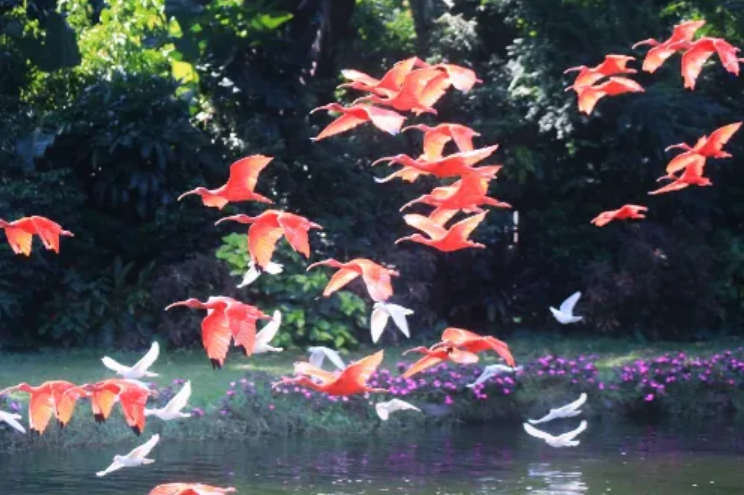
This is the park’s signature core attraction and performance venue, built around a wide open circular natural lake. It is one of the few large?scale wetland sites in the world for live, collective bird flight displays. At fixed daily showtimes, dozens of species—including flamingos, white spoonbills, pelicans, and various herons—are released to fly low over the lake and around islets, replicating natural migratory flight behavior. The venue features stepped open?air terraced seating with unobstructed views, making it the prime spot for watching mass bird flights. Regular showtimes are 11:30 and 15:30, with additional shows on weekends depending on visitor numbers.
Flamingo Island
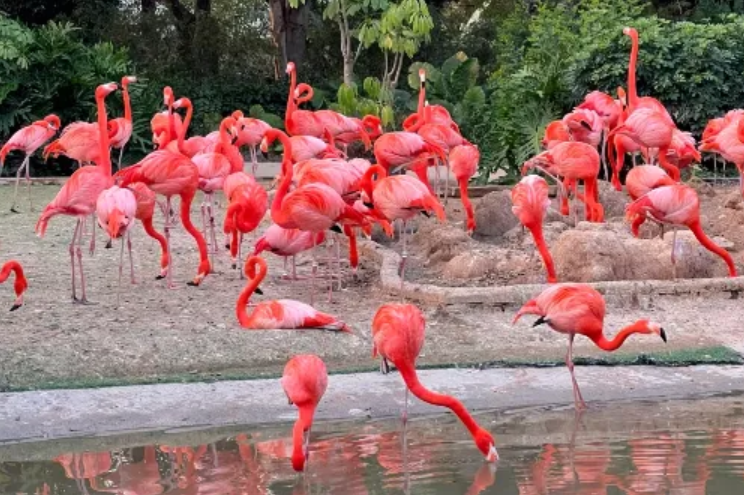
Located in the central wetland waters, Flamingo Island houses the largest captive flamingo colony in China. The area is landscaped with shallow water, mudflats, and herbaceous vegetation to create a natural habitat, where flocks of pink flamingos feed and rest, offering a highly distinctive visual spectacle. A pedestrian boardwalk and designated feeding points allow visitors to observe flamingo behavior up close. The park regularly offers “Little Keeper” experience sessions to educate visitors about flamingo breeding and habits. It is one of the most popular photo?taking spots.
Pelican Bay
Pelican Bay is one of South China’s largest display areas for great white pelicans. Winding water?level boardwalks are built along branching waterways, allowing visitors to closely watch pelicans swimming, fishing, and preening. Official feeding stations sell approved food for pelican feeding, and the boat tour route passes through the area, providing both water? and land?based viewing perspectives. The large water area meets the pelicans’ need for extensive swimming activity.
Boat Exploration of the Hidden Wetlands
This is an immersive water tour that navigates through multiple private wetland channels across the park. The route covers several independent bird islands, with lush naturally?grown vegetation along the banks. Along the way, visitors can see over 30 species and nearly 1,000 free?ranging waterbirds. Each boat carries a guide who explains the species and behaviors encountered. The boat tour reaches native bird habitats that are inaccessible by foot, offering an in?depth experience of the wetland landscape. This attraction requires a separate paid ticket inside the park.
Hippo Zone
This is the same venue featured in the popular TV show Dad, Where Are We Going?. It includes a large outdoor hippo pool housing several adult hippos, with a safe, fenced feeding platform where visitors can purchase pumpkins, carrots, and other ingredients to feed the hippos and watch them eat and play in the water. Scheduled keeper talks cover hippo care, and sometimes hippo care demonstrations are open to the public, combining viewing with educational content.
Crane Bay
Located near the entrance on the left, Crane Bay covers several hundred mu and is built on the natural alluvial plain wetlands of the Pearl River Delta. It is planted with native Lingnan wetland vegetation and is home to six rare crane species, including red?crowned cranes, black?necked cranes, grey cranes, and white?naped cranes, along with associated waterbirds such as black swans, egrets, and pochards. The area is quiet and ecologically pristine; cranes are most active at dawn and dusk, making it an ideal spot for observing their natural behavior in a peaceful setting.
Scarlet Ibis Square
Adjacent to the rainforest area near the entrance, Scarlet Ibis Square is a dedicated exhibit for American scarlet ibises, known for their bright red plumage and nickname “red dancers.” The exhibit includes pools and low shrubs that replicate their native habitat, with gentle walking paths. It is the first viewing point upon entering the park, great for photography, and has designated close?viewing areas.
Wonderful Elves Pavilion
This is an indoor, climate?controlled hall showcasing a variety of amphibians and reptiles, including golden pythons, various lizards, tree frogs, and chameleons. All are displayed in ecologically simulated enclosures that recreate their natural environments. The pavilion features educational panels and provides scheduled keeper talks. It is not affected by outdoor weather, making it a great indoor retreat during hot summer afternoons and a place to learn about herpetofauna.
Bird Breeding Center
Opened to the public in 2020, this is a research and educational facility equipped with professional incubation and monitoring equipment. Visitors can watch the entire process of egg hatching and chick development through viewing windows, with keepers giving regular talks. It vividly demonstrates the artificial breeding process for rare birds and offers strong educational value, especially for families with children.
Suggested Route:
Pick up a map and show schedule at the entrance → Scarlet Ibis Square → Crane Bay → Wonderful Elves Pavilion → Birds in Flight Show (watch the performance) → Flamingo Island → Pelican Bay (take the boat tour) → Hippo Zone → Bird Breeding Center → Animal interaction areas → Exit.
Visitor Tips:
Allow 4–6 hours for a full visit. Plan your route around performance times, and prioritize the free fixed?time shows such as Birds in Flight and Wetland Elves.
Arrive at the Birds in Flight venue at least 20 minutes early to secure a good seat; front?row waterside spots offer the best views and photo opportunities.
Only purchase official feed from designated outlets inside the park; do not bring your own food to feed animals.
In summer, enter early in the morning; during peak heat at midday, cool off at the Wonderful Elves Pavilion or park restaurants, and avoid prolonged outdoor walking in direct sun.
Strollers are available for rent; the park is mostly flat and stroller?friendly throughout.
Wear light?colored clothing and bring a telephoto lens camera for the best shots at Flamingo Island and Scarlet Ibis Square.
For a deeper wetland experience, take the boat tour—combining water and land routes gives you access to more pristine wetland areas that cannot be reached on foot.
Important Notes:
The park stops ticket checking at 17:00 daily. Even though the park closes at 18:00, late arrivals will not be admitted, so plan your arrival time accordingly.
The wetland has dense greenery and many mosquitoes; bring insect repellent and sun protection (hats, sunscreen).
Do not feed, chase, or disturb birds or other animals; do not climb over boardwalk railings or fences to avoid safety risks.
During the boat tour, remain seated, do not lean out, and do not throw anything into the water; follow all safety instructions from the boat crew.
Discounted tickets require valid ID (e.g., ID card, senior citizen card, household registration booklet) for on?site verification.
There are many water areas; supervise children closely and keep them away from unprotected water edges to prevent drowning.
Performance schedules may change due to weather or animal conditions; be sure to pick up the current daily schedule at the entrance.
Skateboards, hoverboards, large suitcases, and bulky luggage are not allowed in the游览 areas; large items can be stored in lockers at the entrance.
Transportation:
Metro: Take Guangzhou Metro Line 2 to Huijiang Station, Exit C, then transfer to the park’s free shuttle bus (runs about every 10 minutes; travel time 3–10 minutes to the main gate). Guests staying at Chimelong Resort hotels can use the resort?wide free shuttle service to reach the park.
Self?driving: Navigate to the main gate parking lot; open 8:00–23:00, with ample parking spaces.
Public bus: Take bus番187 or 番185 to Huijiangcunwei stop, then walk a short distance to the free shuttle pick?up point.
Taxi/ride?hailing: Set your destination to the main gate of Chimelong Bird Paradise; taxis and ride?hailing cars can drop you off directly at the ticket checkpoint.
Opening Hours:
The park is normally open daily from 9:30 to 18:00, with last ticket check at 17:00. Visitors who have already entered may stay until closing. The main operating hours remain largely the same throughout the year, but performance and lecture schedules vary between weekdays and weekends depending on the season (April–June, July–August summer holiday, September–March). On public holidays, some areas may have extended hours based on crowd levels. All real?time operational updates are subject to on?site announcements. The park is open year?round with no fixed closure days, except in cases of extreme weather (heavy rain, typhoons) when outdoor shows may be suspended or the park may close temporarily—notifications will be issued through official channels.
Tickets:
Ticket price: 100 RMB per person.