The Nanyue King Museum (Palace Exhibition Area) is located at No. 316 Zhongshan Fourth Road, Yuexiu District, Guangzhou, Guangdong Province, with its west gate connecting to No. 374 Beijing Road, in the heart of the Beijing Road commercial district. It is an archaeological site museum built around the Nanyue Kingdom Palace Site, a Major Historical and Cultural Site Protected at the National Level. Affiliated with the Nanyue King Museum, it is a National First-Class Museum. The exhibition area covers a total of 3.7 hectares, with supporting buildings totaling nearly 10,000 square meters in floor space. All exterior walls are constructed with hand-split red sandstone panels, giving the buildings a simple and dignified style that integrates modern exhibition halls with the millennium-old archaeological site for integrated protection and display. The core feature of the exhibition area is the in-situ display of multi-layered ancient capital ruins, with intact stratigraphic layers preserving remains from 12 historical periods, including the Qin, Nanyue Kingdom, Han, Jin, Tang, Southern Han, Song, Yuan, Ming, Qing, and the Republic of China. It is a rare millennium-old palace site in the heart of a Chinese city. The exhibition area consists of four main exhibition halls: the Nanyue Garden Hall, the Southern Han Palace Hall, the Exhibition Building, and the Ancient Well Hall. Its permanent core exhibition, "Two Thousand Years as the Center of Lingnan," fully presents the developmental trajectory of Guangzhou as the political center of Lingnan for over two millennia. Among these, the Nanyue Kingdom Meandering Stream and Stone Channel ruins are the oldest and best-preserved surviving Qin-Han royal stone garden water features in China. The excavations of 1995 and 1997 were both selected among China's Top Ten Archaeological Discoveries of the Year.
History and Culture
In 203 BC, Zhao Tuo established the Nanyue Kingdom with its capital at Panyu. The current Palace Exhibition Area covers the core area of the Nanyue King's palace and imperial garden, which existed until the fall of the Nanyue Kingdom in 111 BC. Archaeological excavations have confirmed the presence of complete royal facilities here, including Nanyue Kingdom Palace No. 1 and No. 2, a large stone-built pool, a meandering stream and stone channel, palace corridors, and royal wells. The foundation of Palace No. 1 measures 30.2 meters east-west by 14.4 meters north-south, covering an area of 434.88 square meters; the connecting palace corridor is 5.94 meters wide and 44.05 meters long; the large stone-built pool covers approximately 4,000 square meters, and the excavated meandering stream and stone channel stretches approximately 150 meters, completely recreating the garden construction techniques of the Lingnan royal court two thousand years ago. A pottery lid fragment inscribed with "Huayin Palace" was unearthed at Palace No. 2, directly attesting to the specific name of the palace. The stone slabs of the pool walls bear the earliest carved stone characters in Lingnan, such as "Fan" and "Zi." A large number of "Longevity" wadang (roof-end tiles), large printed floor tiles, stone railings, stone columns, and other palatial architectural components have been unearthed, bearing witness to the fusion of Central Plains ritual systems and local Lingnan craftsmanship during the Nanyue Kingdom.
After the fall of the Nanyue Kingdom, the site continued to serve as the administrative seat of successive governments of Panyu and Guangzhou—whether as commandery, county, prefecture, or provincial capital—from the Han dynasty onward, accumulating layer upon layer of architectural remains, wells, and domestic artifacts from different dynasties. During the Five Dynasties and Ten Kingdoms period, the Southern Han regime established its capital in Guangzhou and turned this site into the Southern Han royal palace. The complete foundation of Southern Han Palace No. 2 has been excavated, along with associated courtyards, corridors, and drainage systems. In the same stratigraphic layer, 83 Southern Han period wells were unearthed, confirming that this place remained the supreme political center of Lingnan. A total of 113 wells from various historical periods have been excavated and cleared at the site, spanning from the Nanyue Kingdom to the Republic of China, fully recording the history of Guangzhou's urban water supply over two millennia. The layered stratigraphy reads like a three-dimensional chronicle, visually demonstrating Guangzhou's uninterrupted urban development. In September 2021, the former Nanyue King Palace Museum and the Western Han Nanyue King Museum were integrated to form the Nanyue King Museum, and the former Nanyue King Palace Museum was officially renamed the Nanyue King Museum (Palace Exhibition Area) and opened to the public.
In 1995, the remains of the Nanyue Kingdom stone-built pool were discovered during urban infrastructure construction and were named one of China's Top Ten Archaeological Discoveries of the Year that same year. In 1997, the complete excavation of the meandering stream and stone channel garden ruins was again selected among China's Top Ten Archaeological Discoveries of the Year. In 1996, the Nanyue Kingdom Palace Site was designated a Major Historical and Cultural Site Protected at the National Level by the State Council. After 2000, systematic archaeological work continued, fully revealing the core remains of the Nanyue Kingdom palace and the Southern Han palace. In 2010, the Nanyue King Palace Museum partially opened to the public. In 2021, it was integrated into the Nanyue King Museum, completing a comprehensive upgrade of the exhibition halls and forming an integrated site museum display system combining in-situ preservation, on-site display, and artifact exhibition. In 2021, the Nanyue Kingdom Palace Site was selected among the "Top 100 Archaeological Discoveries of the Century."
Main Attractions
Nanyue Garden Hall
The Nanyue Garden Hall is the core exhibition hall of the area, built directly over the complete remains of the Nanyue Kingdom's imperial garden. The first floor displays the approximately 4,000-square-meter stone-built pool and the roughly 150-meter-long meandering stream and stone channel in their original location. The pool is paved with ice-patterned, tightly fitted sandstone slabs on a slope, and the stone channel retains landscape features such as stacked stones, stepping stones, flat bridges, and wooden underwater troughs. Artifacts unearthed from the pool include stone columns, stone door lintels, and wooden boat oars, recreating the scene of the Nanyue royal family boating in the garden. The second floor features a supplementary thematic exhibition displaying wadang tiles, stone inscriptions, and architectural components unearthed from the garden, accompanied by multimedia projections that restore the full view of the garden's water features two thousand years ago. This is the only exhibition hall in China where visitors can view the original site of a Qin-Han royal stone garden at close range.
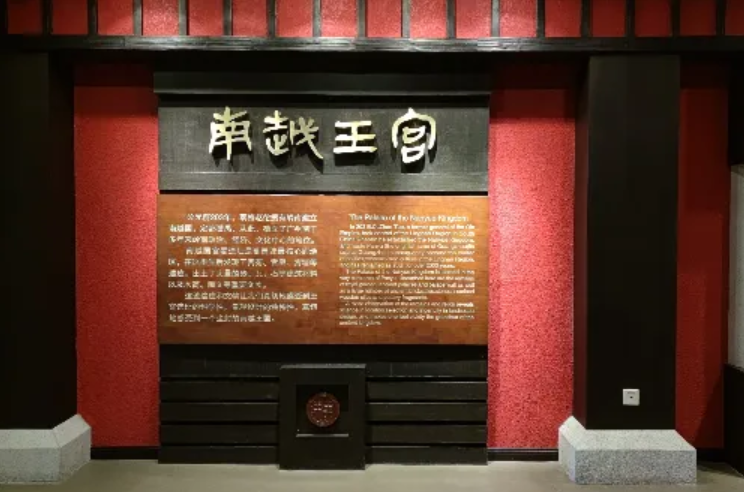
Southern Han Palace Hall
The Southern Han Palace Hall fully preserves and displays the foundation of Palace No. 2 of the Five Dynasties Southern Han kingdom. The hall preserves the complete first main hall, central courtyard, and rammed-earth terrace foundations of the side corridors, along with visible Southern Han brick drainage channels, gutter grooves, and column base pits. In the hall, 83 Southern Han period wells are displayed in situ, with their well rings and brick-and-stone shafts intact, directly demonstrating the Southern Han palace's water supply system. The hall features a layered archaeological section display wall that clearly distinguishes the multi-layered cultural accumulations of the Nanyue Kingdom, Tang, Southern Han, and Song dynasties, vividly illustrating the characteristics of the millennium-old stratigraphic overlay.
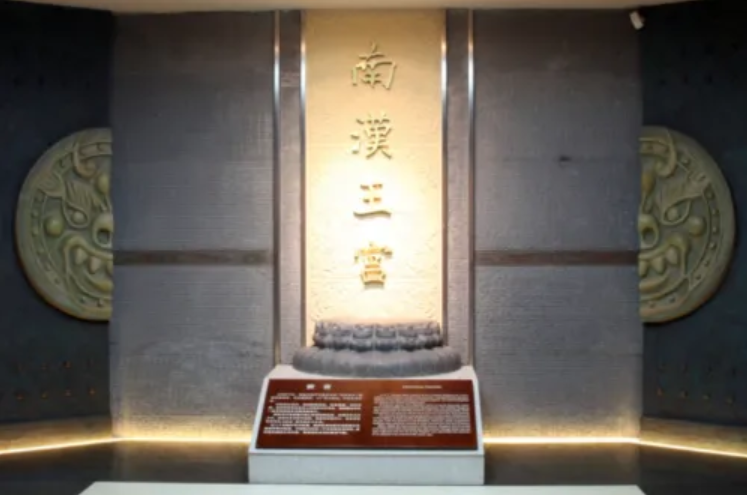
Exhibition Building
The Exhibition Building has three floors and houses four permanent thematic exhibitions. On the south side of the first floor is the "Nanyue King Palace" exhibition hall, displaying architectural components, pottery, stone inscriptions, and daily utensils unearthed from the Nanyue Kingdom palace. On the south side of the third floor is the "Southern Han King Palace" exhibition hall, showcasing Southern Han palace artifacts, tiles, and well-related objects. The north side of the second floor and the north side of the third floor feature the "Famous City Guangzhou: Two Thousand Years" exhibition, tracing the urban transformation of Guangzhou from the Qin-Han period to modern times. The north side also includes a special exhibition area titled "Remembering the Source: Guangzhou's Ancient Well Culture," displaying artifacts unearthed from wells of various dynasties. On the third floor, interactive digital installations allow visitors to simulate the reconstruction of the Nanyue King Palace online. There is also a souvenir sales area offering replica crafts of Nanyue and Southern Han artifacts.
Ancient Well Hall
The Ancient Well Hall is an open-air, semi-open exhibition space that centrally displays well remains from the Nanyue Kingdom to the Republic of China, with dozens of ancient wells from various periods on display. Among them is a Tang-dynasty giant brick-and-stone well with a diameter of 1.2 meters, on whose inner walls clear water-level marks from a thousand years ago remain. The wells are categorized by type, including earth wells, brick wells, tile wells, and stone wells, supplemented with illustrated panels explaining the evolution of water extraction, purification, and storage techniques in ancient Guangzhou. The Ancient Well Hall is only open on Saturdays and Sundays and remains closed on weekdays.
Suggested Route:
East Gate (316 Zhongshan Fourth Road) → Nanyue Garden Hall, first floor (Meandering Stream and Stone Channel ruins) → Nanyue Garden Hall, second floor (auxiliary exhibition hall) → Outdoor garden walkway → Southern Han Palace Hall → Exhibition Building, first floor (Nanyue King Palace exhibition) → Exhibition Building, second and third floors (comprehensive exhibitions) → Ancient Well Hall (open on weekends) → West Gate (374 Beijing Road)
Visiting Tips:
Allow 2 to 3 hours for a complete visit; a tour of only the core exhibition halls can be shortened to 1.5 hours. For a combined visit with the Tomb Exhibition Area, allow 4 to 5 hours total; the two areas are about 2 kilometers apart.
A free fixed-time guided tour is available daily at 9:30, limited to 20 people per session, with no reservation required. Visitors may wait at the Nanyue Garden Hall service desk 10 minutes in advance. Alternatively, a free online audio guide is available via the museum's official WeChat public account.
Weekends and public holidays see heavy visitor flow; it is recommended to enter right after the 9:00 AM opening to avoid the peak hours of 2:00–4:00 PM.
The exhibition area features stone-paved and rammed-earth site paths, with considerable walking distance throughout. Comfortable, non-slip flat shoes are recommended. Wheelchairs are available for free rental for the elderly and visitors with limited mobility.
After the visit, you can walk 3 minutes from the West Gate directly to Beijing Road Pedestrian Street, combining the museum visit with a tour of the historic commercial district.
Visitors accompanied by minors may go to the digital interactive area on the third floor of the Exhibition Building, where interactive installations provide an intuitive understanding of the Nanyue King Palace's architectural layout.
Important Notices:
Admission is free but requires real-name reservation in advance, 1 to 3 days ahead, through the official "Nanyue King Museum" WeChat public account. Entry is limited by time slots, ticket checking stops at 5:00 PM, and entry is not permitted without a reservation.
The use of flash photography and video recording is prohibited in the exhibition halls and site areas. Stepping on rammed-earth ruins, touching unearthed artifacts, or touching original architectural components is strictly forbidden.
Eating, drinking, and consuming beverages are prohibited inside the exhibition halls and site display areas. Drinking water is only permitted briefly in the outdoor public lawn areas.
The exhibition area is closed every Monday for regular maintenance, except on national statutory holidays. During summer and winter vacations and statutory holidays, the closing time is extended to 6:00 PM, with last entry at 5:30 PM.
Large luggage and backpacks can be checked in for free at the East Gate service desk. Strollers, reading glasses, and canes are available for free rental. Sign-language guided services require a telephone reservation 7 days in advance.
Flammable and explosive items, sharp objects, skateboards, balance bikes, and similar items are prohibited. Pets are not allowed.
Commercial photography, live streaming, and unauthorized group activities such as research tours or team-building events are not permitted inside the museum.
Transportation:
Metro: Take Guangzhou Metro Line 1 or Line 2 to Gongyuanqian Station, Exit F, and walk 3 minutes to the East Gate. Alternatively, take Line 1 to Nongjiangsuo Station, Exit D, and walk 5 minutes to the East Gate.
Bus: Take a bus to Caijiang Station or Zhongshan Fifth Road Station and walk 2 to 4 minutes to the East Gate.
Driving: There is no dedicated parking lot inside the exhibition area. Visitors may park at the Sun Yat-sen Memorial Hall public parking lot and walk 10 minutes to the exhibition area.
Opening Hours:
The Nanyue King Museum (Palace Exhibition Area) is regularly open from Tuesday to Sunday, 9:00 AM to 5:30 PM, with last admission at 5:00 PM. It is closed every Monday for maintenance. During national statutory holidays such as the Spring Festival and National Day, it remains open on Mondays. During July–August (summer and winter vacations) and statutory holidays, the closing time is extended to 6:00 PM, with last admission extended to 5:30 PM. Any temporary changes to the schedule will be announced in advance via the museum's official WeChat public account. The Ancient Well Hall is only open on Saturdays and Sundays and remains closed on weekdays.
Admission:
Admission is free. Guided tours require a fee.