Chongqing Two Rivers Cruise is located along the riverside areas of Yuzhong District, Jiangbei District, and Nan'an District in Chongqing. It unfolds along the Yangtze River and Jialing River—the city's two mother rivers—and is one of Chongqing's most iconic urban tourism名片, as well as a core project showcasing the city's mountainous-riverside urban landscape. As a signature tourism product developed by Chongqing, it connects multiple riverside attractions, including several national 4A- and 5A-rated scenic areas and related national-level scenic spots. The core navigable waters cover the Yangtze River section from Chaotianmen to Jiulongpo District and the Jialing River section from Chaotianmen to Ciqikou, with the entire riverside landscape belt covering approximately 50 square kilometres. Its defining feature is the perfect integration of the city's three-dimensional mountainous terrain with the dynamic waterscape of the river city. Visitors can take boats to admire the staggered modern skyscrapers, historic architectural clusters, brilliantly lit night views, and the unique bridge clusters along both banks, creating a stunning picture of "water flowing through the city, and the city reflected in the water." Along the riverside, there are nearly 20 cross-river bridges of various styles, including landmark structures such as Chongqing Yangtze River Bridge and Qiansimen Jialing River Bridge. Among them, the Qiansimen Jialing River Bridge has a main span of 878 metres and a deck width of 36.2 metres, serving both road and rail transit; the Chaotianmen Yangtze River Bridge has a main span of 552 metres and was the world's largest arch bridge at the time of its completion. Also along the river are famous landmarks like Hongyadong and the Grand Theatre. Hongyadong has a floor area of 46,000 square metres, spans 11 levels, and is built into the hillside, showcasing distinctive Bayu traditional architectural style.
History and Culture
The historical roots of the Chongqing Two Rivers Cruise lie in the profound influence of the Yangtze and Jialing rivers on the city's development. Chaotianmen, the confluence of the two rivers, has been an important water?and?land port since the Ming and Qing dynasties, serving as a hub for goods distribution and passenger travel. Merchant ships and fishing boats gathered here, gradually giving rise to a unique dock culture that laid the geographical and cultural foundation for the later cruise tourism. In modern times, with Chongqing's opening as a treaty port and urban expansion, factories, warehouses, and residential areas were built along the river, and bridge construction followed. In 1980, the Chongqing Yangtze River Bridge was completed and opened to traffic, becoming the first large?scale highway bridge on the upper Yangtze and greatly boosting cross?river transport and tourism.
In the 1990s, Chongqing began exploring river?based tourism, initially with small sightseeing boats for short excursions. After 2000, as the city adopted the "Mountainous and Riverside Metropolis" urban positioning, the Two Rivers Cruise gradually became standardised and scaled up, with upgraded vessels and optimised routes. After 2010, with the completion of landmarks such as Hongyadong and the Grand Theatre and the improvement of night lighting projects, the cruise became a core attraction for showcasing Chongqing's night scenery. In addition, the cruise carries the function of spreading Bayu culture: riverside stilted buildings, dock customs, and Sichuan opera elements are introduced through on?board commentary and shoreline displays, allowing visitors to gain insight into Chongqing's historical heritage. Special events like the annual Yangtze River Economic Belt cultural tourism activities and the Mid?Autumn Festival moon?viewing cruises further enrich the cultural connotations of the Two Rivers Cruise.
Major Attractions
Chaotianmen Square
Located at the confluence of the Jialing River and Yangtze River on the Yuzhong Peninsula in Yuzhong District, Chaotianmen Square is the core departure point for the Two Rivers Cruise, covering about 80,000 square metres. Here, the clear Jialing water and the turbid Yangtze water meet in a striking contrast, forming a unique "Jiamashui" (intermingled waters) scene. In the centre of the square stands a 20?metre?high landmark sculpture of Chaotianmen, symbolising the city's historical status as a water?and?land hub. As a long?standing Chongqing landmark, Chaotianmen was once where officials received imperial edicts and court envoys. Today, it offers visitors an excellent vantage point to overlook the confluence and enjoy river views. It is also one of the main docks for cruise ships, from which tours can conveniently begin.
Hongyadong Folk Custom Scenic Area
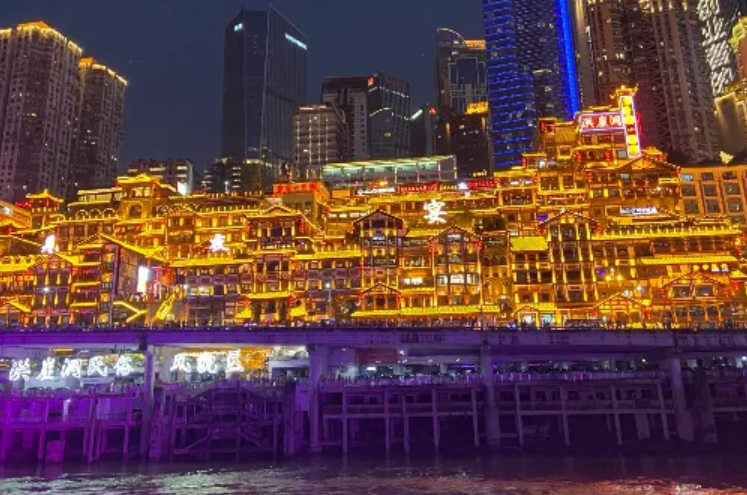
Situated on Jialing River Binjiang Road in Yuzhong District, close to Qiansimen Jialing River Bridge, Hongyadong covers 46,000 square metres and is one of the most visually striking sights along the cruise. The complex is built in the traditional Chongqing stilted?house (diaojiaolou) style, with 11 levels rising layer upon layer, perfectly adapted to the hilly terrain. Hongyadong integrates dining, entertainment, accommodation, and sightseeing, and includes a Bayu folk culture exhibition area showcasing old Chongqing's customs and traditional crafts. At night, when all its lights are lit, the warm yellow illumination outlines the architecture, reflecting in the Jialing River to create a scene reminiscent of Spirited Away—a core highlight of the night cruise.
Chongqing Grand Theatre
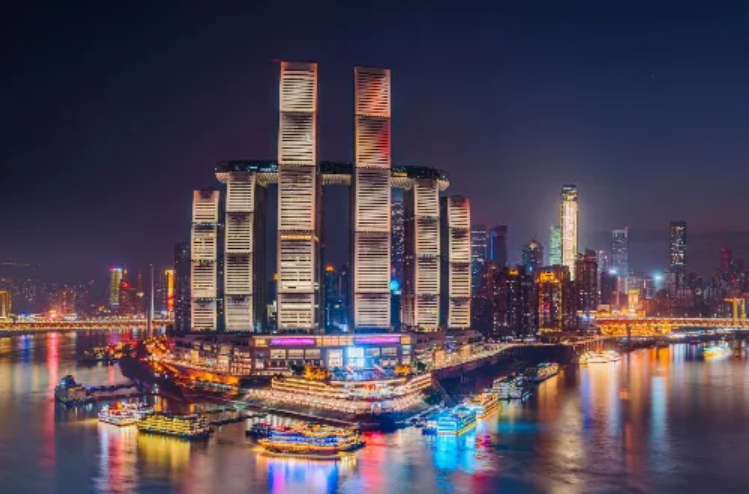
Located on Jiangbeizui Binjiang Road in Jiangbei District, facing the Jialing River, the Grand Theatre has a total floor area of 103,307 square metres and a height of 64.8 metres. Its exterior features an irregular geometric design with light?blue glass curtain walls, resembling a giant ship ready to set sail, harmonising with the surrounding river and bridge views. As an important cultural landmark, it houses a main theatre, a medium?sized theatre, and rehearsal rooms, accommodating nearly 3,000 spectators, and hosts high?level performances such as opera, ballet, and symphony. From the cruise, the modern architectural style of the Grand Theatre contrasts sharply with the opposite Hongyadong—stately and minimalist by day, and more dynamic under night lights, representing Chongqing's contemporary cultural landscape.
Qiansimen Jialing River Bridge
Connecting Yuzhong District and Jiangbei District, this bridge is an indispensable sight along the cruise. Its main span is 878 metres, with a main span of 312 metres and a deck width of 36.2 metres; the upper deck carries road traffic, while the lower deck carries Chongqing Rail Transit Line 6. The design incorporates the city's mountain?and?river characteristics, with a single?tower cable?stayed structure that is light and graceful, complementing nearby Hongyadong and the Grand Theatre. At night, the bridge's lighting changes colours over time, casting a brilliant ribbon of light on the Jialing River, making it a highly recognisable feature of the night scene and a popular spot for photography.
Nanbin Road Riverside Scenic Area
Located on the south bank of the Yangtze River in Nan'an District, Nanbin Road stretches about 25 kilometres and is a large?scale riverside landscape belt integrating flood control, urban roads, tourism, and leisure. Along the route are historic and cultural sites such as Ciyun Temple, Danzishi Old Street, and Longmenhao Moon. Danzishi Old Street covers about 120,000 square metres and preserves many ancient buildings from the Ming and Qing dynasties, reflecting Chongqing's post?treaty?port history. The landscaping balances nature and culture, with extensive greenery, multiple viewing platforms, and riverside parks. Passengers on boats can enjoy the staggered historic architecture and modern leisure facilities along the bank, and it also offers an excellent vantage point for viewing the Yuzhong Peninsula nightscape, complementing the opposite side to form a complete two?river night panorama.
Tour Routes:
The mainstream routes for the Chongqing Two Rivers Cruise are daytime and nighttime tours, with the night tour being the most popular. The standard night tour lasts about 60 minutes, starting from Chaotianmen Wharf. The boat first enters the Jialing River, passing Qiansimen Jialing River Bridge, Hongyadong, Chongqing Grand Theatre, Jiangbeizui Financial City, and other attractions, to enjoy the brilliant night views along the Jialing River. It then returns to Chaotianmen and enters the Yangtze River, passing Chaotianmen Yangtze River Bridge, Nanbin Road Riverside Scenic Area, Danzishi Old Street, and finally back to Chaotianmen Wharf. The daytime tour lasts about 90 minutes and extends the Yangtze River segment up to Caiyuanba Yangtze River Bridge, allowing visitors to see architectural details and natural scenery more clearly, such as the hillside landforms along the river and the ecological landscapes of riverside parks. In addition, there is a featured long?distance route of about 120 minutes, which goes upstream from Chaotianmen along the Yangtze to Jiudu Kou near Jiulongpo District, passing Egongyan Yangtze River Bridge and the entrance to Huangge Ancient Path, suitable for visitors with more time who wish to explore the Yangtze riverfront in greater depth.
Travel Tips:
The night cruise is the best choice; it is recommended to choose a departure between 19:30 and 21:00, when the sky is fully dark and all riverside lights are on, providing the best night views. During this period, departures are most frequent, every 15–20 minutes.
Cruises are available on standard boats and luxury boats. Standard tickets are more affordable, while luxury boats offer observation decks, refreshments, and other value?added services. For a better viewing experience, choose a luxury boat. Arrive at the wharf at least 1 hour in advance to exchange tickets and board, so you can secure a good spot on the second?deck observation area.
Spring (March–May) and autumn (September–November) are the most pleasant seasons, with temperatures between 15–28°C and moderate winds on the river. In summer, bring sun protection as UV rays are strong on the water; in winter, bring a thick coat as night winds are stronger and temperatures are 3–5°C lower than in the city.
Bring a compact camera or smartphone; the deck is the best place for night photography. A phone stabiliser is recommended to avoid blurry shots from boat movement.
Learn about the historical and cultural background of the attractions in advance, and combine that with the on?board audio commentary to better appreciate the cultural depth of the cruise. Some boats also offer special performances such as Sichuan opera excerpts—plan your time to enjoy them.
Important Notices:
During the cruise, the deck can be crowded; take care of the elderly and children. Do not climb over the railings (approximately 1.2 metres high). Minors must be accompanied by adults while on deck to prevent the risk of falling into the water.
Flammable, explosive, or controlled knives and other dangerous items are prohibited on board. Passengers must cooperate with security checks during boarding. Fire extinguishers and life?saving equipment are provided on board—do not move or damage them.
Smoking is prohibited on board. Eating and drinking are allowed only in designated areas. Do not litter; keep the cabin and deck clean to help protect the river ecosystem.
During holidays, visitor numbers surge and tickets are in high demand. It is advisable to book tickets 3–5 days in advance through official channels to avoid being sold out or facing long queues.
In case of heavy rain, strong winds, or other severe weather, cruises may be suspended or routes adjusted. Call the scenic area enquiry hotline before departure to confirm sailing conditions and avoid delays. If the boat experiences slight turbulence during navigation, it is normal—remain calm and follow crew instructions.
Transportation:
Bus: Multiple bus routes (112, 120, 141, 372, 414, etc.) go directly to Chaotianmen Wharf Station; after getting off, walk about 50–100 metres to the boarding points. For Nanbin Road viewing platforms, take buses 338, 354, or 375 to Nanbin Road Zhonglou Station.
Rail Transit: Take Rail Transit Line 1 to Xiaoshizi Station, exit from Gate 8, and walk about 1.2 kilometres to Chaotianmen Wharf. Alternatively, take Line 6 to Grand Theatre Station, walk about 800 metres to the Jiangbeizui riverside viewing area, and you can also take a ferry from there to the opposite Chaotianmen Wharf.
Driving: Navigate to "Chaotianmen Square Parking Lot," which has about 800 parking spaces. Charges: 10 CNY for the first 2 hours for small vehicles, and an additional 3 CNY per hour thereafter. Parking is tight during holidays; consider travelling at off?peak times.
Ferry: You can take a ferry from Danzishi Wharf to Chaotianmen Wharf. The fare is 2 CNY per person and the journey takes about 10 minutes, offering a taste of river transport and early views of the river—a unique way to reach the departure point.
Opening Hours:
The Chongqing Two Rivers Cruise operates year?round (except during severe weather), with separate daytime and nighttime sessions.
Daytime: 10:00–16:00, with departures every 2 hours.
Nighttime: 19:00–22:00, with peak departures from 19:30 to 21:00 every 15–20 minutes.
In summer, due to longer daylight, the night session starts earlier at 18:30; in winter, it starts at 19:00. During major holidays such as Chinese New Year and National Day, additional early and late cruises may be added, with the last departure extended to 22:30. Specific schedules are subject to the daily notice at the wharf.
Tickets:
Day tour: from 58 CNY/person
Night tour: from 95 CNY/person