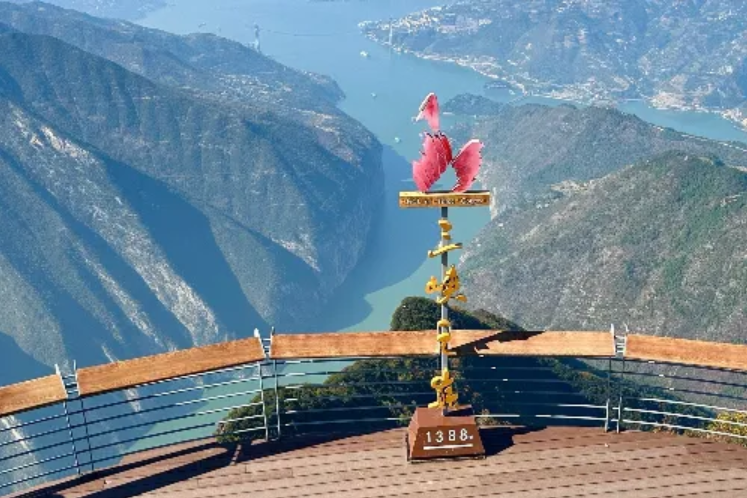
The Summit of the Three Gorges scenic area is located in Kuimen Subdistrict, Fengjie County, Chongqing Municipality. It is a national 4A-level tourist attraction and one of the core landscapes of the Three Gorges of the Yangtze River. Featuring “majesty, ruggedness, peril, and elegance,” the scenic area is built around the main peak of Chijia Mountain on the north bank of Qutang Gorge, with an altitude of 1,388 meters – the highest point of the Three Gorges, hence the name “Summit of the Three Gorges.” The total area is about 4.8 square kilometres, with the core visiting area covering 1.8 square kilometres, encompassing natural landscapes, historical relics, ecological trails, and other functional zones. The area has a complete hiking trail system with a total length of about 6.5 kilometres, along which there are 12 supporting facilities including viewing platforms and rest stops. The core viewing platform, “Summit of the Three Gorges Observation Deck,” covers about 800 square metres and offers a 360?degree panoramic view of Qutang Gorge, the surging Yangtze River, and the full vista of Fengjie County town. It is an excellent spot for viewing the sunrise, sea of clouds, and sunset over the Three Gorges. Vegetation coverage exceeds 90%, with native plants such as Masson pine, cypress, and rhododendron, making the ecological environment outstanding. The area also incorporates Kuimen Pass, ancient plank roads, and poetic cultural elements, making it a tourist destination that perfectly combines natural scenery with human history.
History and Culture
Fengjie County, where the Summit of the Three Gorges is located, was known as “Kuizhou” in ancient times. It is the starting point of the Three Gorges of the Yangtze River and has a history of more than 2,300 years as a city. It is an important cradle of Bayu culture, poetry culture, and Three Kingdoms culture. Human activity traces date back to the Neolithic Age. During the Spring and Autumn and Warring States periods, it was part of the Ba State. In the Qin Dynasty, it was established as Yufu County, and in the Tang Dynasty it was renamed Fengjie, meaning “to uphold the imperial festival.” Throughout history, it has been a military stronghold and transport hub in eastern Sichuan.
The core area, Chijia Mountain, is named for its red?coloured rocks and is a landmark mountain range of Qutang Gorge. It has been a strategic military site since ancient times. During the Three Kingdoms period, after Liu Bei was defeated at Yiling, he retreated to Baidi City (present?day Fengjie). Zhuge Liang set up the Eight?Formation Maze there to defend against enemies. The Kuimen Gate formed by Chijia Mountain and the opposite Baiyan Mountain served as a natural barrier, witnessing countless historical conflicts.
The Summit of the Three Gorges is also an important landmark of Chinese poetry culture. Since the Tang Dynasty, many literary figures – including Li Bai, Du Fu, Bai Juyi, Su Shi, and Lu You – passed through Kuimen and climbed high to gaze into the distance, leaving behind numerous celebrated poems. During his stay in Kuizhou, Du Fu wrote more than 430 poems, including Climbing High and Eight Autumn Meditations. The famous lines “The boundless forest sheds its leaves shower by shower; the endless river rolls its waves hour after hour” were inspired by his ascent of Chijia Mountain. The scenic area still preserves many stone inscriptions and stele records bearing the rich heritage of poetry, and it is honoured as the core viewing site of the “City of Chinese Poetry.”
Major Attractions
Summit of the Three Gorges Observation Deck
This is the core attraction of the area, located at the top of the main peak of Chijia Mountain at an elevation of 1,388 metres. Covering 800 square metres, it is a fully open viewing platform. The platform is constructed with a steel structure and glass walkway design; the glass viewing area, about 150 square metres, extends over the edge of the cliff, offering a striking visual impact. From the deck, visitors can look directly down upon the magnificent “Kuimen, the most majestic pass under heaven,” with the Yangtze River cutting through the gorge and cliffs rising like knife cuts on both sides; the narrowest part is only slightly over 100 metres wide. To the southeast, you can see the full view of Fengjie county town and the ruins of Baidi City; to the west, you can admire the rolling ridges of Chijia Mountain and the sea of clouds. It is the best spot for photographing the panoramic Three Gorges. Around the deck, there is a poetry corridor inscribed with classic verses about the Three Gorges by writers of past dynasties, complementing the natural scenery.
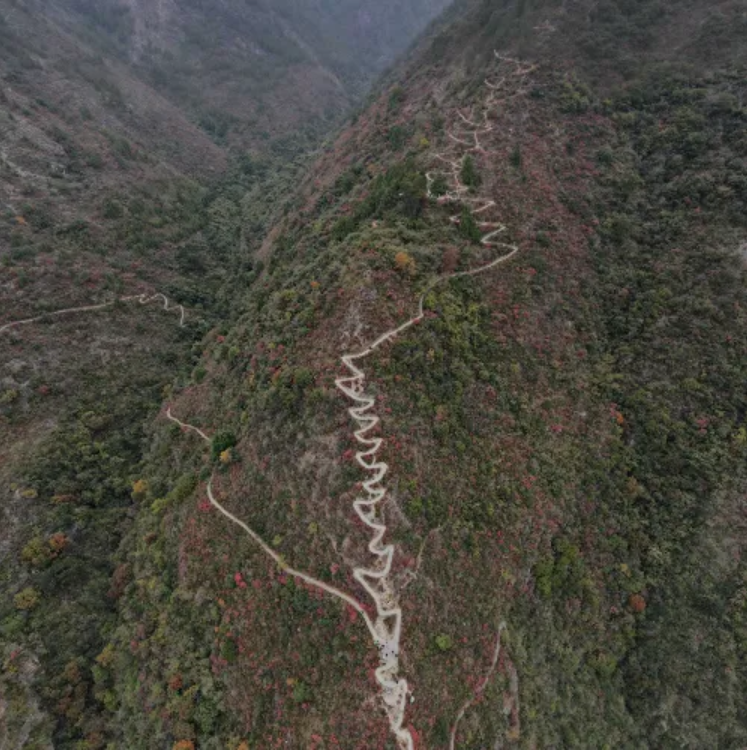
Sixty?six Turns
This is a highly challenging mountain path, steep and winding, with about 66 bends – hence its name. It is the only way for hikers to reach the summit and poses a true test for every hiking enthusiast.
Perilous Rock Bird Path
This is a cliff?side trail combining majesty, ruggedness, peril, and steepness. It allows visitors to experience the most thrilling and direct view of the core grandeur of the Three Gorges.
Tour Routes:
Hiking Route: Baidi City Qutang Gorge Scenic Area → Chijia Tower → 211?metre elevation checkpoint → Monkey Mountain → Xiaodong (Nitrate Cave) → Taozidong (Peach Cave) → Shuijingwan (Well Bay) → Yinlongcao (Hidden Dragon Trough) → Jiguliang (Chicken Bone Ridge) → 520?metre elevation checkpoint → Sixty?six Turns → Qingshan Renjia (Green Mountain Homestead) → 985?metre elevation checkpoint → Perilous Rock Bird Path → 1314?metre elevation checkpoint → Summit of the Three Gorges. Total distance: 10 kilometres, hiking time about 5 hours.
Shuttle Bus Route: Take the park shuttle bus from the Summit of the Three Gorges Visitor Service Point (Lan Yue He) to and from Chijia Square, then walk to the observation deck.
Cable Car Route: Take the cable car from the Summit of the Three Gorges Visitor Centre (Shimiao) to and from Chijia Square, then walk to the observation deck.
Travel Tips:
The best seasons are spring and autumn (March–May and September–November), when the weather is mild, vegetation lush, and the probability of viewing seas of clouds and sunrises is higher. Summer is hot, so take precautions against heat; winter is cold, and some sections may be icy – watch your step.
Before hiking, prepare comfortable hiking shoes, a backpack, sunscreen, a sun hat, drinking water, and some snacks; there are no vendors along certain sections.
The trails are steep, with many steps. It is recommended that seniors over 65, young children, and those with limited physical strength take the shuttle bus to the mid?mountain viewing area and then walk to the summit.
To watch the sunrise, check the weather and sunrise time in advance. It is advisable to set off from the visitor centre at 4:30–5:00 am; hiking to the viewing deck takes about 1.5 hours, allowing you to catch the sunrise (around 5:30 am in summer, 7:00 am in winter).
Mobile phone signal is generally good, but some sections have weak network coverage; it is recommended to download offline maps in advance to avoid getting lost.
Allow half a day to a full day for the visit. If time permits, you can combine it with nearby Baidi City and Qutang Gorge boat cruises to create a complete Three Gorges travel itinerary.
Important Notices:
Smoking and littering are prohibited inside the scenic area. Protect the ecological environment and cultural relics; do not carve or damage cliff inscriptions, stone statues, or any other features.
Follow the park rules during the hike; do not leave the designated trails or enter undeveloped areas to avoid accidents. On narrow sections, yield to other visitors and avoid crowding.
On rainy days or right after rain, be cautious of slippery steps; wear non?slip shoes and consider bringing a trekking pole if necessary.
The altitude is high; some visitors may experience mild altitude sickness. Walk slowly, avoid strenuous exercise, and carry a small supply of common medicines (e.g., cold remedies, motion?sickness pills, band?aids).
The shuttle bus operates from 8:00 am to 5:00 pm, with departures every 30 minutes; the last bus leaves at 5:00 pm. Allow enough time if hiking downhill so you do not miss the last bus.
Respect local customs. There are Tujia and Miao minority communities around the area; abide by local etiquette and do not disturb villagers’ daily life.
There is no accommodation inside the scenic area. Visitors should stay in Fengjie county town, about 15 km away, with convenient transport and various hotels and guesthouses.
Transportation:
Self?driving: From downtown Chongqing, take the G50 Shanghai–Chongqing Expressway for about 4 hours (about 400 km). Exit at Fengjie East Interchange, then follow Kuimen Subdistrict to the Summit of the Three Gorges visitor centre. The road is in good condition. Parking fee: RMB 10 per entry (within 24 hours).
Public transport: Take a high?speed train from Chongqing North Railway Station to Fengjie Station. Outside the station, take the dedicated scenic area shuttle bus – about 30 minutes to the visitor centre. Alternatively, take a bus from Fengjie Bus Station towards Kuimen and get off at the Summit of the Three Gorges stop, then walk 5 minutes to the visitor centre.
Local transport: Fengjie county town is about 15 km from the scenic area; you can take a taxi or hire a car – convenient.
Opening Hours:
Open all year round.
Summer (1 April – 31 October): 7:00 am – 6:00 pm; last entry at 4:00 pm.
Winter (1 November – 31 March the following year): 8:00 am – 5:00 pm; last entry at 3:00 pm.
The shuttle bus service hours match the opening hours; the last bus departs 1 hour before closing. Please plan your entry and visit time accordingly to avoid being stranded.
Ticket Prices:
Hiking route: Ticket return shuttle bus: RMB 40/person; Ticket return cable car: RMB 60/person.
Shuttle bus route: Ticket round?trip shuttle bus: RMB 50/person.
Cable car route: Ticket round?trip cable car: RMB 100/person.