The Longshui Gorge Rift Valley Scenic Area is located in Xiannüshan Town, Wulong District, Chongqing. It is an important part of the Wulong Karst Tourist Area, a national 5A-level scenic spot, and lies adjacent to the Three Natural Bridges, together forming the core landscape of Wulong Karst landforms. The scenic area features typical karst gorge?and?rift topography and is a key component of the UNESCO World Natural Heritage site "South China Karst." The rift valley is about 4 km in total length, with 2.8 km developed for tourism. Its narrowest point is only 1 meter wide, the widest about 15 meters, and it ranges from 200 to 500 meters in depth. The valley floor sits at an elevation of roughly 800 meters, with a maximum relative drop of up to 290 meters between the top and bottom. The area boasts unique geological landscapes, including gorges, rifts, waterfalls, deep pools, and sheer cliffs, with a pristine ecological environment, high forest coverage, and abundant negative oxygen ions. It is a natural?scenery attraction integrating geological research, sightseeing, and leisure.
History and Culture
The Longshui Gorge Rift Valley was formed by hundreds of millions of years of tectonic activity and is a classic product of karst evolution. Over geological time, plate movements, crustal uplift, and water erosion and dissolution caused surface rock layers to fracture and collapse, creating this deep rift. Its geological age dates back to the Permian period of the Paleozoic Era, and the strata contain rich fossil remains and tectonic relics, providing important material evidence for studying the formation and evolution of karst landforms in southern China.
In terms of human history, the Wulong region has a long past, with traces of human activity as early as the Neolithic Age. Local ethnic minorities, such as the Tujia and Miao, have lived in harmony with this unique natural environment for generations, developing a rich folk culture. Although the rift valley itself, as a natural landscape, has no large?scale historical architectural remains, the surrounding area preserves many legends and stories related to these ethnic groups. The local people's reverence for and protection of the natural landscape have helped preserve this geological wonder intact to this day.
Major Attractions
Cliffside Plank Walkway
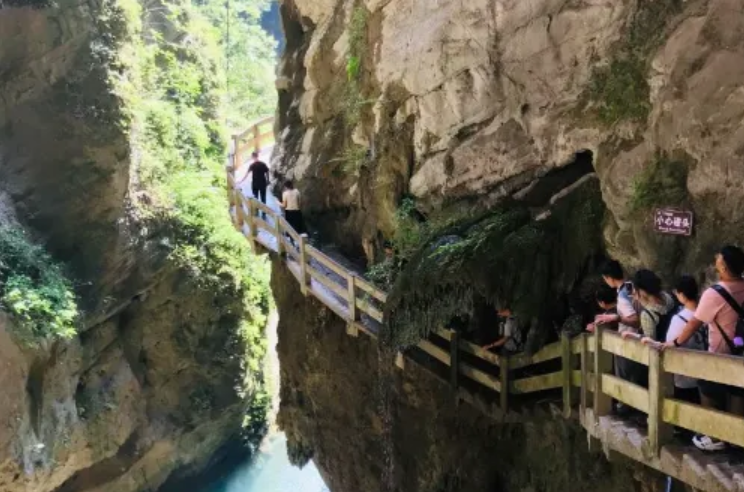
The main route into the valley floor, about 1,500 meters long, built along steep rock faces, with some sections suspended over the cliff, 1.2–1.5 meters wide. It winds down the mountain with roughly 800 steps and a maximum gradient of 60°. Along the walkway, visitors can closely observe the sheer cliffs on both sides, with numerous karst micro?landforms such as dissolution grooves and stone teeth, and spring water seeping from rock cracks to form small water curtains.
Galaxy Waterfal
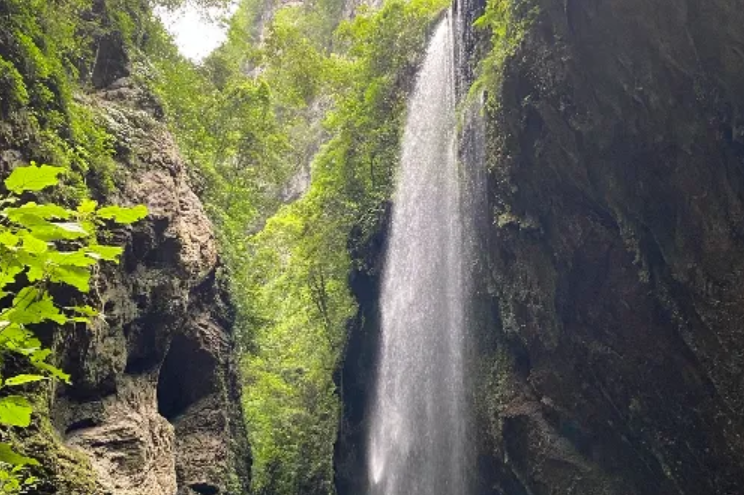
One of the most spectacular water features in the rift, located in the middle section. The waterfall is about 80 meters high and 5–8 meters wide, with water plunging from a natural cave at the top of the cliff into a deep pool below. During the rainy season, the flow is torrential, producing a thunderous roar and mist that often creates rainbows under sunlight.
Jiaolong Cold Cave
The outlet of an ancient underground river formed over hundreds of millions of years as groundwater gradually dissolved rock along fractures, eventually widening into an irregular trumpet?shaped passage. Its height and width range from 60 to 100 meters. Due to crustal uplift and water cutting, it has left a dissolution platform of over 1,000 square meters and a deep gully more than 20 meters deep.
Yunhan Sky Ladder
A winding and steep stairway with over 500 steps. Climbing it and looking back gives the feeling of a ladder reaching straight into the clouds, hence the name "Sky Ladder."
Thread of Sky Light
Located at the narrowest point of the rift, where the cliffs on both sides are nearly vertical and only about 1 meter apart. Looking up, the sky is compressed into a narrow strip of light, thus the name "Thread of Sky Light."
Recommended Tour Route:
Scenic entrance → Cliffside Plank Walkway → Jiaolong Cold Cave → Galaxy Waterfall → Thread of Sky Light → Exit. The route is about 2.8 km in total, with 3 rest areas and 2 restrooms along the way. Visitors can adjust their pace according to their physical condition. The descending walkway has many steps, but there is no need to climb back up; a shuttle bus is available at the exit to return to the starting point.
Travel Tips:
The best seasons are April–May and September–October, when temperatures are pleasant (15–25°C) and rainfall is low, ideal for viewing waterfalls and hiking. Summer is rainy – bring rain gear, as some sections may be slippery. Winter temperatures range from 0–10°C, and the walkway may be icy – watch your step.
The trails are mostly steps and plank walks; wear non?slip athletic shoes, avoid heels or sandals. The entire hike is about 20,000 steps; a trekking pole is recommended.
The rift has high humidity (average over 80%) and limited sunlight; even in summer, bring a light jacket to avoid chills. Mosquitoes are common in the valley – use insect repellent.
No dining facilities inside; eat at the entrance or in Xiannüshan Town beforehand, and carry some water and energy snacks. Keep the environment clean and take your litter with you.
Photographers: bring a wide?angle lens and tripod for panoramic shots and waterfalls. The best light at the Thread of Sky Light is around noon.
Those with limited stamina or elderly visitors can rent portable folding chairs at the entrance; handrails and rest platforms are available on steep sections.
Important Notices:
Smoking and littering are strictly prohibited; fines range from 50 to 200 RMB. Recycling bins are provided – dispose of waste properly.
Some sections of the cliff walkway are narrow and single?file only. Observe the "upward priority" rule, do not push or run, and take care of children and the elderly to prevent accidents.
Near waterfalls and deep pools, do not climb over railings. Swimming in deep water is strictly forbidden – violators bear full responsibility.
Mobile phone signals are weak, and some areas have no coverage. Stay with your group, keep in touch, and pick up a paper map at the entrance.
During thunderstorms, stay away from cliffs, waterfalls, and tall trees; avoid open areas and follow staff instructions to shelter in designated spots.
Entry is single?use per day – re?entry requires a new ticket. Plan your visit accordingly.
Visitors with heart disease, high blood pressure, acrophobia, or other conditions should assess their fitness before entering; some steep sections may cause discomfort.
Transportation:
Public transport: From Chongqing's Sihui Road Transport Hub, take a long?distance bus to Wulong Bus Station, then transfer to a bus to Xiannüshan Town, and finally take the scenic shuttle to the entrance.
Tour buses: Many travel agencies in Chongqing offer one?day or two?day tours to the Wulong Karst area, including admission and round?trip transport, departing around 7–8 am daily – consult local agencies.
Self?driving: From Chongqing, take the G65 Yu?Xiang Expressway to the Wulong interchange, then follow Xiannüshan Avenue to Xiannüshan Town, and follow signs to the parking lot. No private vehicles are allowed inside; visitors walk or take the shuttle.
On?site transport: A shuttle bus connects the entrance and exit; walking round?trip takes about 1 hour.
Opening Hours:
Open year?round, with seasonal adjustments:
Peak season (Apr 1 – Oct 31): 8:00–17:30 (last entry 16:30)
Low season (Nov 1 – Mar 31): 8:30–17:00 (last entry 16:00)
The scenic area may close temporarily during heavy rain, thunderstorms, geological hazards, etc. From December to February, some sections may be partially closed during icy/snowy weather – follow staff guidance.
Admission:
Low season: 85 RMB/person; Peak season: 115 RMB/person.