Shamian Island is located on the banks of the White Swan Lake (Bai'etan) in Liwan District, Guangzhou, Guangdong Province. It is a sandbank formed by alluvial deposits from the Pearl River and was historically known as Shicui Islet. It is a Major Historical and Cultural Site Protected at the National Level, a China Historic and Cultural Street, and a provincial-level tourist and leisure block. The island covers a total area of 0.3 square kilometres (approximately 330 mu) and features a checkerboard street layout of three horizontal and five vertical axes. It retains 169 European-style buildings, including Neo-Baroque, Gothic Revival, arcade-style, Neoclassical, and Sino-Western eclectic designs, of which 54 are listed as Major Historical and Cultural Sites Protected at the National Level. The island has rich vegetation, with over 700 trees, including 137 registered ancient and famous trees, making it one of the areas with the highest density of ancient trees in central Guangzhou. Centred on its century-old concession-era architecture, Shamian is often called an “open-air museum of world architecture.” It integrates modern diplomatic, financial, and trading historical sites, and offers recreational riverside views, artistic photography opportunities, and historical study value. The roads across the island are flat and barrier?free, suitable for walking tours, family outings, and elderly visitors.
History and Culture
Since the Song Dynasty, Shamian Island served as an important foreign trade hub in Lingnan. During the Song, Yuan, and Ming dynasties, it continued to function as a transshipment point for foreign merchants. In the Ming Dynasty, the Huajie Pavilion was established here to manage the entry and exit of overseas merchant ships. In the mid-Qing Dynasty, the government built the Xigu Fort on the island as a riverside military post to defend Guangzhou. During both the First and Second Opium Wars, the fort participated in battles against foreign invasions. In 1963, two Qing?era cannons were unearthed during infrastructure construction on the island.
In 1857, the British and French forces captured Guangzhou, and in 1858 the relevant treaties were signed, selecting Shamian as a settlement area for foreigners. The Shaji Creek was excavated to separate the sandbank from the mainland, turning it into an independent island surrounded by water. The area was divided into the British and French concessions, with 44 acres in the west under British control and 11 acres in the east under French control. On 3 September 1861, China, Britain, and France signed the Shamian Concession Agreement for a term of 99 years, and Shamian officially became a foreign concession enclave. Subsequently, nine countries—including Britain, France, the United States, Germany, Japan, and Russia—set up consulates here, along with nine foreign banks and dozens of trading firms. European-style buildings, roads, embankments, and parks were systematically constructed, creating a complete Western-style town layout.
In 1946, the Shamian Concession was officially returned to Chinese sovereignty. In 1959, Premier Zhou Enlai visited Shamian and explicitly instructed that the original appearance of the historic buildings be preserved intact as tangible testimony to modern China’s foreign relations. In 1996, the Shamian architectural complex was listed by the State Council as a Major Historical and Cultural Site Protected at the National Level; in 2013, it was selected as a China Historic and Cultural Street; and in 2024, it was awarded the title of provincial-level tourist and leisure block. Local authorities continue to carry out building restoration, ancient tree care, and environmental improvement works, balancing heritage protection with tourism development.
Main Attractions
Our Lady of Lourdes Chapel
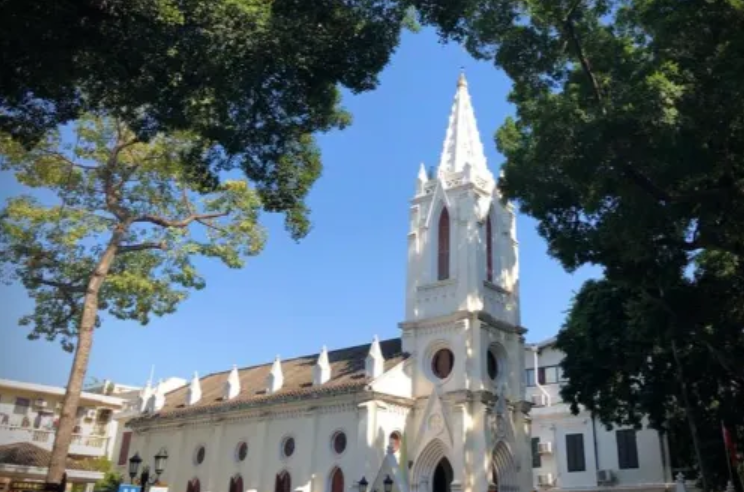
Located at No. 14 Shamian South Street, completed in 1890, this is a typical Gothic Revival building with two stories, a tall spired steeple, and pointed arch windows. The walls are in cream-yellow with reddish?brown window frames. Inside, stained glass windows and a statue of the Virgin Mary are preserved. It is an iconic photo spot on the island. The outdoor area is open all day; the interior may be visited during service times. Visitors should dress appropriately, remain quiet, and refrain from using flash photography inside.
Guangdong Museum of Foreign Affairs (former French Consulate site)
Situated at No. 20 Shamian South Street, built in 1890, this Baroque-style two?storey main building with an annex features curved arcades and carved ornaments on the facade. It served as the French Consulate in Guangzhou. The museum displays modern diplomatic documents, old photographs, artefacts, and other items recording the history of Sino?foreign relations from the late Qing to the Republican period. Admission requires ID registration; it is closed on Mondays and open from 9:00 to 17:00.
Former British Consulate
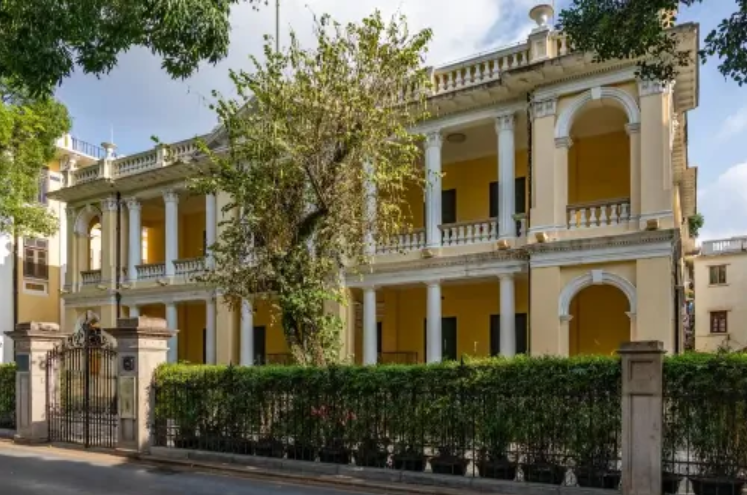
Located at Nos. 44 and 46 Shamian South Street, first built in 1865 and reconstructed in 1923, this eclectic-style building comprises a two?storey main block and two two?storey wings. The facade adopts a three?part composition with continuous arcades on the ground floor and recessed balconies on the second floor, finished with faux?stone washed?terrazzo render. It is the earliest consular building on Shamian. Currently used as office space, it can only be viewed from the outside; entry is not permitted.
Former HSBC Building
At No. 54 Shamian Street, completed in 1918, this Neoclassical financial building stands four storeys high with a symmetrical facade, giant Roman columns, a solid base, and arched windows. It was once the largest foreign bank branch in modern South China. The exterior retains its century-old financial architecture and is open for photography; the interior is not open to the public.
Shamian Christian Church (former Anglican St. Peter's Church)
Address: No. 60 Shamian South Street. Built in 1865, this simple Western?style church has mint?green walls, long arched windows, and no ornate spires, giving it a clean and fresh look. Surrounded by ancient banyan trees, it is a popular spot for artistic photography. The outdoor area is open all day.
Shamian Park
Located at the southern tip of the island, adjacent to the White Swan Lake on the Pearl River, the park covers about 0.06 square kilometres. It features Western?style pavilions, a fountain, scenic walkways, and riverside benches. Along the embankment, visitors can enjoy views of cruise boats, the Renmin Bridge, and the city skyline. It is a prime sunset viewing spot, with ancient banyan trees throughout.
Circular Stone Embankment and Old Wharves
Built in 1859 concurrently with the concession development, the entire embankment is constructed of granite ashlars and includes several old stone wharves for water transport. These historic structures are protected as cultural relics. Walking along the embankment offers a full view of the island’s riverside scenery.
Suggested Routes:
Classic Half?Day Walking Route:
Huangsha Metro Station Exit F → Pedestrian footbridge → West Bridge entrance to Shamian → Instagram?worthy flower wall → Our Lady of Lourdes Chapel → Heart?shaped ancient banyan tree → Starbucks Reserve store → Former HSBC Building → Shamian Christian Church → Guangdong Museum of Foreign Affairs → Shamian Park riverside promenade → East Bridge exit → Cultural Park Metro Station.
In?Depth Historical Study Route:
Cultural Park Metro Station Exit E → East Bridge to Shamian → Guangdong Museum of Foreign Affairs → Former British Consulate → Shamian Street mansion cluster → Former HSBC Building → Our Lady of Lourdes Chapel → Circular stone embankment walkway → White Swan Hotel “Hometown Water” landscape → Shamian Park sunset viewing point → West Bridge exit.
Visiting Tips:
Recommended visit duration: 2.5 to 4 hours. Best visiting times: 9:00–11:00 and 16:00–18:00, when light is soft and crowds are thinner, ideal for architecture and river photography.
Prefer weekdays; on weekends and public holidays, 10:00–16:00 is peak hour with reduced experience quality.
Dress in light?coloured, vintage, or French?style outfits for photo shoots with European architecture. The entire route is paved with stone slabs and has protruding tree roots; wear flat, non?slip shoes and avoid high heels.
Plan your visit in segments: architecture, museums/exhibitions, then riverside park. Take breaks at cafes along the way for refreshments.
Combine with nearby Yongqing Fang and Shangxiajiu Pedestrian Street for a full?day West Guan (Liwan) tour.
In summer, bring a sun hat and portable fan; in spring and autumn, evenings by the river can be breezy, so a light jacket is advisable.
Important Notes:
The island has dense greenery and many mosquitoes; be sure to bring insect repellent spray or cream.
Bicycles and e?bikes (including shared bikes) are prohibited throughout the island. No sightseeing trams are available; all visits are on foot.
All historical buildings are protected cultural relics. Do not climb walls, window sills, or columns, and do not scratch or deface any surfaces.
Some buildings are office spaces or private residences; do not force entry or make loud noise.
Inside churches, tripods and flash are prohibited; avoid sleeveless or revealing clothing and keep quiet.
Convenience stores are scarce on the island; bring your own drinking water and snacks.
Parking is extremely limited; driving is not recommended.
Keep children under close supervision; the embankment has no full?height guardrails—keep away from the water’s edge and avoid running or chasing.
Transportation:
Metro:
Line 1 / Line 6 – Huangsha Station, Exit E or F; cross the footbridge and walk 3 minutes via the West Bridge to enter the island.
Line 6 / Line 8 – Cultural Park Station, Exit D or E; walk 5 minutes via the East Bridge to enter Shamian.
Bus:
Liuliu San Lu Station or Guangzhou Traditional Chinese Medicine Hospital Station: routes 1, 38, 57, 75; walk 5?8 minutes to the island entrances.
Water Bus:
From Tianzi Pier, take a water bus to Xidi Pier; disembark and walk 5 minutes to the Shamian South Street entrance, enjoying river views along the way.
On the Island:
Only walking is permitted. Roads are flat and suitable for strollers and wheelchairs, with good barrier?free access.
Opening Hours:
The outdoor areas, Shamian Park, and the circular embankment are open 24 hours a day, year?round.
Indoor venues have specific hours: Guangdong Museum of Foreign Affairs is open daily 9:00–17:00, closed on Mondays. Our Lady of Lourdes Chapel is open outdoors all day; interior visits are allowed only during service times. Other bank and consulate buildings are exterior?only and have no fixed visiting hours.
Admission:
Free entry. Guided tours in person are available for a fee.