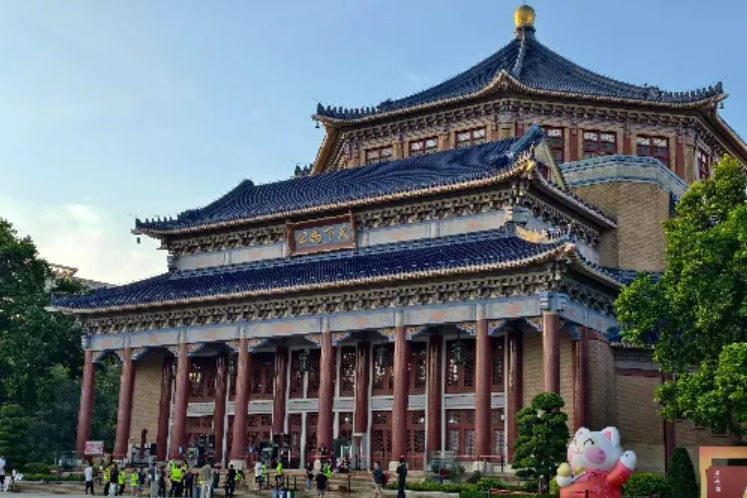
Guangzhou Sun Yat-sen Memorial Hall is located at No. 299 Dongfeng Middle Road, Yuexiu District, Guangzhou, Guangdong Province, at the southern foot of Yuexiu Mountain. The site was originally the Presidential Palace where Sun Yat-sen served as the Extraordinary President of the Republic of China in 1921. The scenic area is rated as a national 4A-level tourist attraction, and has also been designated as a Key National Cultural Relic Protection Unit, a Guangdong Provincial Patriotism Education Base, a Guangzhou Historic Garden, and an Ancient Tree Park. It stands as an iconic modern commemorative building on Guangzhou’s central axis. The entire site covers a total area of 61,000 square metres, with the main building and its surrounding platforms occupying 12,000 square metres. The main building rises to a height of 48.63 metres, with a north?south depth of 72.65 metres and an east?west width of 63.32 metres. The building was designed by the renowned modern architect Lü Yanzhi, combining the external form of a Song?dynasty palace with Western steel trusses and reinforced concrete. The hall features an octagonal pointed roof, covered with sapphire?blue glazed tiles and complemented by vermilion pillars and doors and windows. Internally, it achieves a large?span column?free hall space of 71 metres, with 3,238 fixed seats. The venue serves multiple functions, including historical commemoration, cultural tourism, theatrical performances, and conferences and exhibitions, and it is the largest Sun Yat?sen commemorative hall in China by volume.
History and Culture
The site of the Memorial Hall was originally the office of the Guangdong Military Governor during the Qing dynasty. In May 1921, Sun Yat?sen established the Extraordinary Presidential Office of the Republic of China here and carried out administrative work. In 1922, Chen Jiongming launched a rebellion, and the Presidential Palace buildings were damaged by artillery fire. After Sun Yat?sen’s death in 1925, overseas Chinese and local residents of Guangzhou proposed building a commemorative structure to honour his achievements. In January 1926, the Second National Congress of the Chinese Nationalist Party formally resolved to build the Sun Yat?sen Memorial Hall on the former Presidential Palace site. That same year, the Preparatory Committee launched an international architectural design competition, and Lü Yanzhi’s design was ultimately selected for implementation.
Construction officially began in January 1929 and was completed in October 1931. After its completion, the Memorial Hall witnessed many significant modern historical events. On 16 September 1945, Lieutenant General Tanaka Hisaichi, Commander of the Japanese 23rd Army, signed the instrument of surrender here, marking a symbolic historical site for the victory of the Anti?Japanese War in South China. After 1949, the Memorial Hall long served as a venue for large?scale municipal gatherings, political events, and cultural performances. From the 1950s to 1988, the relevant authorities carried out seven routine maintenance and repair projects. In 1998, a comprehensive renovation costing 60 million yuan was undertaken, replacing the entire audio?visual, seating, fire?protection, and monitoring systems, while also refurbishing the bronze statue pedestal and the surrounding landscape. In 2001, the building was listed among the fifth batch of Key National Cultural Relic Protection Units. In 2021, it was officially designated as an education base for members of the Chinese Revolutionary Committee of the Kuomintang. From July 2023 to July 2024, the largest roof waterproofing and anti?seepage renovation project in nearly three decades was carried out, providing continued systematic protection for the cultural relic itself.
Major Attractions
Main Building of the Memorial Hall
The main building is the core attraction of the scenic area. Its overall plan is a regular octagon, with double?eaved, gable?and?hip (xieshan) wing rooms on all four sides and an octagonal pointed roof with a gilded brass finial at the top. The roof is entirely covered with sapphire?blue glazed tiles. The exterior walls are faced with cream?coloured ceramic tiles, and the base is built of granite and bluestone, with painted cement bracket complexes (dougong) under the eaves. Inside, a steel truss system supports the vaulted ceiling, creating a spacious, column?free hall. Above the main entrance hangs a plaque inscribed with the four characters "Tiānxià wéi gōng" (The World is for the Common Good) in Sun Yat?sen’s own handwriting. On the stage, the Premier’s Will and accompanying couplets are displayed. The hall also features permanent exhibitions on Sun Yat?sen’s historical materials and the construction archives of the Memorial Hall, and regularly hosts concerts, dramas, and other performing arts events.
Sun Yat?sen Bronze Statue
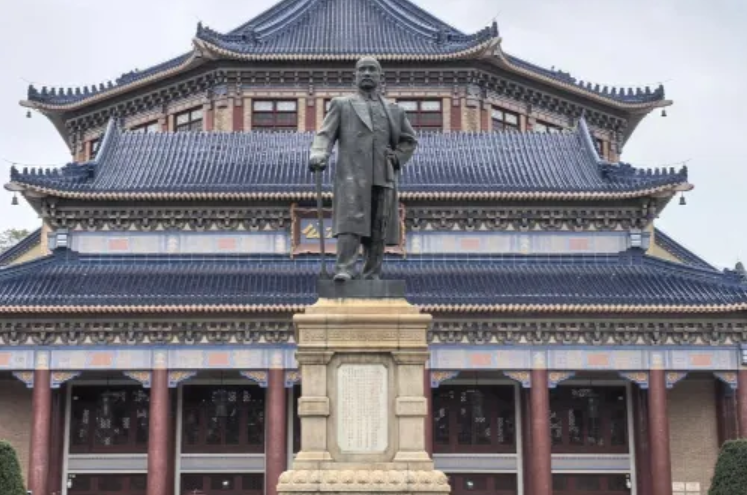
The bronze statue stands at the centre of the central?axis plaza directly in front of the main building. The statue itself is 5.5 metres tall, set on a stone pedestal, presenting a solemn and dignified appearance. It replicates Sun Yat?sen’s classic standing oratorical pose. The original statue was erected shortly after the Memorial Hall was completed; during the 1998 comprehensive renovation, it was replaced with a pure?copper cast version. It is a key spot for visitors to pay respects and take photographs. The central lawn where the statue is located forms the visual centre of the scenic area, creating a fully symmetrical landscape with the main building behind it.
Gate Archway
The gate archway is situated at the southern entrance of the scenic area and forms part of the Memorial Hall’s auxiliary complex. Built of reinforced concrete, its fa?ade features three arched openings, with the central arch higher than the two side arches. The roof combines xieshan and wudian styles, also covered with blue glazed tiles. Above the central arch hangs a horizontal plaque bearing the name "Sun Yat?sen Memorial Hall." The exterior walls are finished with a granite base, making it the first landmark building visitors encounter upon entering the park.
Cloud?Crane Ornamental Pillars (Huabiao)
A pair of Cloud?Crane ornamental pillars stand symmetrically on both sides of the lawn at the southern plaza. The pillars are carved with cloud patterns and crane reliefs in a traditional ceremonial architectural style. They serve both to define the spatial boundary and to convey the people’s reverence for Sun Yat?sen. Together with the bronze statue and the main building, they lie on the same central axis, reinforcing the symmetrical, Chinese?style aesthetic of the entire site.
Ancient Kapok Tree King
The Kapok Tree King grows in the northern area of the scenic site. It is over 300 years old and is registered as a first?class protected ancient tree in Guangzhou. The trunk exhibits a natural "tree?in?tree" growth form. During its flowering period from March to April each year, the tree is covered with bright red blossoms, creating a highly distinctive Guangzhou?style landscape when framed against the main building behind it. Nearby, white?jade magnolia trees also give off a delicate fragrance throughout the seasons, forming the core ancient?tree landscape area of the park.
Suggested Tour Route:
South Gate Entrance → Gate Archway → Cloud?Crane Ornamental Pillars → Sun Yat?sen Bronze Statue Plaza → Main Building Interior Visit → East and West Garden Paths → Kapok Tree King Scenic Area → West Gate Exit
Visiting Tips:
Allow 1.5 to 2 hours for a general visit; if you wish to view the indoor historical exhibitions in detail, extend your visit to 2.5 hours.
The main building offers two free guided commentary sessions daily, at 9:30 am and 4:00 pm, starting at the service desk at the building entrance. No prior reservation is required. The commentary covers architectural techniques, construction history, and modern historical events.
For outdoor photography, it is best to take pictures before 10:00 am or after 4:00 pm, when natural light is softer and the blue tiles and red pillars show their best colour. Light?coloured or neo?Chinese style attire complements the setting.
Spring, when the kapok trees are in bloom, and early evening, when the building’s night lighting is switched on, are the best times for scenery and photography.
After your visit, you can walk from the West Gate to the adjacent Yuexiu Park to combine visits to the Five?Rams Sculpture, Zhenhai Tower, and other attractions for a well?planned urban cultural itinerary.
Important Notices:
The main building is closed every Monday for maintenance, except on statutory holidays. During closure, only the outdoor areas of the park remain open to the public. Please check the opening status before your visit to avoid disappointment.
Inside the main building, eating, drinking, smoking, and loud noise are prohibited. When photographing exhibits or architectural decorations, do not use flash, as strong light may damage the cultural relics.
Please do not step on the lawns, break branches or flowers, or feed wild animals in the park. Help maintain the garden’s ecological environment.
In summer, there are many mosquitoes; it is advisable to bring insect repellent. The plaza areas lack extensive rain shelters, so bring rain gear in cloudy or rainy weather. The pedestal of the bronze statue can be slippery when wet, so watch your step when walking or taking photos.
The indoor visiting routes in the main building are wheelchair?accessible. Visitors with limited mobility can use the accessible paths. Public drinking?water points are available in the park; you may bring your own cup.
Parking spaces are extremely limited and often full on both weekdays and weekends. Public transport is strongly recommended.
As this is a commemorative site, please maintain a solemn and respectful atmosphere. Do not play or behave rowdily near the statue or the main hall.
Transport:
Metro: Take Guangzhou Metro Line 2 to Memorial Hall Station, Exit C, and walk 2?3 minutes to the South Gate.
Bus: Take bus routes 2, 27, 42, 56, 74, 133, 185, 204, 224, 297, or 518, and get off at the "Sun Yat?sen Memorial Hall (Municipal Federation of Trade Unions)" stop; then walk into the park.
Driving: Set your navigation to No. 299 Dongfeng Middle Road, Yuexiu District, Guangzhou. Parking is available at the East Gate and West Gate car parks, open from 9:00 am to 5:00 pm daily. Due to limited spaces, driving is not recommended.
Opening Hours:
The outdoor areas of the scenic site, including plazas, gardens, and ancient?tree zones, are open free of charge all year round from 6:00 am to 10:00 pm. The indoor visiting hours of the main building are from 9:00 am to 5:30 pm daily, with last admission at 4:45 pm. The main building is closed on Mondays for maintenance, except on statutory holidays such as Spring Festival and National Day, when it remains open. Public restrooms and rest areas within the site operate according to the overall park opening hours, while exhibition spaces and performance venues within the main building follow the building’s opening schedule.
Tickets:
The outdoor park is free of charge. Admission to the interior of the main building is 10 yuan per person. Guided commentary requires an additional fee.