Guanzhashan Scenic Area, located in Liancheng County, Longyan City, Fujian Province, is a national 5A-level tourist attraction. The scenic area covers a total of approximately 123 square kilometers, with its main scenic zone spanning 82.65 square kilometers. It features a typical monoclinal Danxia landform, with over 70 Danxia stone wall clusters, more than 60 Danxia red cliffs, as well as unique landscapes including fluvial erosion valleys, monoclinal peak clusters, a perennial mountain tianchi (a high-elevation lake), and water-eroded grooves. The area integrates "mountains, water, rocks, springs, and temples" and serves functions of sightseeing and leisure, sports activities, and scientific research and education. Inside the scenic area, there are ancient academies built since the Song Dynasty, such as the "Yangzhi Pavilion" and "Qiushi Academy," along with over 40 cliff-side stone inscriptions, where cultural heritage and natural scenery complement each other.
History and Culture
According to the Liancheng County Annals, the development of Guanzhaishan dates back to the third year of the Shaoxing era of the Song Dynasty (1133 AD), when Liancheng County was established, giving it a history of over 800 years. It was called "Dongtian Rock" in the Song Dynasty and "Lianfeng Mountain" in the Yuan Dynasty. In the 24th year of the Zhizheng era of the Yuan Dynasty (1364 AD), acting county magistrate Ma Zhouqing led a thousand people to open up stone paths, turning it into a scenic destination. During the Yongle period of the Ming Dynasty, the government built an academy on the mountaintop. Thereafter, scholars and literati flocked to the area, leaving behind numerous cliff inscriptions, such as the two characters "Guanzhai" inscribed by Huang Gongfu of the Ming Dynasty and the inscription "Top View of the Upper Reaches" by Hanlin scholar Zhu Yang of the Qing Dynasty, establishing Guanzhaishan as a cultural sacred site in western Fujian.
The Shimen Lake within the scenic area was excavated during the Tang Dynasty and is one of Liancheng's earliest water conservancy projects. The Fayun Temple, first built in the Yuan Dynasty, once served as the center of Buddhism in western Fujian and still houses precious cultural relics such as a Ming Dynasty bronze Buddha. The "Qiaochang Shanzhang" Academy, built in the Ming Dynasty, was the place where the Neo-Confucian scholar Qiu Rui studied and testifies to the flourishing of imperial examination culture in western Fujian.
Major Attractions
Main Peak of Guanzhaishan
The main peak of Guanzhaishan rises 661 meters above sea level. It is named for its resemblance to the ancient Chinese hat called "Xiezhi." As the core area of the Danxia landform, the peak features vivid stone formations such as "Lingzhi Peak" and "Five Sisters Rocks." The Ming Dynasty cliff inscription of the two characters "Guanzhai," each 3.7 meters high and 4.2 meters wide, is a landmark of the scenic area. From the top, visitors can overlook the Liancheng Basin with a broad view, making it an excellent spot for watching the sunrise.
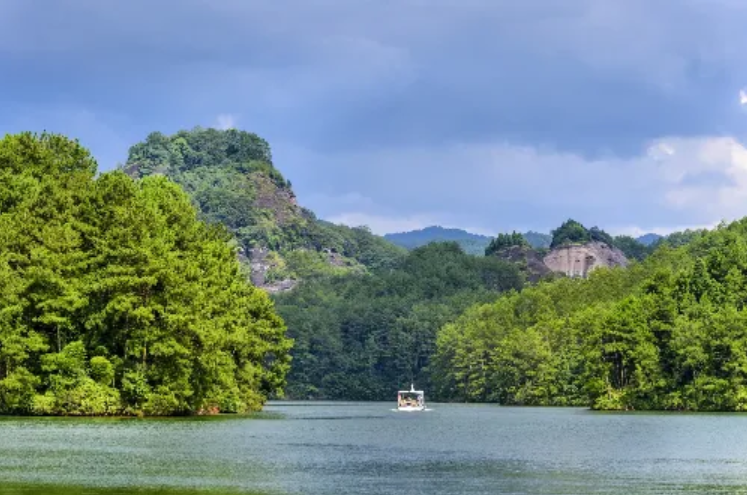
Shimen Lake
Shimen Lake covers an area of about 0.7 square kilometers and was artificially excavated during the Tang Dynasty. There are 12 natural scenic spots within the lake. A boat tour allows visitors to see Danxia reflections such as "Elephant Playing in Water" and "Ma'an Peak." The "Gate of Life" on the lakeshore, over 10 meters high, is a rare water-eroded cave in Danxia landforms and is hailed as the "Oriental female fertility totem." The lake area also preserves Qing Dynasty stone inscriptions recording the history of ancient water management.
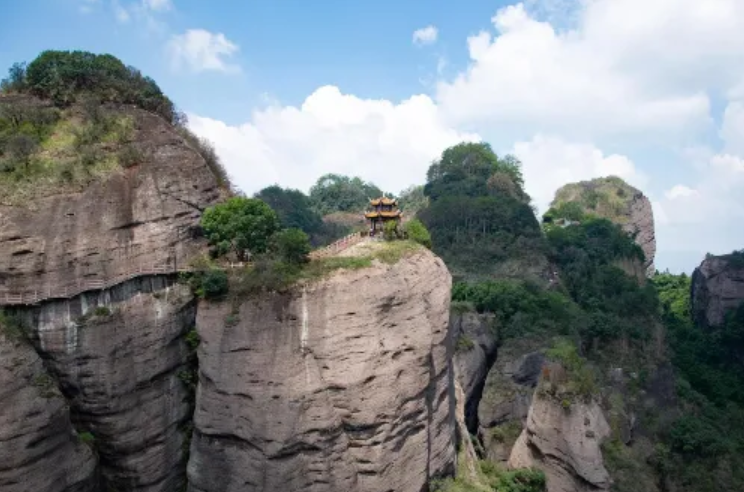
Zhu'an Village
Zhu'an Village is a military mountain fortress built in the late Qing Dynasty for defense against war. At an elevation of 660 meters, it features the "Heavenly Wall," a majestic Danxia stone wall over 100 meters high and 300 meters long. The "Longevity Star Rock," 39 meters tall and shaped like an old man, is a rare giant stone statue in Danxia landforms. The "Twin Sword Peaks," two standing rocks over 80 meters high, resemble drawn swords and are an ideal site for rock climbing.
Jiulong Lake
Jiulong Lake covers an area of approximately 3.2 square kilometers and consists of nine bays, with a shoreline of 18 kilometers. The "Nine Dragons Paying Homage" landscape is formed by the reflections of nine Danxia peaks in the water. A boat tour can take visitors to view spots such as "Crocodile Entering the River" and "Golden Turtle Exploring Water." The lake area has a forest coverage rate of 92% and is home to over 30 species of birds, including egrets and mandarin ducks, making it a paradise for birdwatchers.
Tour Routes:
Route A: Guanzhaishan Shimen Lake (including boat ride) cable car Zhu'an Village Jiulong Lake sightseeing shuttle bus. Duration: approximately 5 hours.
Route B: Guanzhaishan Shimen Lake (including boat ride). Duration: approximately 2.5 hours.
Travel Tips:
In summer, it is hot and rainy; it is advisable to bring sun protection and rain gear, and wear non-slip sports shoes. In winter, temperatures vary greatly between day and night, so a jacket is recommended.
The stone steps on the main peak of Guanzhaishan are steep (some sections have gradients exceeding 60 degrees). Elderly visitors and children are advised to go in groups, and those with heart conditions should avoid climbing the "Heavenly Ladder" section.
For the Shimen Lake boat ride, tickets must be purchased 30 minutes in advance; group visitors can book a private boat in advance. The rock climbing project at Zhu'an Village requires a one-day advance reservation.
Restaurants are concentrated near the visitor center. It is recommended to try Liancheng white duck soup and Dengzhan cake (a local snack). Bringing your own snacks can help save costs.
Important Notes:
Smoking and littering are prohibited in the scenic area. As the Danxia landform is a geological heritage site, it is strictly forbidden to carve on rocks or pick vegetation.
Life jackets must be worn while boating on Shimen Lake; do not stand or play in the water. The viewing platform at the "Longevity Star Rock" in Zhu'an Village is a suspended plank walkway, so visitors with acrophobia should proceed with caution.
The last tourist shuttle bus from Guanzhaishan Railway Station to the scenic area departs at 18:00; if you miss it, you will need to take a taxi. Do not park in undesignated areas to avoid vehicle towing.
During the rainy season (May–June), some mountain paths may be slippery; it is recommended to follow a guide or travel in groups. In winter (December–February), the "Tianchi" may freeze, so caution is needed to prevent slips.
During holidays, it is recommended to purchase tickets one day in advance.
Transportation:
High-speed rail: Take the Ganruilong high-speed railway to "Guanzhaishan Station," then take the tourist shuttle bus directly to the visitor center.
By air: Flights from Xiamen Gaoqi Airport and Fuzhou Changle Airport are available to Liancheng Guanzhaishan Airport. Upon arrival, take the airport shuttle bus (15 RMB/person) to the county seat, then transfer by taxi to the scenic area.
Self-driving: From Fuzhou or Xiamen, take the Changshen or Xiarong Expressway to the Liancheng exit, then follow the Guanzhaishan Tourist Avenue for about 15 kilometers to reach the scenic area.
City bus: Take Bus No. 1 or No. 2 in Liancheng County to the "Guanzhaishan Scenic Area" stop; the ride takes about 15 minutes.
Opening Hours:
Open year-round, daily from 08:00 to 17:30 (last entry at 16:30). On statutory holidays and during the summer peak season (July 1 – August 31), hours are extended to 18:00 (last entry at 17:00). The last boat departure for Shimen Lake is at 17:00. The Zhu'an Village area stops receiving visitors after 16:00 due to rock climbing activity restrictions.
Tickets:
Ticket price: 115 RMB per person.