The Pearl River Night Cruise is located in Guangzhou, Guangdong Province. Its cruise route covers four major urban districts: Yuexiu, Haizhu, Liwan, and Tianhe. It is a landmark waterfront cultural tourism project in Guangzhou and a core nighttime water sightseeing route in the city. The main navigation channel of the Guangzhou section of the Pearl River is about 12.8 kilometers long, and the main nighttime cruise waters cover about 3.5 square kilometers. The entire route relies on the original riverbanks on both sides of the Pearl River, cross-river bridges, and urban landmark building clusters to create a nighttime sightseeing system. The core feature of the scenic area is viewing the night scenery of both banks of the Pearl River from a boat, integrating urban skyscrapers, historic arcade buildings, modern lighting projects, and cross-river bridge landscapes. It is one of China’s earliest and largest inland river nighttime cruise projects. Along the route are more than ten dedicated cruise piers, including Tianzi Pier, Dashaotou Pier, Canton Tower Pier, and Haixinsha Pier. Each pier is equipped with waterfront facilities such as waiting halls, tourist rest platforms, and boarding boardwalks. The building area of a standard pier waiting building ranges from 800 to 2,200 square meters, and the total pier shoreline along the route exceeds 3,000 meters. The entire cruise route connects the old and new core areas of the city. During the day, visitors can enjoy the urban scenery along the river; at night, the comprehensive lighting project creates a dedicated nighttime sightseeing landscape belt.
History and Culture
The shipping history of the Pearl River can be traced back to the Qin and Han dynasties. The Guangzhou section of the Pearl River has been an inland departure channel of the Maritime Silk Road since ancient times. During the Tang and Song dynasties, trade at the riverbank wharves flourished. Since the Qing dynasty, Tianzi Pier became a dedicated wharf for officially welcoming and seeing off officials and receiving foreign guests. It preserves centuries of official wharf culture and is an important carrier of Guangzhou’s modern foreign exchanges. In the late Qing dynasty and early Republic of China period, ferry routes were opened on both sides of the Pearl River, and crossing the river by boat became a daily way for citizens to travel. The prototype of nighttime water tours gradually emerged. During the Republic of China period, literati already took night cruises on the Pearl River and left poems and writings recording the river scenery at night.
In 1993, Guangzhou officially launched standardized Pearl River Night Cruise boat operation services, beginning a commercial nighttime water sightseeing model. In the early stage, there was only one route from Tianzi Pier, operated by small sightseeing boats. In 2001, Guangzhou launched the first phase of the lighting renovation project for both banks of the Pearl River. Buildings and bridges along the route were uniformly equipped with landscape lighting, greatly improving the value of the night cruise experience, and passenger volume grew steadily year by year. Before the 2010 Guangzhou Asian Games, the Pearl River completed a full-line lighting upgrade, adding the core landscape belts of Canton Tower and Haixinsha Asian Games Park. At the same time, several cruise piers, including Dashaotou and Canton Tower, were expanded, and the number of boats and routes was increased. The Pearl River Night Cruise became a key cultural tourism calling card of the Asian Games. After 2020, the scenic area continued to upgrade cruise facilities, adding themed cruise boats, dining cruise boats, and immersive performance cruise boats, integrating Lingnan culture, Cantonese folk customs, and modern urban elements to form a comprehensive water tourism product combining sightseeing, leisure, dining, and cultural performance functions.
Major Attractions
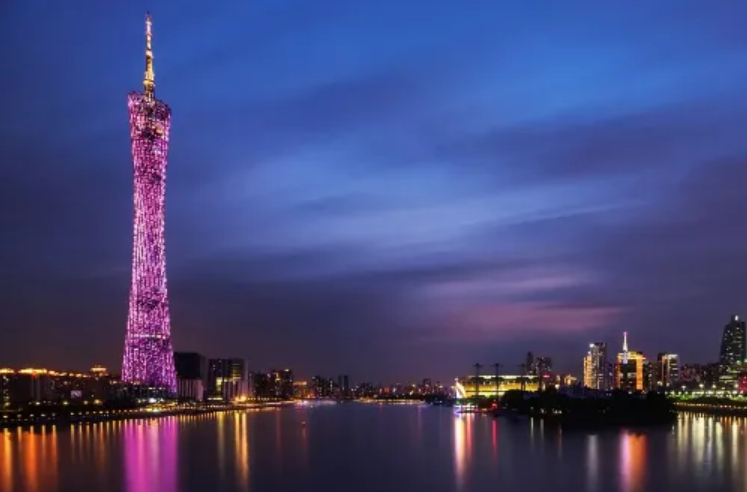
Canton Tower
Canton Tower is located on the south bank of the Pearl River in Haizhu District. With a total height of 600 meters, it is the core landmark building of the Pearl River Night Cruise route. When cruise boats travel through the waters from the Haizhu Bridge section to the Haixinsha section, passengers can fully view the tower’s nighttime lighting changes. The tower’s lights switch to special colors for holidays and special events, forming a double-layer lighting landscape with its reflection on the river. It is the visual focus of the entire night cruise route. Most cruise routes pass close to the river surface below the tower and stop to allow tourists to take photos and enjoy the view.
Haixinsha Asian Games Park
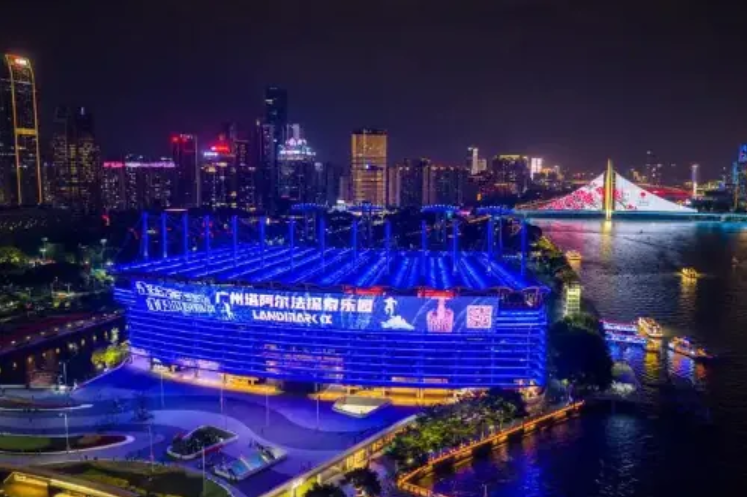
Haixinsha Asian Games Park is located on an island in the Pearl River. It was the venue for the opening and closing ceremonies of the 2010 Guangzhou Asian Games. Along the island’s waterfront, there are large lighting landscape belts, green landscape platforms, and Asian Games-themed sculpture groups. Cruise boats passing through the north channel can view the lighting outline of the entire island. Large projection lighting installations on the riverbank play city cultural images on a loop at night. With river breezes and green landscapes, it is a scenic node combining leisure and cultural features along the route.
Liede Bridge
Liede Bridge is an iconic arch-shaped cross-river bridge on the Pearl River. Its main arch adopts a double-arch design, and the total length of the bridge is 4.3 kilometers. The bridge deck and arch body are fully covered with dynamic landscape light strips. At night, the lights gradually change and flow, and the arch bridge outline is reflected on the river, forming a symmetrical light-and-shadow image. When the route passes here, the river view is open, with no high-rise buildings blocking the view, making it an excellent spot for photographing the bridge at night.
Tianzi Pier
Tianzi Pier is located on Yanjiang Middle Road in Yuexiu District. With a history of more than 300 years, it is the departure pier with the deepest historical heritage for the Pearl River Night Cruise. The pier retains the original riverbank layout of an official wharf from the Qing dynasty, is equipped with a retro-style waiting corridor, and has a Cantonese historical and cultural relief wall on the bank. Before boarding, visitors can closely observe the cultural landscape of the ancient pier. The pier is adjacent to Beijing Road Pedestrian Street, Haizhu Square, and other old-city commercial areas, connecting the historic features of the old Cantonese city.
Haizhu Bridge
Haizhu Bridge is Guangzhou’s first cross-river steel bridge. It was first built in 1929 and carries nearly a century of urban development memory. The bridge retains its retro steel frame structure and is paired with warm yellow static lighting at night. Together with the surrounding arcade buildings and old-city buildings, it forms a retro river view. It is an iconic historical landscape of the northern section of the Pearl River route, allowing visitors to directly experience the contrast between Guangzhou’s old and new urban features.
Cruise Routes:
Route 1 (Dashaotou Pier Classic Loop): Board at Dashaotou Pier → Haizhu Bridge → Tianzi Pier → Haixinsha Asian Games Park → Canton Tower → Liede Bridge → return to Dashaotou Pier
Route 2 (Canton Tower Pier Short Route): Board at Canton Tower Pier → Liede Bridge → Haixinsha Asian Games Park → circle around the waters by Canton Tower → return to Canton Tower Pier
Route 3 (Tianzi Pier Old City Long Route): Board at Tianzi Pier → Haizhu Bridge → Renmin Bridge → Bai’etan → return to Tianzi Pier
Travel Suggestions:
It is best to choose a departure between 19:30 and 21:00, when the lighting on both banks is fully illuminated and the viewing effect is at its best.
When boarding, choose the open deck area on the second floor of the cruise boat. The first-floor cabin has glass window reflections that can affect night photography views.
In summer, bring a light jacket. The wind on the river is stronger at night, and the temperature by the water is 2–3°C lower than in the city center.
If you plan to take photos, bring stabilization equipment. The cruise boat may shake slightly while moving on the river, which can easily blur images.
During holidays, passenger flow increases significantly. It is recommended to buy tickets online 1–3 days in advance to avoid having no tickets left at the pier and delaying your trip.
If you want dining service, choose themed cruise boats that include buffets or dim sum. They provide supporting leisure food and drinks throughout the journey.
After the tour, you can walk to the riverside promenade along the river to check in at waterfront lighting landmarks up close and take additional close-up night photos.
Notes:
During the entire cruise, it is prohibited to climb over the side of the boat or lean on railings. It is also prohibited to extend mobile phones, cameras, or other valuables outside the boat to prevent them from falling into the water and being lost.
Flammable, explosive, and controlled items are prohibited at piers and on cruise boats. Alcoholic drinks and glass-bottled beverages are not allowed on open decks on some routes.
Children under 1.2 meters tall are free. Children between 1.2 and 1.5 meters need to buy child tickets. Children must be accompanied by an adult guardian throughout boarding.
Cruise boats are not recommended for elderly people with severe heart disease, high blood pressure, vertigo, or limited mobility. River turbulence may cause physical discomfort.
In case of severe weather such as heavy rain, force 6 or above winds, or lightning, the operator will temporarily suspend cruises or adjust routes. Before purchasing tickets, you can check the day’s sailing notice in advance.
Swimming is not allowed during the cruise, and it is prohibited to throw garbage or food into the river. All water environmental protection regulations must be followed throughout.
Boarding requires the ID document corresponding to the ticket. Pier security checks require ID verification, and persons without ID cannot complete boarding procedures.
Running and roughhousing are prohibited on the deck during the cruise. When people gather to enjoy the view, queue in an orderly manner to avoid crowding and collisions.
Transportation:
Public Metro: To reach Dashaotou Pier, take Metro Line 6 to Donghu Station Exit B and walk 800 meters. To reach Canton Tower Pier, take Metro Line 3 or the APM Line to Canton Tower Station. To reach Tianzi Pier, take Metro Line 2 to Haizhu Square Station Exit A and walk 500 meters.
Bus Travel: Dashaotou Pier is served by the Dashaotou Pier stop, with routes 7, 12, and 89. Canton Tower Pier is served by Canton Tower West stop, with routes 262 and 468. Tianzi Pier is served by Nanguan stop, with routes 1, 4, and 57.
Self-Driving: Major piers have paid parking lots. Canton Tower has a large underground parking lot.
Taxi/Ride-Hailing: Directly set the destination to the corresponding cruise pier name. A dedicated drop-off and pick-up area is set up at the pier entrance for temporary stopping.
Opening Hours:
The Pearl River Night Cruise operates normally all year round. Departure periods are divided into daytime cruises and nighttime cruises. Daytime cruise operating hours are from 10:00 to 17:00, with departures about every 60 minutes. The core nighttime sightseeing period is from 18:30 to 22:30. The first night cruise departs at 18:30 each night, and the last cruise departs at 22:00. The duration of a single cruise depends on the route: short routes last 40 minutes, the classic loop lasts 70 minutes, and the long Bai’etan route lasts 90 minutes. On statutory holidays, during summer vacation, and during the Spring Festival, additional departures at 22:10 and 22:20 will be added. The specific real-time schedule is subject to the day’s pier notice and online ticketing platform information. In extreme weather, the operator may temporarily shorten operating hours or suspend all departures for the day.
Tickets:
Tickets start at RMB 36 per person.