Tianzhu Mountain Scenic Area is located in Qianshan City, Anqing, Anhui Province. It is one of China’s first batch of key national scenic spots, a national 5A-level tourist attraction, a national forest park, a national geopark, and a national natural and cultural heritage site. It is also listed as one of the “Top Ten Most Promising Scenic Spots in China.” The scenic area covers 102.72 square kilometers, with a protected area of 304 square kilometers. Tianzhu Mountain is a mountain?type scenic area dominated by granite peak?cluster landforms, combining the grandeur of northern mountains with the elegance of southern ridges. It features numerous spectacular peaks, strange rocks, deep caves, and secluded waterfalls, and hosts the world’s largest and deepest exposed ultra?high?pressure metamorphic belt.
History and Culture
Tianzhu Mountain has a long history. During the Spring and Autumn period, it was the fiefdom of the State of Wan, with the mountain called Wan Mountain and the river called Wan River. Anhui Province’s abbreviation “Wan” originates from this. In 106 BC, Emperor Wu of the Han Dynasty ascended the mountain to offer sacrifices and bestowed upon it the title “Southern Mountain” (Nanyue). In the ninth year of the Kaihuang era of the Sui Dynasty (AD 589), Emperor Yang expanded the empire and redesignated Mount Heng in Hunan as the Southern Mountain, but Tianzhu Mountain has since been respectfully called the “Ancient Southern Mountain.” Successive emperors either personally paid homage or sent officials to offer sacrifices to the Southern Mountain at Tianzhu.
Tianzhu Mountain has also been a thriving center of religious culture. Since the late Eastern Han Dynasty, it has seen numerous religious activities, with alchemists, monks, and Taoist priests practicing, building temples, and preaching here. The renowned Jinling monk Baozhi established a monastery at the foot of the mountain (in the area of today’s Sanzu Temple). During the Tang Dynasty, Qianshan served as the administrative seat of Shuzhou. In the Wanli reign of the Ming Dynasty, the emperor conferred the name Foguang Temple on Mazhu Nunnery, making it a famous Buddhist monastery.
Moreover, the mountain boasts a rich cultural heritage, attracting literati such as Wang Anshi, Su Shi, and Huang Tingjian, who left behind many poems, songs, travelogues, and stone carvings. It is also the setting of The Peacock Flies Southeast, China’s longest narrative poem, and the hometown of the Three Kingdoms beauties Da Qiao and Xiao Qiao, where they once adorned themselves. Additionally, it is the birthplace of Cheng Changgeng, the “father of Peking opera,” and Zhang Henshui, a master of chapter novels, as well as the hometown of acrobatic queen Xia Juhua and Huangmei opera star Han Zaifen.
Major Attractions
Tianzhu Peak
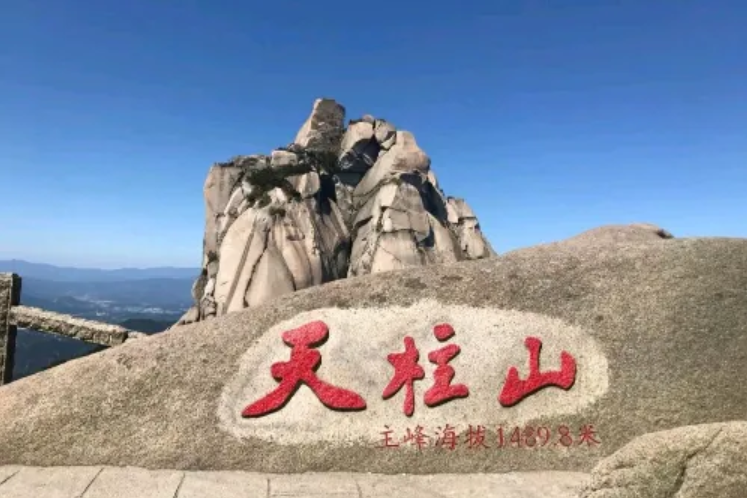
At an elevation of 1,489.8 meters, Tianzhu Peak rises abruptly from the ground with a solid rock body, towering over the Jianghuai region like a pillar supporting the sky. On its top are carved eight large characters—“Central Sky Pillar” and “Alone Supporting the Vault”—each character measuring five meters square, exuding a majestic presence.
Tianchi Peak
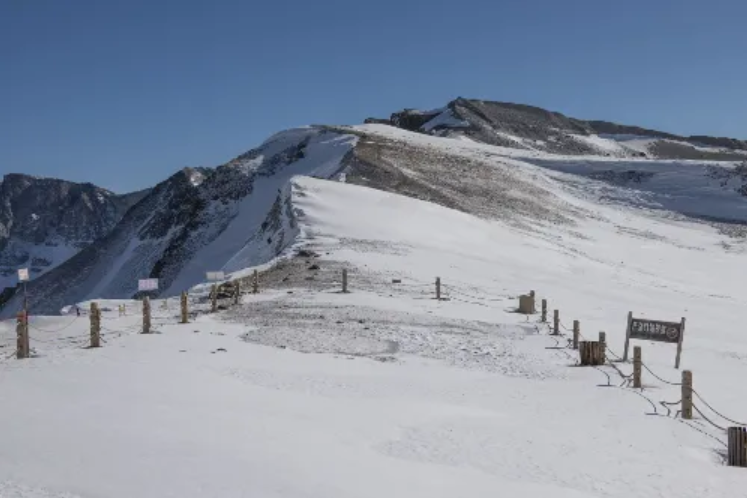
The second highest peak of Tianzhu Mountain, slightly taller than Feilai Peak at 1,426 meters, Tianchi Peak is the best vantage point for viewing sunrise, sea of clouds, Buddha’s halo, and sunset glow.
Feilai Peak
At 1,424 meters, the entire peak is a single colossal boulder, with a stone atop it that appears to have fallen from the sky, hence the name “Feilai Stone” and the peak’s name “Feilai” (meaning “flying here”).
Mysterious Valley
A highlight of the main peak area, the Mysterious Valley is formed by fallen giant boulders naturally stacking into caves. It stretches over 450 meters with a vertical drop of more than 100 meters. Within the valley, caves interlink, winding up and down, left and right, creating sections named “Heavenly Palace,” “Earth Palace,” “Carefree Palace,” “Labyrinth,” and “Dragon Palace.”
Valley Stream Cliff Carvings
Over 400 inscribed stone carvings from the Tang Dynasty to the Republic of China era survive here, bearing authentic poems, prose, travel notes, and inscriptions by high officials and literary figures through the ages. These carvings encompass a variety of literary forms—poetry, lyrics, essays, and records—and styles of calligraphy including running, cursive, regular, clerical, and seal scripts, making it a natural museum of calligraphy and a gallery of steles.
Alchemy Lake
The third largest high?altitude artificial lake in China, situated at an elevation of 1,100 meters, with a water surface of nearly 30,000 square meters and a storage capacity of 80,000 cubic meters. It is like a piece of jade set among the surrounding peaks.
Tour Routes:
One?Day Tour: Take the Dalongwo Cable Car up the mountain → Tianzhu Peak → Feilai Peak → Mysterious Valley → Alchemy Lake → Descend via Tianzhu Mountain Cable Car.
Two?Day Tour:
Day 1: Dalongwo Cable Car up → Tianzhu Peak → Feilai Peak → Mysterious Valley, stay overnight on the mountain;
Day 2: Alchemy Lake → Descend via Tianzhu Mountain Cable Car → Sanzu Temple → Valley Stream Cliff Carvings.
Travel Tips:
Check the weather forecast in advance and choose a clear day for better views.
Wear comfortable sports shoes, as the hike is long and involves climbing.
Consider taking the cable car to save energy, depending on your physical condition.
Bring adequate water and snacks; there are some small shops on the mountain, but prices are relatively high.
Important Reminders:
Follow the scenic area regulations—do not spit or litter.
Stay safe during climbing and follow signs and staff instructions.
Protect cultural relics and historic sites—do not touch or carve on cliff inscriptions.
In case of severe weather such as heavy rain or strong winds, seek shelter in safe areas immediately.
Transportation:
High?speed rail: Take a train to Qianshan South Station, where a tourist shuttle bus directly connects to the scenic area.
Bus: Qianshan has a bus station with scheduled buses to Tianzhu Mountain.
Self?driving: Navigate to Tianzhu Mountain Tourist Center; there is parking available at the scenic area.
Opening Hours:
Open from 07:00 to 17:30; last entry is at 16:00.
Ticket Price:
130 RMB per person.