Located in Xidi Town, Yixian County, Huangshan City, Anhui Province, the Xidi Ancient Village Scenic Area covers a village area of 10.7 square kilometers. It is a traditional Chinese village, a nationally renowned historical and cultural village, and a key national cultural relics protection unit. On December 2, 2000, the ancient villages of southern Anhui, represented by Xidi, were inscribed on the UNESCO World Heritage List. On May 5, 2011, the Xidi Village Scenic Area was officially awarded the title of "National 5A-Level Tourist Attraction" by the China National Tourism Administration. In December 2021, it was selected among the first batch of UNWTO "Best Tourism Villages." Today, Xidi Village preserves three intact ancestral halls, one memorial archway, and 155 ancient residential houses, earning it the reputations of "Museum of Ming and Qing Residential Architecture" and "A Dwelling in the Peach Blossom Land."
History and Culture
Xidi Village was first established during the reign of Emperor Renzong of the Northern Song Dynasty (around the Huangyou era, 1049–1054), developed through the Jingtai period of the Ming Dynasty (mid?15th century), and reached its zenith in the early Qing Dynasty. In the Huangyou era of the Northern Song, Hu Shiliang, the fifth?generation descendant of Hu Changyi, traveled to Jinling (present?day Nanjing) on official business. Passing by Xidi Pu, he was captivated by the surrounding mountains, beautiful scenery, and fertile soil, so he moved his entire family from Kaoshui, Wuyuan, to Xidi. There, they combined farming with study and prospered through generations.
Xidi Village boasts a profound cultural heritage, including two national?level intangible cultural heritage items: Huizhou Three Carvings (wood, stone, and brick carving) and traditional Huizhou residential construction techniques. The village layout is structured around a longitudinal main street and two roads along the streams, forming a street?and?lane system that extends primarily eastward and also north?south. All lanes are paved with Yixian bluestone. The ancient buildings are mostly timber?framed with brick walls, featuring rich wood, stone, and brick carvings, and the design and layout of lanes and structures are harmoniously coordinated. The village spaces are flexible and varied, while the architectural tones are simple and elegant, making it a quintessential representative of Huizhou architectural art.
Major Attractions
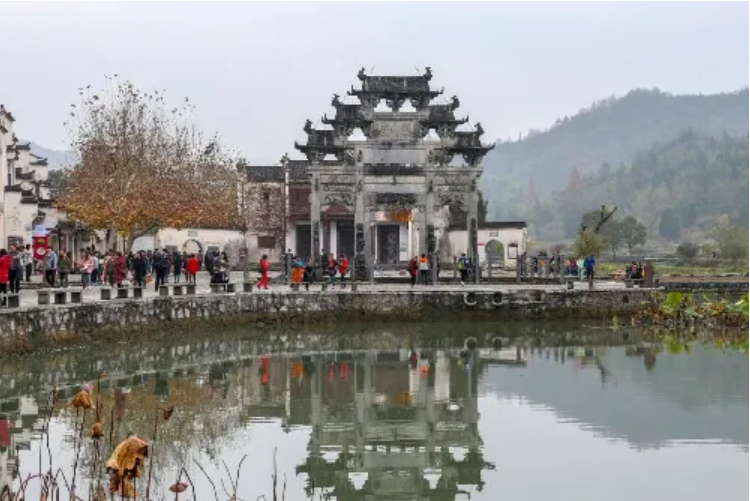
Hu Wenguang Memorial Archway
Built in the 6th year of the Wanli reign of the Ming Dynasty (1578), commonly known as the "Xidi Archway," it stands at the entrance of Xidi Village. The structure occupies an area of 15.75 meters in length, 8.1 meters in width, and 127.6 square meters in total area, following a three?bay, four?pillar, five?story architectural format. The imperial court erected it in honor of Hu Wenguang, who served as an official for 32 years with outstanding achievements. The archway is 12.3 meters high and 9.95 meters wide, built of Yixian bluestone. The main pillars have rectangular stone bases, the end pillars are adorned with drum?shaped supporting stones, and the two central pillars are decorated front and back with two pairs of crouching stone lions serving as bracket supports, rendered in a lifelike manner. The archway features exquisite open?work relief carvings, each with a distinct character. On the east and west sides, the inscribed plaques read "Jingfan Shouxiang" (Prime Minister of the Frontier) and "Jiaozhou Cishi" (Governor of Jiaozhou) in large characters.
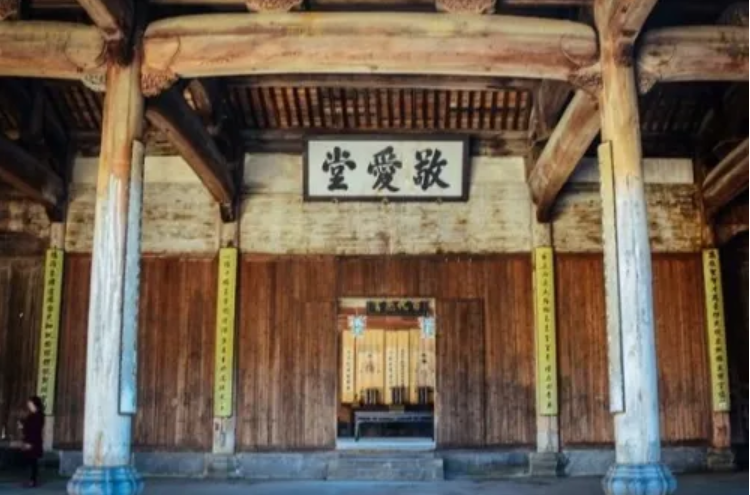
Jing'ai Hall
Originally the residence of Shì Heng, the 14th?generation ancestor of the Hu clan of Xidi, it was first built during the Wanli reign of the Ming Dynasty (1563–1620) and later destroyed by fire. It was rebuilt during the Qianlong reign of the Qing Dynasty. As the Hu clan grew and prospered, the hall was expanded into an ancestral hall. It is a typical Huizhou brick?and?wood structure covering 1,800 square meters and is the largest surviving ancestral hall in Xidi Village. It served as a place for worshipping ancestors, educating descendants, uniting the clan, and holding various religious activities. A stream flows around the hall, and it is now open as the "Xidi Folk Customs Exhibition Hall."
Zouma Lou (Horse?Riding Gallery)
Distinguished by its unique architectural style and exquisite interior decorations, the wood carvings here demonstrate the superb construction techniques and artistic standards of the time.
Kuanggu Zhai
Built in the 1st year of the Kangxi reign of the Qing Dynasty (1662), covering an area of 130 square meters.
Ruiyu Ting
Houses a plaque of Xidi Ancient Village and the famous Huizhou merchant couplet: "Happiness is often gained through hard work; benefits often come from accepting losses," which is inscribed here.
Taoli Yuan (Peach and Plum Garden)
Located in the middle of Henglu Street, it was built during the Xianfeng reign of the Qing Dynasty (1831–1861) and consists of a main house and a courtyard. It is the former residence of Hu Yuanxi, a Xidi Huizhou merchant, and is the only building in Xidi that combines a residence with a study. On both sides of the rear hall, there are 12 carved wooden panels inlaid with the entire text of "The Pavilion of the Drunkard" in lacquered calligraphy, written by the renowned calligrapher Huang Yuanzhi of Yixian during the Kangxi era.
Xi Yuan (West Garden)
A relatively typical Huizhou garden?style residence among ancient Huizhou dwellings. Its brilliance lies in the harmony between the house and the courtyard and the seamless connection between the garden and nature. It was the former residence of Hu Wenzhao, the 25th?generation ancestor of the Xidi Hu clan, built during the Daoguang reign of the Qing Dynasty (1824) and has a history of over 180 years.
Dong Yuan (East Garden)
Opposite the West Garden, it features similarly exquisite architecture and a distinctive layout, embodying the characteristics of Huizhou architecture.
Lüfu Tang
The private residence of Hu Shangzeng, a high?ranking Qing official of the second rank and the highest?ranking official from Xidi. Built during the Kangxi reign (1662–1722), it is a three?bay, three?story residential structure that is spacious, elegant, and simple. The front hall contains a large central painting of "Pine and Crane," and above it hangs a plaque inscribed with the bold calligraphy "Lüfu Tang."
Yingfu Tang
Noted for its unique architectural style and decorative features, it showcases the charm of Huizhou architecture.
Shangde Tang
Reflects the traditional culture and values of Xidi Village, with a simple and historic architectural style.
Dafu Di (Grand Official's Mansion)
Well?proportioned in layout, displaying the architectural standards and style of its time.
Diji Tang
Possesses its own distinctive architectural features and historical significance.
Zhuimu Tang
Features an upturned eaves roof and a large gate tower shaped like the character "八" (eight). Outside the triple gate under the eaves, wooden railings are installed, and the side walls are made of polished Yixian marble. Inside, there are portraits of meritorious officials from Emperor Li Shimin's reign and a statue of Li Shimin himself.
Duyi Ting (also known as Zhenshi Xiaozhu)
Built during the Daoguang reign (1821–1851), it was originally the former residence of Hu Yuanxi—the youngest son of Hu Guansan, a third?rank Tongyi Dafu (official) and one of the six wealthiest men in Jiangnan, and the son?in?law of Cao Zhenyong, a prime minister serving under the Qianlong, Jiaqing, and Daoguang emperors. The courtyard gate is a brick arched gate tower with a brick carving reading "Ziqì Dōnglái" (Purple Qi from the East). Inside the gate, a scroll?shaped stone carving bears the inscription "Zhenshi Xiaozhu" (Small Studio on the Pillow Stone). On both sides of the gate pavilion are small leaf?shaped door openings with brick carvings reading "Yuhu" (Jade Flask) and "Yingchun" (Greeting Spring), and inside there is a greenhouse where the owner once kept flowers and plants through the winter.
Suggested Tour Route:
After entering the scenic area, visitors can start from the Hu Wenguang Memorial Archway at the village entrance, then visit the Ying Tianqi Art Museum, Kuanggu Zhai, Duyi Ting, Diji Tang, Shangde Tang, Dong Yuan, and other attractions. Wander along the ancient lanes to admire the residential houses and ancestral halls, and continue to Xi Yuan, Taoli Yuan, Jing'ai Hall, and others. Finally, ascend the observation deck for a panoramic view of the entire Xidi Ancient Village. The entire tour is recommended to take 3 to 5 hours to fully appreciate the charm of the ancient village.
Travel Tips:
Learn about Huizhou architecture and the historical culture of Xidi Village in advance to better appreciate and understand the scenic area's buildings and cultural attractions.
Try to visit on weekdays or during the off?peak tourist season to avoid crowds and enjoy a more leisurely experience of the village's tranquil atmosphere.
Consider hiring a local guide to gain deeper insights into the stories and cultural connotations behind each attraction.
Wear comfortable shoes, as you will do a fair amount of walking on bluestone?paved lanes.
Stay overnight in the village to experience its early morning and nighttime ambiance, which offer a different perspective.
Important Notes:
Most ancient buildings in the scenic area are old and fragile; please do not touch or climb them to prevent damage.
Respect local customs and religious beliefs; avoid making loud noises or behaving inappropriately in ancestral halls and other sacred places.
When purchasing souvenirs, pay attention to quality and price to avoid unnecessary disputes.
Help protect the environment by not littering and keeping the village clean.
Follow the instructions of the scenic area staff and comply with all regulations during your visit.
Transportation:
By Air: Fly to Huangshan Tunxi International Airport. From there, take a shuttle bus to Yixian County, then transfer to Xidi Ancient Village. The airport is about 55 km from Yixian, approximately 1 hour and 15 minutes by car.
By Train: Take a train to Huangshan Railway Station or Huangshan North Railway Station.
Huangshan Station is about 50 km from Yixian; you can take a shuttle to Yixian and then transfer to Xidi.
Huangshan North Station is about 40 km from Yixian; similarly, take a shuttle to Yixian and then to Xidi.
By Car (Self?drive): From Huangshan City, take the G56 Hangrui Expressway and exit at the Yixian exit, then follow navigation to Xidi Ancient Village Scenic Area. The total distance is about 50 km, taking roughly 1 hour. From other cities, navigate first to Yixian County, then to Xidi.
Opening Hours:
The scenic area is generally open from 7:30 to 17:30 (with a night lighting show until 20:00).
Admission Fee:
The ticket price is 94 RMB per person.