The Ancient Huizhou Cultural Tourism Zone is located in Huangshan City, Anhui Province. It borders Mount Huangshan to the north and Qiandao Lake to the south, covering an area of 9.5 square kilometers. It is a national 5A-level tourist attraction. By bringing together elements such as ancient city life, ancestral hall culture, memorial archway culture, Huizhou merchant culture, village culture, and residential culture, it vividly presents “Hui culture”—one of China’s three major regional cultures—in its most authentic and living form. Within the scenic area, there are various types of ancient buildings, including 116 structures in 4 spatial categories and 3,358 individual architectural units in 12 categories. Among these, 1,325 ancient residences have been protected through programs of “adoption, residential use, and purchase” by the public.
History
The Ancient Huizhou Cultural Tourism Zone has a long history. In the fifth year of the Dali era of the Tang Dynasty (770 AD), the “one prefecture, six counties” administrative pattern of Huizhou began to take shape. In the sixth year of the Wude era of the Tang Dynasty (623 AD), structures such as Zhongwang Street, Liujiayuan, and Taizitang were built in the area, gradually forming clan-based villages. From the Song and Yuan dynasties through the Ming and Qing dynasties, a large number of ancient buildings were constructed, such as the five-arch stone bridge Huanxiu Bridge in Chengkan (Yuan Dynasty) and the Jinzi Ancestral Hall in Qiankou (built in the 10th year of the Zhengde era of the Ming Dynasty, 1515). The Ming and Qing dynasties marked the peak period for the construction of most ancient Huizhou buildings in Huangshan, Anhui. In 1984, the Qiankou Folk Residences began to be conserved as a cluster of Ming?dwellings; in the same year, the former site of Chongyi School was converted into the Tao Xingzhi Memorial Hall. Since then, the scenic area has continued to develop and improve, and in 2014 it was awarded the title of “National 5A-level Tourist Attraction.”
Major Attractions
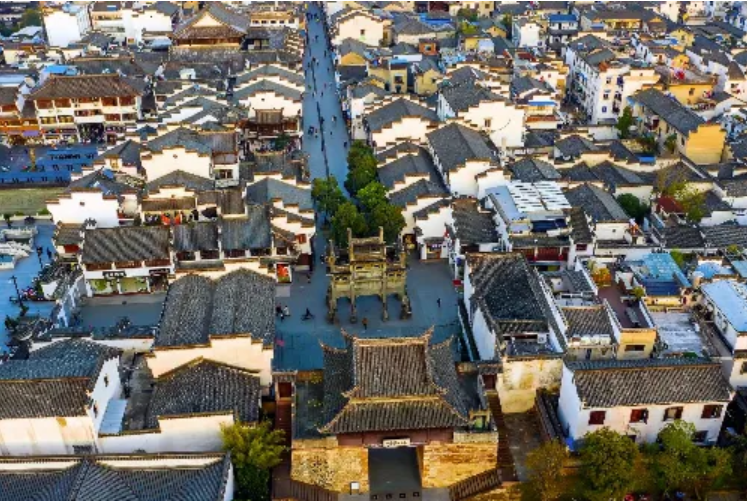
Huizhou Ancient City
Huizhou Ancient City was the seat of the Huizhou prefectural government and is one of the four best?preserved ancient cities in China today. Within the scenic area are ancient residential clusters, ancient bridges, ancient pagodas, ancient streets, ancient lanes, ancient weirs, and ancient memorial archways. The scenic area comprises six sites: the “Arc de Triomphe of the East”—Xuguo Stone Archway; the symbol of Huizhou Ancient City—the Huizhou Prefectural Yamen; the “Number One Street South of the Yangtze”—Doushan Street; the source of Huizhou merchants—Yuliang Ancient Wharf; the “Grand View Garden of Huizhou”—Huiyuan Garden; and the national patriotic education base—Tao Xingzhi Memorial Hall.
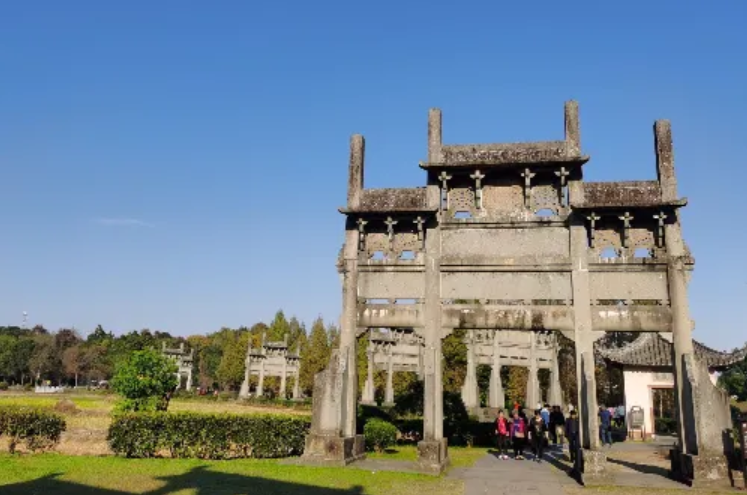
Archway Group · Bao Family Garden
This scenic area is located in Tangyue Village, She County, 10 km from the ancient city and 27 km from the city seat of Tunxi. Here you can find the ancient village of Tangyue, seven memorial archways, a male ancestral hall, a female ancestral hall, the Shixiao Hall (carved with the names of filial descendants and their deeds from successive generations of the Bao clan), and numerous other commemorative structures for clan affairs, public welfare, cultural gatherings, academies, and charity granaries. The Bao Family Garden complements the archway group. Set against the backdrop of a private Huizhou merchant garden and featuring Huizhou-style penjing (miniature landscapes), it brings together the essence of Huizhou penjing art while also showcasing representative works from various Chinese penjing schools. It is known as the “Mother of Oriental Gardens.”
Tangmo
Tangmo is known as “China’s No. 1 Water?Mouth Garden Village.” It was first established in the Tang Dynasty, nurtured in the Song and Yuan, and flourished in the Ming and Qing. Historically, thanks to its vibrant economy and simple folk customs, it was called “Model Village of the Tang Dynasty.” Here lies the famed Tangan Garden, which replicates the scenery of West Lake with pavilions, terraces, water pavilions, and long bridges. The lake embankment is planted with tan flowers and purple vitex. The garden also features the Three Pools Mirroring the Moon, Mid?Lake Pavilion, White Causeway, Jade Belt Bridge, and other scenic spots—a miniature West Lake. The Mirror Pavilion is the center of the “Little West Lake,” and its interior walls are built of marble, inlaid with stone inscriptions by master calligraphers including Su Shi, Zhu Xi, and Dong Qichang.
Qiankou Folk Residences
Also known as Zixia Villa, the Qiankou Folk Residences are located at the southern foot of Zixia Peak, Qiankou Town, Huizhou District, Huangshan City. This is a cluster of Huizhou?style folk dwellings from the Ming Dynasty, displaying a variety of ancient residential forms on a small hill in a well?planned arrangement. In terms of building types, there are ancestral shrines, residences, small bridges, roadside pavilions, and memorial archways. Chronologically, they span from the 8th year of the Hongzhi era of the Ming Dynasty (1495) to the mid?and?late Ming period.
Chengkan
Chengkan is nothing short of a miracle in China’s ancient architectural history. Integrating naturally with the landscape, the village was laid out according to the trigram?based feng shui theories of the I Ching (Book of Changes), embodying ancient philosophical ideas of mutual generation and restraint among all things. It is hailed as “China’s No. 1 Feng Shui Village.” The long streets and short lanes inside the village form a maze; as you stroll through, the scenery changes with every step—it feels like walking through a painting. Chengkan now boasts 49 national?level key protected cultural relics and has been named a “National Historic and Cultural Town,” “Town of Ancient Chinese Architecture,” “Hometown of Chinese National Treasures,” and “China’s Best Tourist Ancient Town.”
Suggested Itinerary:
She County (Huizhou) – Jixi – Yuliang Dam – Yuliang Ancient Town Old Street – Taibai Wenjin Place – Yan Si Wenfeng Pagoda – Qiankou Pagoda – Qiankou Folk Residences – Chengkan Bagua Village – Baolun Hall – Tangmo – Tangyue Archway Group – Xin’an Stele Garden · Taibai Tower – Xuguo Stone Archway.
Travel Tips:
It is recommended to allocate 2–3 days to fully appreciate the charm of Hui culture.
Consider staying in a Huizhou?style homestay to experience the local lifestyle.
There are many cobblestone paths in the scenic area, so comfortable shoes are advised.
If you are interested in Hui culture, hiring a guide will provide deeper insights into the historical and cultural significance of the sites.
Important Notes:
Along the waterway in Tangmo’s Water Street, stay safe and avoid falling into the water.
Do not touch or damage cultural relics when visiting ancient building areas.
In summer, protect yourself from the sun and mosquito bites.
Some attractions may be crowded; keep an eye on your personal belongings.
Transportation:
By air: Fly to Tunxi International Airport, then take a taxi to Huangshan Bus Station and transfer to a bus to She County. At She County Bus Station, take Bus No. 4 directly to the scenic area.
By high?speed rail: Take the Beijing?Fuzhou high?speed railway to Shexian North Station, then take a bus to Huizhou Ancient City.
By car: Navigate directly to the various scenic areas of the Ancient Huizhou Cultural Tourism Zone; parking lots are available nearby.
Opening Hours:
Huizhou Ancient City: 8:00–16:30; Night tour 19:00–21:30.
Archway Group: 7:00–18:00.
Chengkan: 8:00–17:00.
Tangmo: 8:00–17:30.
Qiankou Folk Residences: 8:00–16:30.
Tickets:
Five?site combo ticket (Huizhou Ancient City, Archway Group, Tangmo, Chengkan, Qiankou Folk Residences): 220 RMB/person. Individual site tickets are also available.