The Sanhe Ancient Town Scenic Area is located in Feixi County, Hefei City, Anhui Province, on the shore of Chaohu Lake, bordering Lujiang County and Shucheng County. It is famously described as "a single step across three counties, with the crowing of roosters heard in all three." The ancient town covers a total area of 2.9 square kilometers, with the scenic area spanning approximately 2 square kilometers. With a history of over 2,500 years, Sanhe Ancient Town is a national 5A-level tourist attraction. The town derives its name from the three rivers that flow through it—Fengle River, Hangbu River, and Xiaonan River—and is characterized by its water-town scenery. It boasts a rich collection of cultural attractions, forming the unique "Eight Ancients" landscape of the Jianghuai region, namely ancient rivers, ancient bridges, ancient dikes, ancient streets, ancient residences, ancient teahouses, ancient temple platforms, and ancient battlefields. The town preserves a large number of ancient buildings from the late Qing Dynasty and the Republic of China period, with architectural styles incorporating both northern and southern characteristics. These structures are predominantly a mix of timber and brick-and-stone construction, representing the architectural style of the late Qing Dynasty in central Anhui and making it one of the region's quintessential water towns.
History and Culture
Sanhe Ancient Town has a long history. Over 2,550 years ago, it was originally a highland emerging from Chaohu Lake, serving as a resting place for birds, and was anciently known as "Quezhu" and "Que'an." During the Spring and Autumn and Warring States periods, the town began to take shape, and the Battle of Que'an between the Wu and Chu states took place here. After the unification of China under the Qin Dynasty, Sanhe belonged to Jiujiang Commandery, and during the Han Dynasty, it came under the jurisdiction of Lujiang Commandery. During the Three Kingdoms period, Cao Cao trained his navy here. After the Eastern Jin Dynasty, its administrative affiliations changed frequently, mostly falling under the Eastern Jin, the Song, Qi, Liang, and Chen of the Southern Dynasties, during which it was also known as "Quewei" and "Sanchahe." At the beginning of the Sui Dynasty, Luzhou was established, and since then, Sanhe has always been under Luzhou's jurisdiction. During the Tang Dynasty, under Emperor Xuanzong, the original Shuxian County was divided into Lujiang and Shucheng counties. From then until the Republic of China period, Sanhe lay at the junction of Hefei, Shuxian, and Lujiang counties. At the end of the Ming Dynasty, Zhang Xianzhong's uprising led to the establishment of a naval force in Sanhe. During the Ming and Qing dynasties, Sanhe Town was formally established. In the late Qing Dynasty, the Taiping Army achieved a major victory over the Qing forces here in the Battle of Sanhe. Sanhe Ancient Town was once a vital commercial hub due to its developed water transportation, earning the titles "Inexhaustible Sanhe" and "the Commodity Corridor of Central Anhui." During the War of Resistance Against Japan, a large influx of people spurred commercial development, earning it the nickname "Little Nanjing." During the War of Liberation, commerce declined and the town fell into disrepair. After the founding of the People's Republic of China, commerce revived. Following the reform and opening-up policy, the development of land transportation led to a decline in water transport and a reduction in the town's commercial status. However, its industrial development began early, with textile, tobacco, and food industries among more than ten types of factories established before liberation, exporting about 20 products abroad. It gradually transitioned into an industrial and commercial town.
Major Attractions
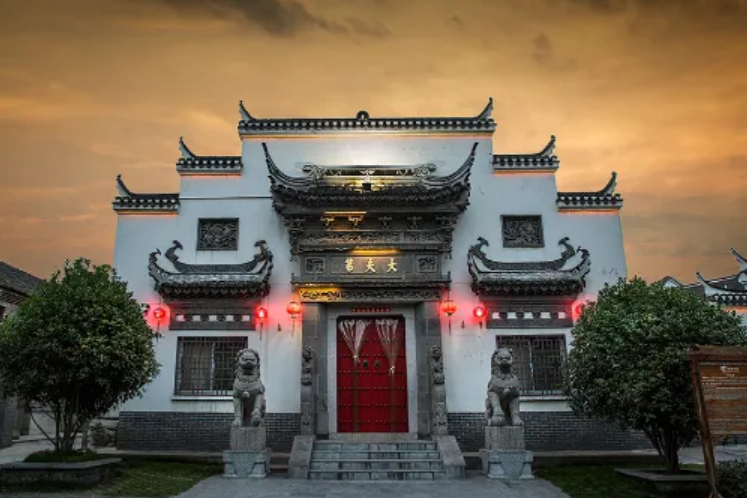
Grand Doctor's Mansion (Dafudi)
The private residence of a civil official during the Ming and Qing dynasties. It displays Ming and Qing furniture and architectural components. Notable exhibits include a plaque inscribed with "Grand Doctor's Mansion" by Zhu Fengbiao, a high-ranking official who served as minister of five ministries (Works, Justice, Revenue, War, and Personnel) in the sixth year of the Tongzhi reign, a square table made of entire cherry wood from the Ming Dynasty, rosewood and huali wood armchairs, nanmu cabinets, a golden nanmu canopy bed, and early Qing ancestral portraits.
Liu Tongxing Longzhuang (Liu's Tongxing Prosperous Manor)
Sanhe has long been a land-water transportation hub, known as the "Commodity Corridor of Central Anhui." Liu Tongxing Longzhuang was the shop of Liu Jintang, chairman of the Sanhe Chamber of Commerce in the late Qing Dynasty. At its peak, business was thriving, and the shop was named "Tongxinglong" (Prosperous Together). The entire complex consists of five halls, eight side rooms, and thirty-two chambers. The street-facing building is a two-story wooden structure, the second hall is a walkway-connected turret building, and the rear three halls are single-story buildings. The third hall is an open hall for receiving guests, the fourth is an incense hall for ancestral worship, and the fifth contains living quarters, covering a total floor area of about 700 square meters.
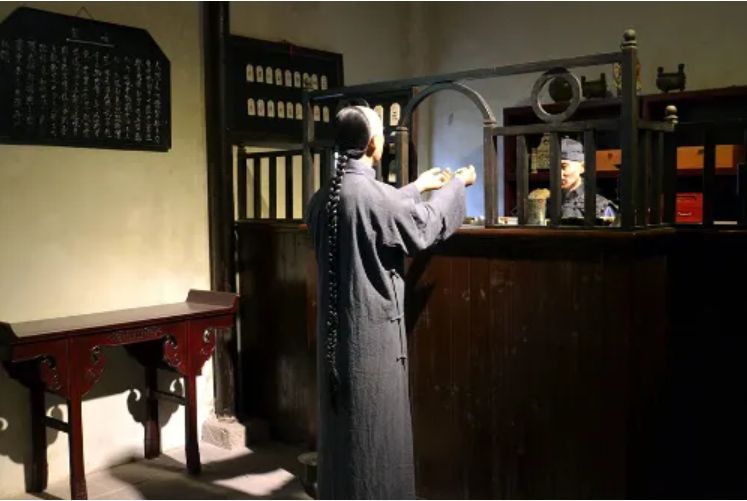
Dong Yinchu Memorial Hall
Mr. Dong Yinchu was born in Sanhe in 1915 and dedicated his life to the pursuit of truth, maintaining a sincere partnership with the Chinese Communist Party. His memorial hall is located on the ancient West Street of Sanhe Town and comprises five courtyards. The exhibition hall uses texts, photographs, artifacts, and wax figures to present his selfless and fearless life.
Yang Chen-ning Former Residence
A Huizhou-style residence originally built during the Ming and Qing dynasties. Consisting of five halls in a row, it is adjacent to the "One-Person Lane." Professor Yang Chen-ning lived and studied here with his mother during his childhood, and the residence bears traces of his diligent studies.
Sun Liren Former Residence
Sun Liren was a renowned anti-Japanese general and a senior Kuomintang military officer. Born in Sanhe in 1900, the Sun family owned vast fertile fields and hundreds of rooms in the town. The former residence still preserves the well from which the general drew water in his childhood.
Heru (Crane Lodge)
The former residence of Liu Bingzhang, a general of the Huai Army. Liu Bingzhang, a native of Sanhe, was a favored subordinate of Li Hongzhang. He led troops to repel the French army and decisively defeated the Nian Army, serving successively as Governor of Jiangxi, Governor of Zhejiang, and Governor-General of Sichuan. He once owned over a hundred residences in Sanhe; this one has been restored in later times.
Xiangu Lou (Immortal Maiden Pavilion)
In 1898, Shi Daosheng, Peng Zhongqiao, and Wang Liangzhi jointly invested in the establishment of the food industry enterprise "Zhonghexiang." Shi Daosheng was generous, charitable, and sincere, embracing the Buddhist principle of "good deeds bring good rewards." He worshipped year-round with incense and his entire family paid homage. Jin Jufeng, a wealthy merchant in Sanhe's department store industry, shared Shi's sentiments. Influenced by him, they gathered various merchants to build the "Xiangu Lou," gilding the statue, setting up an incense altar, lighting candles, offering cakes, and burning incense morning and evening. Despite his vast wealth, Jin Juzhai was troubled by having no daughter. On the Mid-Autumn Festival that year, he led his family in purification, fasting, and kowtowing, praying for a daughter. The following year (1903), his wife indeed gave birth to a daughter, named "Qigu" (Seventh Maiden). Since then, the Xiangu Lou gained widespread fame, attracting pilgrims from Shucheng, Tongcheng, Lujiang, and as far as Lu'an, Hefei, and Wuhu. The current Xiangu Lou largely retains its original appearance, and a stone stele inscribed with "Bodhisattva Heart Saves the World," erected in the 25th year of the Republic of China (1936), still stands.
Wangyue Ge (Moon-Viewing Pavilion)
Also known as "Guocui Lou" (Essence of the Nation Tower), this is a seven-story ancient pagoda standing 37 meters tall on the shore of Xiaonan Lake, and is one of the town's landmark buildings. The pavilion houses exhibition halls displaying nearly a thousand pieces of ancient art treasures from private collections in Sanhe Ancient Town. The second floor displays plaques of various styles from different dynasties, the third features Qing Dynasty red-lacquered carved and gold-leafed furniture, the fourth displays plaques of officials and celebrities as well as stone carvings, the fifth mainly shows official plaques, the sixth features Tang and Song wine vessels, Qing tinware, and other tin daily utensils, and the seventh displays Buddhist statues from various dynasties.
Sanhe Battle of the Taiping Heavenly Kingdom Exhibition Hall
In 1858, the Taiping Army defeated over 6,000 Hunan Army troops at Sanhe in what became known as the "Sanhe Victory." The exhibition hall is located at the site of the Taiping Army's garrison, preserving the original walls and well. Covering an area of 2,200 square meters, the hall is rich in historical materials and grand in scale, vividly recreating that turbulent period of history.
One-Person Lane (Yiren Xiang)
Tall ancient gable walls separate the buildings on both sides, leaving only enough space for one person to pass through, hence the name "One-Person Lane." This was a route that Professor Yang Chen-ning passed four times daily during his studies in Sanhe, and it is now a popular photo spot for tourists.
Suggested Sightseeing Route:
Enter through the Dajie Gate (Great Victory Gate), first visit the Former Residence of the King of the Brave (Gu Yingwangfu) to learn about the Taiping Heavenly Kingdom period, then proceed to the Taiping Heavenly Kingdom Ancient City Wall to experience the atmosphere of the ancient battlefield. Next, head to the Wannian Terrace (Ten-Thousand-Year Stage) to appreciate the central point of the ancient town. Then follow the ancient street to visit the Dong Yinchu Memorial Hall, Yang Chen-ning Former Residence, One-Person Lane, Xiangu Lou, and other attractions in sequence. Finally, arrive at Wangyue Ge and ascend the pavilion for a panoramic view of Sanhe, concluding the tour. Along the way, you can also admire the ancient bridges over the Xiaonan River and savor the charm of the water town.
Travel Tips:
Plan for 1–2 days to fully appreciate the charm of the ancient town.
Consider staying in a characteristic boutique inn within the town to experience the local lifestyle.
Sample local specialty foods such as Sanhe rice dumplings, tea-flavored dried tofu, and rice wine.
If you are interested in history and culture, hiring a tour guide can provide deeper insights into the town's historical and cultural significance.
Important Notes:
When strolling through the ancient streets, take care to protect the historic buildings—do not touch or damage them.
In summer, remember to apply sun protection and take measures against mosquitoes and insects.
When walking along the riverbanks, exercise caution to prevent falling into the water.
As the town attracts many visitors, keep an eye on your personal belongings.
Transportation:
Public Transit: From Hefei city center, take a bus to Feixi County, then transfer to a bus or shuttle bound for Sanhe Ancient Town.
Driving: Navigate directly to the Sanhe Ancient Town Scenic Area; parking lots are available near the scenic area.
Opening Hours:
The ancient town is open all day; individual internal attractions are generally open from 8:00 AM to 5:00 PM.
Tickets:
All-in-one pass: 110 RMB per person.