Hongcun Scenic Area is located in Hongcun Town, Yixian County, Huangshan City, Anhui Province, covering an area of 19.11 hectares. It is a traditional Chinese village, a nationally renowned historical and cultural village, and a key national cultural relic protection unit. In December 2000, Hongcun was inscribed on the UNESCO World Heritage List as part of the Ancient Villages in Southern Anhui. In May 2011, it was awarded the title of "National 5A-Level Tourist Attraction" by the China National Tourism Administration. Today, Hongcun preserves 137 ancient buildings from the Ming and Qing dynasties, including 3 ancestral halls and 124 well-preserved traditional residences. Notable structures such as Chengzhi Hall and South Lake Academy possess exceptional historical and artistic value, earning Hongcun the reputation of "a village in a Chinese painting."
History and Culture
Hongcun was first established in the first year of the Shaoxing reign of the Southern Song Dynasty (1131 AD), with a history of nearly 900 years. During the Southern Song, the village’s founding ancestor, Wang Yanji, fled a fire disaster and moved his family upstream along the stream from Qishu Village in Yixian to the area around Leigang Mountain, where they built houses and gradually formed a settlement. In the Yongle period of the Ming Dynasty, the 76th-generation ancestor Wang Siqi three times invited the Feng Shui master He Keda from Haiyang County (now Xiuning County) to survey and plan the village. They diverted water from the West Stream into the village, dug irrigation canals, and constructed the Crescent Pond, establishing the initial water system of the settlement.
The planning and construction of Hongcun were deeply influenced by Huizhou culture and Feng Shui theories. The overall layout resembles a reclining ox: Leigang Mountain forms the ox’s head; two ancient trees at the village entrance are the horns; the rows of houses make up the body; the Crescent Pond is the ox’s stomach; South Lake is the ox’s belly; the winding water channels are the intestines; and four ancient bridges are the legs. This "bionic" village layout is a model of traditional Chinese settlement planning.
Hongcun boasts profound cultural heritage, with multiple intangible cultural heritages, including Huizhou-style architecture and traditional Huizhou residential building techniques. During the Ming and Qing dynasties, the Wang clan members who became wealthy through commerce abroad would return to build residences, ancestral halls, and academies, forming a grand complex of ancient buildings that reflects the Huizhou merchants' cultural pursuit of "being merchants yet loving Confucianism."
Major Attractions
South Lake
Located at the southern end of Hongcun, South Lake was excavated in the 35th year of the Wanli reign of the Ming Dynasty (1607 AD) and covers about 2 hectares. The lake is shaped like a half-moon; an embankment divides it into upper and lower sections. On the embankment stand six stone bridges, known as the "Six Bridges," modeled after the Su Causeway on West Lake in Hangzhou. Surrounded by towering ancient trees, the lake offers picturesque views of mountains and water reflections—it is one of the most photogenic spots in Hongcun and a popular sketching base for art students from many academies.
Crescent Pond (Yue Zhao)
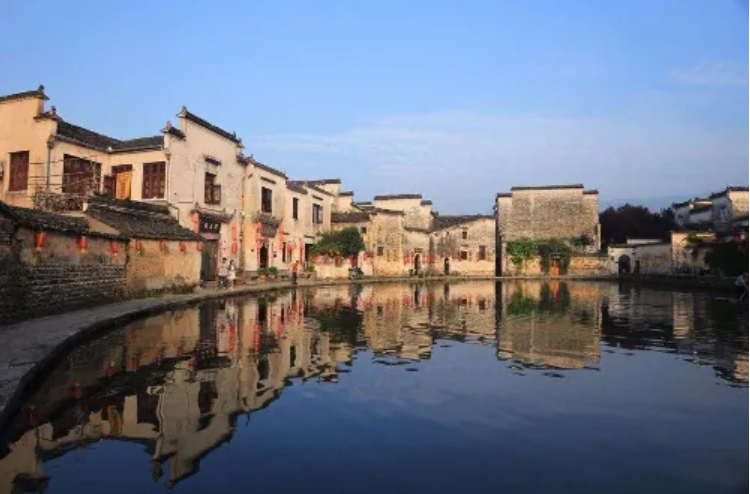
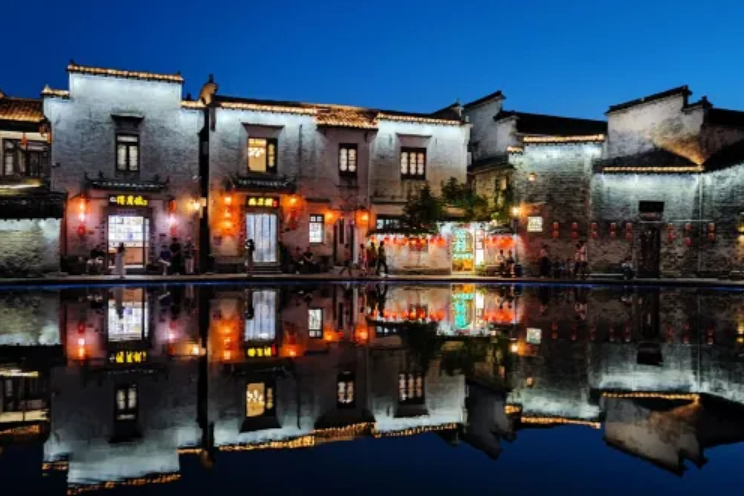
Situated in the center of Hongcun, the Crescent Pond was dug during the Yongle period of the Ming Dynasty and covers about 1,300 square meters. The pond is half-moon shaped, named after the saying "a full moon wanes," reflecting the traditional Chinese philosophy of the "Golden Mean." Ancient buildings line the pond, with whitewashed walls and black tiles mirrored in the water, creating a still ink-wash painting. The buildings around the pond are mostly ancestral halls and important residences, making it the core area of Hongcun.
Chengzhi Hall
Located in the middle section of Hongcun, Chengzhi Hall was built in the fifth year of the Xianfeng reign of the Qing Dynasty (1855 AD). It is the largest and most ornately decorated residence in Hongcun, covering a total area of 2,100 square meters with over 3,000 square meters of floor space, including 9 courtyards, 7 floors, and 60 rooms. The hall is renowned for its exquisite wood, stone, and brick carvings. Notably, the wooden carving on the main beam of the front hall, depicting "Emperor Suzong of Tang Entertaining Guests," features lifelike figures and is considered a masterpiece of Huizhou-style wood carving.
South Lake Academy
Located on the shore of South Lake, the academy was built in the 19th year of the Jiaqing reign of the Qing Dynasty (1814 AD) and was a private school funded by the Wang clan. The academy comprises several buildings, including Zhidao Hall, Wenchang Pavilion, Huiwen Pavilion, Qimeng Pavilion, and Wanghu Tower, covering about 6,000 square meters. Surrounded by a quiet environment, facing South Lake and backed by Leigang Mountain, it was an ideal place for study and learning. Many local children studied here, and some later achieved scholarly honors or commercial success.
Wang Clan Ancestral Hall
Also known as "Lexu Hall," it is located north of Crescent Pond and was built during the Yongle period of the Ming Dynasty. It served as a place for the Wang clan to worship their ancestors. The hall covers about 2,000 square meters with a built area of 1,300 square meters, consisting of a gate arch, courtyard, patio, and main hall. The main hall is bright and spacious, housing the ancestral tablets of the Wang clan, with thick pillars and exquisite carvings that exemplify the architectural style of Huizhou ancestral halls.
Shuren Hall
Located in the central part of Hongcun, Shuren Hall was built in the first year of the Tongzhi reign of the Qing Dynasty (1862 AD) and was the residence of the wealthy merchant Wang Xingju. Covering about 800 square meters with over 1,000 square meters of floor space, it includes 4 courtyards and 26 rooms. The hall is decorated with fine wood, stone, and brick carvings, especially the indoor "Hundred Children" wood carving, which symbolizes abundant offspring and good fortune, and is regarded as a high-quality example of Huizhou wood carving.
Jingxiu Hall
Situated on the west side of Crescent Pond, Jingxiu Hall was built during the Qianlong reign of the Qing Dynasty and is one of the best-preserved ancient residences in Hongcun. It covers about 600 square meters with over 800 square meters of floor space, featuring 2 courtyards and 16 rooms. The gate tower boasts exquisite brick carvings, and the interior décor is simple yet elegant, reflecting the merchant culture of "cultivating oneself and managing the family."
Deyi Hall
Located in the northwestern part of Hongcun, Deyi Hall was built during the Guangxu reign of the Qing Dynasty and is a typical private garden-style residence of the Huizhou tradition. It covers about 400 square meters with over 500 square meters of floor space, including 2 courtyards and 12 rooms. The garden layout is exquisite, featuring a pond, rockeries, and flowers, creating a tranquil environment—one of the few ancient residences in Hongcun with a garden landscape.
Jicun Street
Located on the north side of Hongcun, Jicun Street is a commercial street lined with shops, inns, and restaurants. The street retains traditional Huizhou architectural features, with winding bluestone-paved paths, offering visitors a taste of local customs and culture.
Suggested Tour Route:
Upon entering the scenic area, visitors can start with South Lake, enjoying the lake views and the ancient architecture of South Lake Academy. Then proceed to Crescent Pond to visit the Wang Clan Ancestral Hall and the surrounding old residences, experiencing the core cultural atmosphere. Next, tour Chengzhi Hall to admire the exquisite wood, stone, and brick carvings of Huizhou architecture. Afterward, visit other ancient residences such as Shuren Hall and Jingxiu Hall to learn about local residential culture. Finally, head to Jicun Street to sample local specialties and buy souvenirs. The entire tour is recommended to take about 3–5 hours. For a deeper experience of the night scenery and folk culture, consider staying overnight and joining the evening activities.
Travel Tips:
Learn about Huizhou architecture and the history of Hongcun in advance to better appreciate the cultural and architectural heritage.
Visit on weekdays or during the off-season to avoid crowds and enjoy the tranquil atmosphere.
Hire a local guide to gain deeper insights into the stories and cultural significance behind each attraction.
Wear comfortable shoes, as the village paths are mostly paved with bluestone and require a fair amount of walking.
If time permits, stay overnight to experience the village at dawn and dusk, and participate in night tours.
Hongcun is a popular destination for sketching; if interested, bring your painting tools and capture scenes at South Lake or Crescent Pond.
Important Notes:
Most ancient buildings are old and fragile; please do not touch, climb, or damage them to prevent irreversible loss.
Respect local customs and religious beliefs; avoid loud noises or inappropriate behavior in ancestral halls and similar sites.
When buying souvenirs or snacks, check quality and prices carefully to avoid being overcharged.
Protect the environment by not littering and keeping the village clean and beautiful.
Follow the instructions of staff and obey site regulations; do not enter restricted areas.
Roads within the scenic area are narrow, and crowds can be heavy during peak seasons—please stay safe and take special care of the elderly and children.
In summer, protect yourself from sun and heat; use insect repellent as there are many trees in the area.
Transportation:
By Air: Fly to Huangshan Tunxi International Airport, about 80 km from Hongcun. Take a shuttle bus to Yixian County, then transfer to Hongcun; the journey takes about 1.5 hours. Alternatively, take a taxi directly to Hongcun (cost approx. 200 RMB).
By Train: Take a train to Huangshan Station or Huangshan North Station. Huangshan Station is about 70 km from Hongcun; transfer to a bus to Yixian, then to Hongcun (total about 1.5 hours). Huangshan North Station is about 60 km away; similarly, take a bus to Yixian and then to Hongcun.
By Car: From Huangshan City, take the G56 Hangrui Expressway and exit at Yixian, then follow the navigation to Hongcun. The total distance is about 60 km, taking about 1 hour. From other cities, navigate to Yixian first, then to Hongcun. The scenic area has parking lots with a fee of about 15 RMB/day.
By Bus: Several bus stations in Huangshan City have direct buses to Hongcun. Huangshan Passenger Terminal offers about 10 daily services; the trip takes about 1.5 hours and costs about 25 RMB.
Opening Hours:
Regular opening hours: 7:30–17:30.
Night tour hours: 18:30–21:00 (some attractions are closed during the night tour).
Hours may be adjusted seasonally or due to weather conditions.
Ticket Price:
Admission: 94 RMB per person.