The Chongzuo Huashan Rock Art Scenic Area is located in Ningming County, Chongzuo City, Guangxi Zhuang Autonomous Region. It is a national 5A-level tourist attraction and an important component of the UNESCO World Heritage Site "Zuojiang Huashan Rock Art Cultural Landscape." The scenic area is renowned for its ancient and mystical rock art, which is the largest in area, most concentrated in composition, richest in content, and best-preserved among rock art sites of its kind in the world. It is hailed as the greatest symbol of China's rice-cultivation culture, a treasure of Zhuang culture, and a masterpiece of global rock art. The "Zuojiang Huashan Rock Art Cultural Landscape" comprises 38 representative rock art sites distributed across Ningming County, Longzhou County, Jiangzhou District, and Fusui County in Chongzuo City, covering a river section of 105 kilometers and a total area of 6,621.6 hectares.
History and Culture
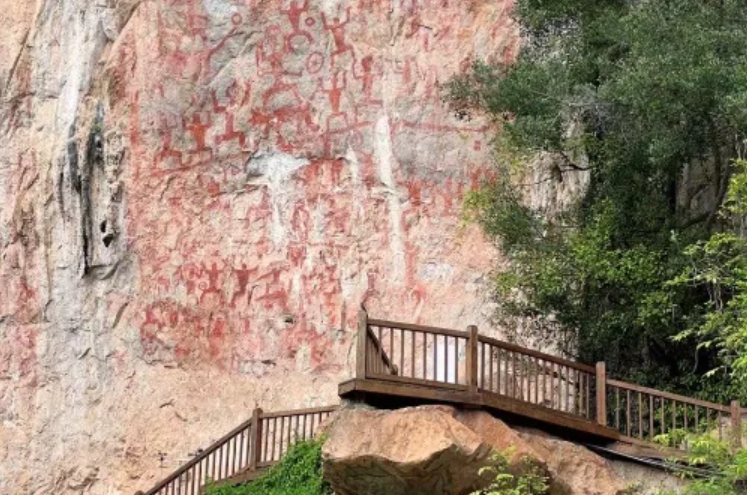
The Huashan rock paintings date back to the Warring States period to the Eastern Han Dynasty, with a history of over 2,000 years. They are relics left behind by the Luoyue people, ancestors of the local Zhuang ethnic group in the Zuojiang River basin of Lingnan, as part of their sacrificial rituals. The paintings were made with pigments mixed from hematite, animal glue, and blood, giving them a red color. The main panel is over 170 meters wide and 40 meters high, covering an area of more than 8,000 square meters. Apart from those that are indistinct, over 1,800 identifiable figures remain. These images are believed to record ceremonial activities and are remnants of shamanistic culture, authentically reflecting the long-vanished social activities of the Luoyue society.
The earliest written record of the Huashan rock art appears in Zhang Mu's Records of Strange Tales from the Ming Dynasty, and it is also mentioned in the Ningming Prefecture Annals compiled in the ninth year of the Guangxu reign (1883) of the Qing Dynasty. However, many mysteries remain unsolved regarding the content, painting methods, and purposes of the Huashan rock art, continuing to attract numerous scholars and tourists to explore them.
Main Attractions
Huashan Rock Art
The Huashan rock art is the core attraction of the scenic area and the largest single rock painting in the world. The panel measures 172 meters long, about 50 meters high, and covers over 8,000 square meters. It currently contains 111 groups of images totaling about 1,900 figures. The images are predominantly human figures, along with bronze drums, swords, knives, sheep-horn knobbed bells, and wild animals. The human figures are depicted with arms raised and bowed outward, and legs half-squatting as if dancing. The largest figure is 3.58 meters tall, while the smallest is only 20 centimeters. The paintings are in a reddish-brown color, with bold lines, varied postures, and lifelike appearances, together forming a grand historical panorama of the ancient Luoyue people.
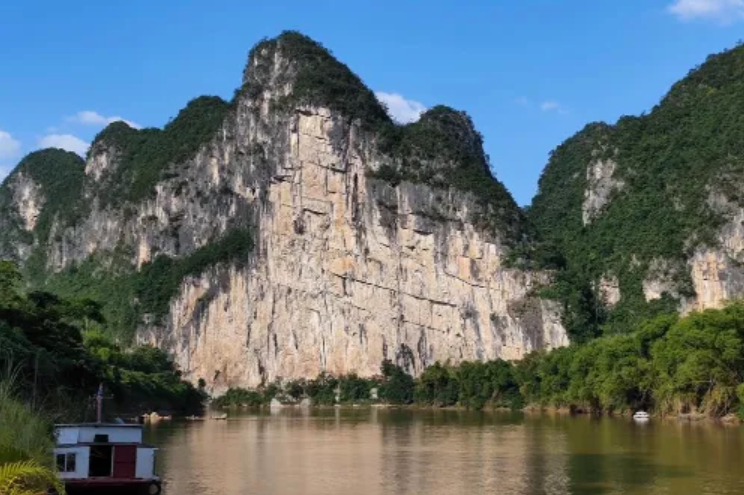
Gaoshan Rock Art
The mountain where the Gaoshan rock art is located has two peaks rising prominently, with steep cliffs facing the river. The north peak is 300 meters high, with the cliff face extending about 250 meters east–west along the river; the east peak is about 200 meters high, with the cliff face extending roughly 170 meters north–south. Painted during the Warring States to Eastern Han period, there are over 300 rock art figures in total: the north peak has 191 human figures, while the east peak has 41 human figures, 10 bronze drums, and a set of sheep-horn knobbed bells.
Longxia Mountain Rock Art
The Longxia Mountain rock art dates from the Warring States to Eastern Han period. It is divided into two sites. Site 1 is on the southwestern cliff face of Longxia Mountain, about 100 meters from the Ming River. The paintings are about 65 meters above the ground, covering about 20 square meters, with 12 identifiable figures, of which 6 are relatively complete, all side-view human figures. Site 2 is on the western cliff face of Longxia Mountain facing the river. The paintings are about 60 meters above the ground and include 50 figures: 44 human figures, 3 animal images, 2 bronze drum images, and 1 boat image.
Zhushan Rock Art
The Zhushan rock art dates from the Warring States to Eastern Han period and is the uppermost rock art distribution point along the Ming River, a tributary of the Zuojiang River. Zhushan runs north–south, with cliffs on the east side of both peaks facing the river. The south peak is about 120 meters high, and the north peak about 100 meters high. The rock art is distributed on the river-facing cliff faces of the two peaks, with a panel width of about 400 meters, composed of multiple independent pictures. Currently, there are 169 human figures, 15 animal images, and 10 bronze drum images.
Suggested Tour Route
You can start by visiting the Huashan Rock Art Visitor Center, where you can explore the digital exhibition hall to learn about Luoyue history and watch a Tianqin (a traditional Zhuang instrument) performance. Then proceed to Bahe Pier and take a boat along the Ming River to admire the ancient and mysterious Huashan rock art. After disembarking, visit the intangible cultural heritage exhibition hall and watch a dance performance. In the afternoon, take a stroll through Zhulian Old Kapok Art Village, play by the riverbank, view the Zhushan rock art, and try your hand at traditional ancient?method brown sugar making. In the evening, check in at the Huashan Hot Spring International Hotel, enjoy a Zhuang bamboo?tray feast, and soak in the natural hot springs.
Travel Tips:
Check the weather forecast in advance and choose a clear day for your visit to better appreciate the rock art.
Follow safety instructions and heed the staff's guidance when taking the boat tour.
Wear comfortable shoes for walking around the scenic area.
If you are interested in history and culture, you may read relevant materials beforehand to gain a deeper understanding of the rock art.
Important Notes:
The scenic area implements a real?name reservation system for ticket purchases; be sure to book in advance.
Pets are not allowed on sightseeing boats, shuttle buses, or within the scenic area.
For cultural relic protection and safety reasons, aerial surveys, drone flights, and other flying activities are prohibited in the rock art boardwalk area.
Do not touch, or apply paint or carvings on the rock art, cultural relics, trees, or public facilities.
In case of adverse weather, the rock art boardwalk will be temporarily closed; please keep an eye on official notices.
Transportation:
Self?driving: Navigate directly to the Ningming Huashan Rock Art Scenic Area Visitor Center or the Ba Yao Visitor Service Center to purchase tickets.
Tourist shuttle: A dedicated tourist bus route runs between Ningming Bus Station and Chongzuo International Passenger Transport Center.
Scenic area bus: Upon arriving at Chongzuo South Railway Station, you can transfer to the scenic area's direct bus.
Opening Hours:
General service hours are from 08:00 to 18:00, but these may be adjusted according to actual conditions. In case of severe weather, the rock art boardwalk will be closed.
Tickets:
Boat ticket (round trip): 90 RMB per person.