Mount Huangshan Scenic Area is located in Huangshan District, Huangshan City, Anhui Province. It is a national-level scenic area, a national 5A-level tourist attraction, and a UNESCO World Cultural and Natural Heritage Site. The total area of the scenic area is approximately 160.6 square kilometers, with the core scenic area covering about 1,154 square kilometers. It consists of 72 peaks, of which Lotus Peak, Bright Summit, and Heavenly Capital Peak are the three main peaks, all rising above 1,800 meters. Lotus Peak is the highest at 1,864.8 meters. Mount Huangshan is renowned worldwide for its "five wonders": peculiarly shaped pines, grotesque rock formations, sea of clouds, hot springs, and winter snow. It is honored as the "No. 1 Fantastic Mountain under Heaven." The vegetation coverage rate in the scenic area reaches 98.29%, with 1,805 species of higher plants belonging to 827 genera and 222 families, as well as over 300 species of wildlife, making it an important area for biodiversity conservation in China.
History and Culture
Mount Huangshan has a long history. In the Qin Dynasty, it was called "Yi Mountain." In the sixth year of the Tianbao era of the Tang Dynasty (747 AD), Emperor Li Longji issued an imperial edict renaming Yi Mountain to Huangshan (Yellow Mountain), a name that has been used ever since. Mount Huangshan is one of the sacred sites of Taoism in China. Legend has it that the Yellow Emperor (Xuanyuan) once practiced alchemy and cultivated himself here, leaving behind relics such as the Alchemy Platform and the Herb-Washing Pool. During the Ming and Qing dynasties, the mountain became a favorite destination for literati and artists, giving rise to artistic schools such as the "Huangshan Painting School." Painters like Shi Tao and Jian Jiang created numerous masterpieces inspired by the mountain's scenery. Today, there are over 280 cliff inscriptions in the scenic area, among which inscriptions like "Immediately Ascend the East Sea, Climb High to Gaze at Peace" hold significant historical and cultural value.
Mount Huangshan was also an important site for the spread of Buddhism. During the Tang Dynasty, temples such as Xiangfu Temple and Cuiwei Temple were built. The现存 (existing) Yungu Temple and Ciguang Pavilion were constructed during the Ming and Qing dynasties and serve as important physical materials for studying the propagation of Buddhist culture in the Huangshan region. In addition, Tunxi Old Street and ancient Huizhou-style villages at the foot of the mountain embody rich Huizhou culture, showcasing distinctive cultural elements such as Huizhou merchants, Huizhou architecture, and Huizhou folk customs.
Major Attractions
Lotus Peak
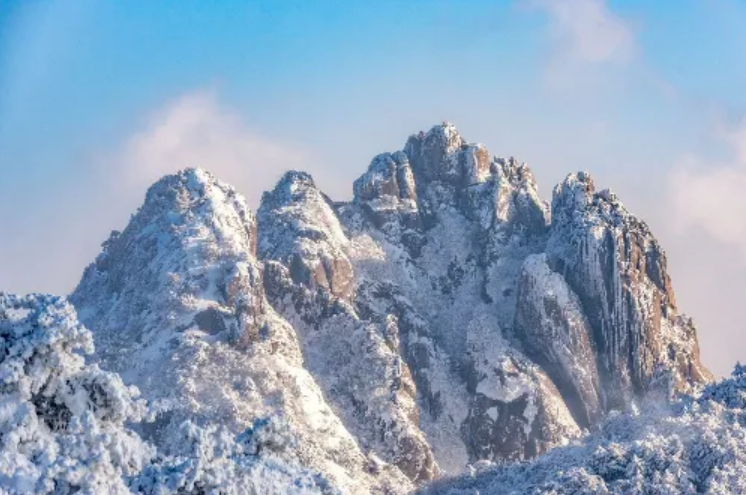
Lotus Peak is the highest peak of Mount Huangshan, at 1,864.8 meters above sea level. It is named for its shape resembling a blooming lotus. The peak is steep and towering, offering a majestic view. From the summit, visitors can enjoy a panoramic view of the entire Huangshan range and marvel at wonders such as the "Buddhist halo in the sea of clouds." Lotus Peak faces Heavenly Capital Peak across a valley, and the two peaks are opened to visitors on a rotating basis every five years. From 2023 to 2027, Lotus Peak is open to the public.
Bright Summit
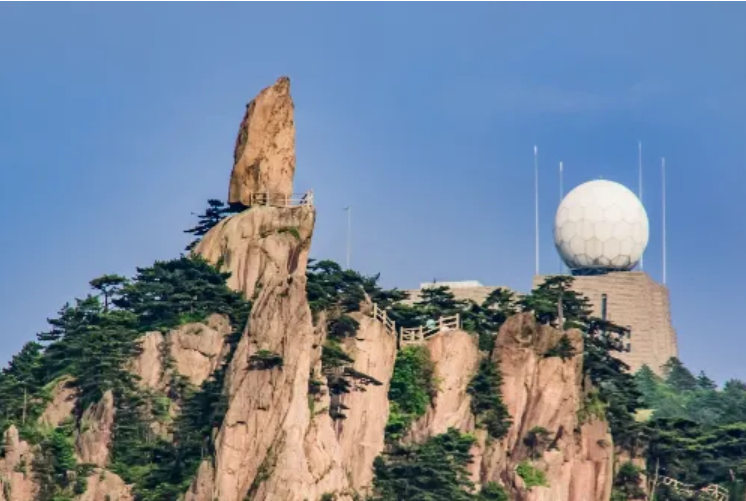
Bright Summit stands at 1,860 meters, making it the second highest peak of Mount Huangshan. It gets its name from its high, open terrain and long hours of sunlight. This is one of the best spots on the mountain to watch the sunrise and observe the sea of clouds. It houses the Huangshan Meteorological Station, the highest-altitude weather station in East China. There are many scenic spots around Bright Summit, such as Flying Stone and White Goose Ridge, making it a popular gathering place for visitors.
Heavenly Capital Peak
Heavenly Capital Peak has an elevation of 1,829.5 meters and is famous for its steepness. In ancient times, it was called "the capital of all immortals," implying a heavenly metropolis. The peak features treacherous paths like the Crucian Carp Back, a stone ridge about 10 meters long and only 1 meter wide, with bottomless abysses on both sides—it is one of the most perilous spots on Mount Huangshan. Heavenly Capital Peak rotates its opening with Lotus Peak; it will reopen to visitors in 2028.
Greeting Pine
The Greeting Pine is an iconic landmark of Mount Huangshan. Located to the left of Yuping Pavilion and above Wenshu Cave, it stands 10.1 meters tall and is about 1,300 years old. One of its branches stretches out like an arm welcoming guests from afar, with an elegant posture that makes it a representative of Huangshan pines. The Greeting Pine is listed in the World Natural Heritage protection roster and is under the care of dedicated guardians.
West Sea Grand Canyon
The West Sea Grand Canyon lies in the western part of the Mount Huangshan Scenic Area. It is one of the most beautiful and deepest canyons of the mountain, stretching approximately 15 kilometers in length, with an average depth of 1,000 meters and a maximum depth of 1,300 meters. Inside the canyon, strange peaks rise abruptly, grotesque rocks are scattered, and clouds and mist swirl around, creating a fairyland-like atmosphere. A sightseeing cable car is available for visitors to enjoy the canyon scenery, and they may also choose to hike through the canyon to experience the delight of "every step revealing a scenic view."
Hot Spring Scenic Area
The Hot Spring Scenic Area is located on the front side of Mount Huangshan and is one of the "five wonders." The hot spring water maintains a temperature of around 42°C throughout the year. It is clear and rich in various minerals, which are said to be effective for skin diseases, rheumatism, and other ailments. The hot springs have a long history, with records indicating over 2,000 years of use. A hot spring bathhouse was built here during the Tang Dynasty, and today cliff inscriptions such as "Famous Spring under Heaven" can still be seen.
Suggested Tour Routes:
One-Day Tour Recommended Route:
Enter via the South Gate, take the scenic shuttle bus to Ciguang Pavilion, then take the Yuping Cable Car up the mountain. Visit Yuping Pavilion, Greeting Pine, Lotus Peak (if open), and Heavenly Capital Peak (if open), then proceed to Bright Summit. After lunch, explore the West Sea Grand Canyon, take the ground cable car to Baiyun Hotel, then pass through Buxian Bridge and Tianhai before taking the Yungu Cable Car down the mountain, and finally return to the South Gate by shuttle bus.
Two-Day Tour Recommended Route:
Day 1: Enter via the South Gate, take the shuttle bus to Yungu Temple, then take the Yungu Cable Car up the mountain. Visit White Goose Ridge, Shixin Peak, the North Sea Scenic Area, and the northern entrance of the West Sea Grand Canyon. Hike or take the ground cable car to the canyon floor, then return to Tianhai and stay overnight at Baiyun Hotel.
Day 2: Get up early to watch the sunrise at Bright Summit, then visit Yuping Pavilion, Greeting Pine, Lotus Peak (if open), and Heavenly Capital Peak (if open). Take the Yuping Cable Car down and return to the South Gate.
Travel Tips:
Recommended visiting duration: 2–3 days to fully appreciate the natural and cultural charms of Mount Huangshan.
Check the weather forecast in advance and choose a sunny or partly cloudy day for better views of the sea of clouds and sunrise.
Wear comfortable sports shoes and a windproof jacket, as there are many mountain paths and the temperature at the summit is relatively low, especially with large temperature differences between morning and evening.
Bring enough drinking water and snacks; prices on the mountain are higher, so consider packing high-calorie foods like chocolate and beef jerky.
Follow queue discipline when taking cable cars, keep your belongings secure, stay safe while hiking, and do not climb undeveloped areas.
Important Notices:
Smoking and littering are prohibited within the Mount Huangshan Scenic Area. Please protect the environment and keep the area clean.
Some sections of the trails are very steep, such as the Crucian Carp Back on Heavenly Capital Peak and parts of the West Sea Grand Canyon. Exercise caution and hike with companions.
Thunderstorms are common. In case of thunderstorms, do not stay on summits or under large trees; take shelter promptly.
During peak season, especially holidays, the area is crowded. It is advisable to book accommodation in advance to avoid disruptions to your itinerary.
Respect local customs. Keep quiet and follow relevant regulations when entering temples or other religious sites.
Transportation:
By Air: Fly to Huangshan Tunxi International Airport, about 50 km from the scenic area. Take the airport shuttle bus (20 RMB/person, about 1 hour) or a taxi.
By High-Speed Rail / Train: Take a high-speed train to Huangshan North Station, about 50 km from the scenic area. Take the dedicated shuttle bus (20 RMB/person, about 1 hour). Alternatively, take a regular train to Huangshan Station, where tourist buses are available (19 RMB/person, about 1.5 hours).
By Car: Drive via the Jingtai Expressway or Hangrui Expressway to the scenic area. There are three parking lots at the South Gate, North Gate, and East Gate. The South Gate lot is the largest, with fees of 30 RMB/day for small cars, 40 RMB/day for medium vehicles, and 50 RMB/day for large vehicles.
Internal Shuttle: Within the scenic area, traffic is restricted, and visitors must take the scenic shuttle buses to various attractions. The shuttle fare is 19 RMB/person for a one-way trip. From the South Gate to Ciguang Pavilion or Yungu Temple, you must take the shuttle.
Opening Hours:
Open year-round.
Peak season (March 1 to November 30): 6:30 – 17:30
Low season (December 1 to February 28): 7:30 – 16:30
Cable car operating hours:
Peak season: 6:30 – 17:40
Low season: 7:30 – 16:40
Opening hours are subject to change due to weather, seasons, or other factors. Please check official announcements before your trip.
Tickets:
Ticket prices start from 95 RMB per person.