The Mogao Caves are located on the eastern cliff of Mingsha Mountain, about 25 kilometers southeast of Dunhuang City, Jiuquan City, Gansu Province. They are a UNESCO World Heritage Site and one of China's four great grottoes. Renowned for their exquisite murals and painted sculptures, the caves are hailed as the "Art Gallery in the Desert" and the "Museum on the Walls." Construction began in the Former Qin period of the Sixteen Kingdoms and continued through the Northern Dynasties, Sui, Tang, Five Dynasties, Western Xia, and Yuan dynasties, eventually forming a vast complex. Today, 735 caves survive, housing 45,000 square meters of murals and 2,415 painted clay sculptures—making it the world's largest and richest repository of Buddhist art. The core protected area covers about 1,324.54 hectares, with a construction control zone of approximately 1,980 hectares. It is a world-class cultural attraction integrating history, art, religion, and culture.
History and Culture
The excavation of the Mogao Caves began in 366 CE (the second year of the Jianyuan era of the Former Qin), when the monk Le Zun opened the first cave. Later, the monk Fa Liang and others continued the work, gradually turning the site into a Buddhist retreat. During the Sixteen Kingdoms period, northern regimes promoted Buddhism, giving the caves their initial growth—cave forms were simple, and murals were rustic in style. In the Northern Dynasties, the Northern Wei, Western Wei, and Northern Zhou expanded the caves; their numbers increased, and murals and sculptures began to merge Central Plains culture with Western Regions artistic traits.
The Sui and Tang dynasties marked the peak of the Mogao Caves. National unity, economic prosperity, and thriving Silk Road trade made Dunhuang a hub of cultural exchange between China and the West. The number of caves skyrocketed, and artistic quality reached its zenith. Tang-dynasty caves are grand in scale, with brilliantly colored murals and diverse themes, and sculptures that are full and lifelike, embodying the high Tang spirit. During the Five Dynasties, Song, and Western Xia periods, cave construction continued, though on a smaller scale, yet retaining distinctive stylistic features of each era. After the Yuan dynasty, excavation largely ceased, and the remote location helped preserve the site intact.
In modern times, the Mogao Caves drew global attention. In 1900, the Library Cave was discovered, yielding over 50,000 artifacts—manuscripts, silk paintings, embroideries, and more—sparking worldwide academic interest and giving rise to the specialized field of "Dunhuang Studies." In 1987, the Mogao Caves were inscribed on the UNESCO World Heritage List, becoming a shared cultural treasure of humanity. Today, they serve as a vital cultural medium showcasing ancient Sino-Western exchanges, Buddhist art evolution, and ancient social life.
Major Attractions
Nine?Story Pavilion
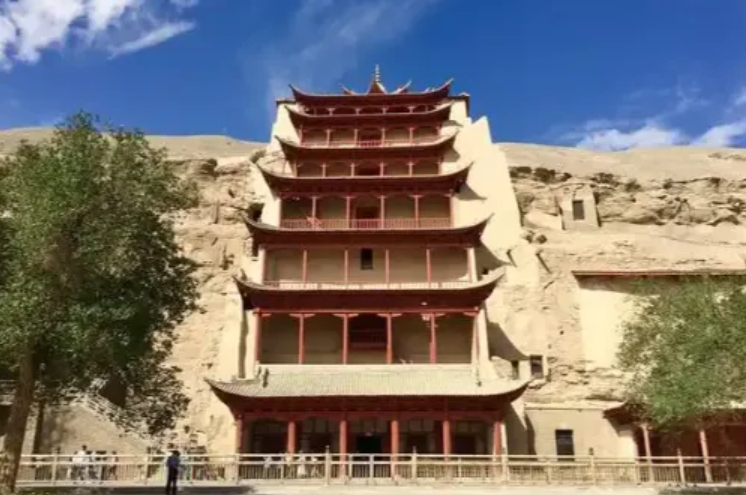
The Nine?Story Pavilion is the iconic structure of the Mogao Caves, designated Cave 96. Excavated in the early Tang, it is named for the nine?story wooden eaves built outside the cave. Inside enshrines a 35.5?meter?tall Maitreya Buddha—the largest painted clay sculpture at Mogao and one of the largest ancient clay statues in China. The pavilion, built against the cliff with upturned eaves, appears magnificent. Though restored many times, the current structure dates from the Republican era and is the first major sight visitors see upon entering the site.
Library Cave (Cave 17)
The Library Cave, numbered Cave 17, is a small cave from the late Tang, originally a memorial shrine for the Hexi monk Hong Bian. In 1900, the Daoist priest Wang Yuanlu accidentally discovered it, revealing more than 50,000 sealed artifacts—sutras, documents, embroideries, paintings, and more—spanning the Sixteen Kingdoms to the Northern Song, covering religion, literature, history, art, and science. It is one of the most significant archaeological discoveries of the 20th century. Today, the cave is empty of original artifacts but displays its original structure, serving as a key site for understanding the origins of Dunhuang Studies.
Central?Pillar Caves
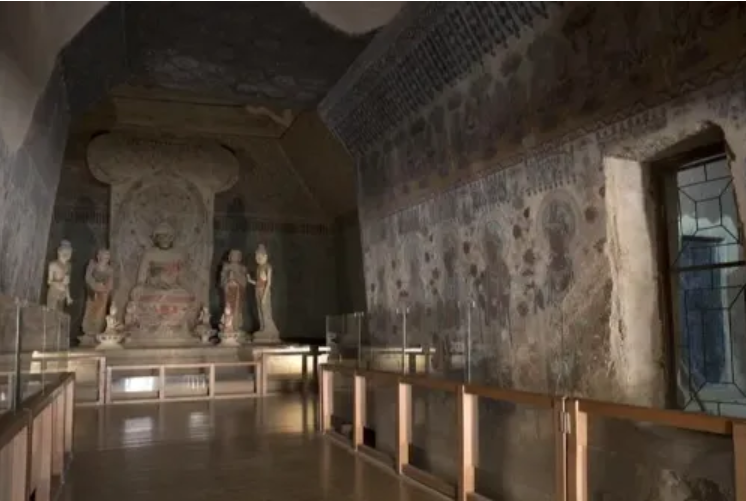
Central?pillar caves are a typical cave form from the Northern Dynasties, with representative examples such as Caves 254 and 257. Inside, a square pillar stands at the center, with niches on each side housing Buddha figures. Murals mainly depict Buddhist jātaka stories and causal tales, rendered in a simple and robust style that blends Gandharan art from the Western Regions with Central Plains aesthetics. They are core physical remains for studying Northern Dynasties Buddhist art and cave architecture.
Great Tang?Dynasty Caves
The great Tang caves, represented by Caves 130 and 148, are the pinnacle of Mogao art. Cave 130 is a large?statue cave from the High Tang, containing a 26?meter?high Maitreya Buddha; Cave 148 is a Nirvana cave, housing a 15.8?meter?long reclining ?ākyamuni Buddha, surrounded by disciples, bodhisattvas, and celestial figures. The murals are vividly colored with flowing lines, depicting Western Pure Land scenes, flying apsaras, and sutra illustrations, vividly showcasing Tang artistic mastery and social life.
Dunhuang Academy Exhibition Center
Located at the entrance of the Mogao site, the Dunhuang Academy Exhibition Center is a modern facility displaying Dunhuang artifacts and art. Through replicated caves, specimen exhibits, graphic panels, and digital media, it systematically presents the history, art, archaeological discoveries, and conservation achievements of the Mogao Caves. Visitors can gain background knowledge here and view replicas of caves not open to the public, complementing their on?site experience.
Suggested Itinerary:
Mogao Caves Digital Exhibition Center → Shuttle bus stop → Cave area → Nine?Story Pavilion → Library Cave → Central?pillar caves → Great Tang caves → Dunhuang Academy Exhibition Center → Shuttle bus stop → Return to Digital Exhibition Center
Visiting Tips:
Book tickets in advance through the official Mogao Caves reservation platform. During peak season, book at least 15 days ahead to avoid sold?out situations.
Before your visit, watch the two introductory films at the Digital Exhibition Center to learn about the history and cave art, enhancing your on?site experience.
Follow the professional guide assigned by the site; independent touring is not permitted. Each guided group visits 8–15 physical caves.
Allow about 3–4 hours in total, including films, shuttle rides, cave visits, and exhibition center tour.
Combine with nearby attractions like Mingsha Mountain & Crescent Lake and Dunhuang Ancient City for a one?day or two?day itinerary.
Bring drinking water and some snacks, as dining options near the cave area are limited; in summer, stay hydrated.
Important Notes:
Photography, videography, touching murals or sculptures, and using flash or any lighting equipment inside the caves are strictly prohibited.
Maintain silence during the visit; no loud talking, running, or touching the cave walls.
Flammable/explosive items, controlled knives, drones, and other prohibited articles are not allowed.
Strictly follow site regulations: do not leave your group, do not enter unopened cave areas.
The cave area is a core heritage protection zone; no carving, graffiti, or littering—help preserve the cultural environment.
Elderly visitors, children, and pregnant women should be accompanied by family members and arrange their itinerary according to physical conditions.
The site uses real?name entry; bring your original ID card (or household registration book for children without ID).
Transportation:
Public bus: Take the Dunhuang Mogao Caves tourist shuttle from near Dunhuang Hotel; the ride takes about 30 minutes.
Taxi: From Dunhuang city center to the Digital Exhibition Center, about 20 minutes.
Self?driving: Navigate to the Digital Exhibition Center parking lot; parking is free, but private cars are not allowed into the cave area.
Ride?hailing: Book via apps; fares are similar to taxis and offer flexible convenience.
Opening Hours:
The Mogao Caves operate on a timed?entry reservation system.
Peak season (April 1 – October 31): 8:00–18:00; Digital Exhibition Center screenings start at 8:00; last entry is at 15:00.
Off?season (November 1 – March 31): 9:00–17:30; screenings start at 9:00; last entry is at 14:00.
Hours may be adjusted on holidays or for conservation needs; check official announcements for legal holiday schedules.
Ticket Price:
From ¥140 per person.