Located 5 km south of Dunhuang City, Jiuquan City, Gansu Province, the Mingsha Mountain and Crescent Moon Spring Scenic Area is a UNESCO Global Geopark and a national 5A-rated tourist attraction. The planned area covers 212.86 km2, with a scenic area of 76.82 km2 and a core zone of 12.79 km2. Renowned for its unique landscape of "sand and spring coexisting, sand and water living in harmony," it is praised as "one of the most magnificent sights beyond the Great Wall."
History and Culture
In the Han Dynasty, Mingsha Mountain was called "Shensha Mountain" or "Shajiao Mountain," and it was first named "Mingsha Mountain" during the Wei and Jin periods. Crescent Moon Spring was known as "Shajing" in the Han Dynasty, "Yaochun" (Medicinal Spring) in the Tang Dynasty, and received its current name in the Qing Dynasty. As early as the Han Dynasty, it was a popular tourist destination. In the Tang Dynasty, the spring had deeper and broader waters, with pleasure boats and temples along its banks. In July 1988, the site came under government management and protection. In 1994, it was designated as one of the third batch of "National Key Scenic Spots" by the State Council. In 2015, it was rated as a national 5A tourist attraction and a China Dunhuang World Geopark.
Major Attractions
Mingsha Mountain
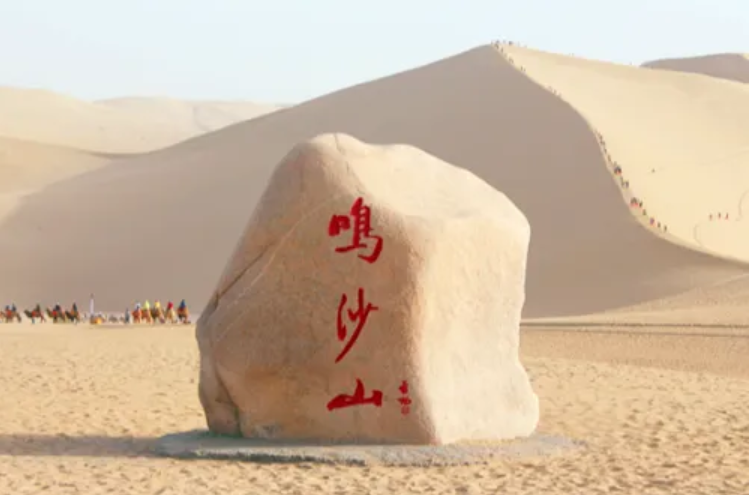
Stretching about 40 km east–west and 20 km north–south, with its main peak at 1,715 meters above sea level, the mountain is formed by fine sands in five colors: red, yellow, green, black, and white. Viewed from the foot, the dunes resemble ancient Egyptian pyramids, appearing splendid and majestic. When people slide down the slopes, the sand emits a loud rumbling sound, hence the name "Mingsha" (Singing Sand Mountain).
Crescent Moon Spring
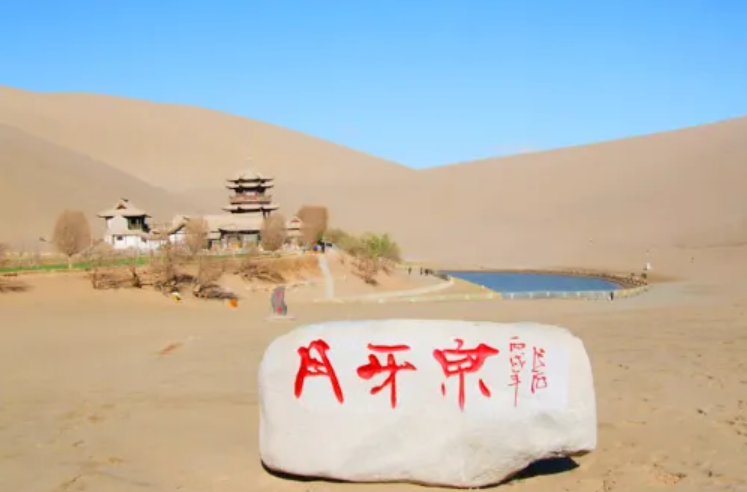
Nestled in the embrace of Mingsha Mountain, the spring is shaped like a crescent moon. Its water is deeper in the east and shallower in the west, with a maximum depth of about 5 meters, earning it the title "No. 1 Spring in the Desert." In 2022, the water area was 8,200 m2, with a length of 242 meters east–west, a maximum width of 50 meters north–south, an average depth of about 1.5 meters, and a deepest point of 2.2 meters.
Folk Customs Museum
Built in 1988, the museum covers a floor area of 4,300 m2. Its exterior is a traditional castle-like structure, with inner courtyards built in the typical Siheyuan (quadrangle) style common in Dunhuang residential architecture. The museum collects and displays the essence of Dunhuang folk architecture, living customs, and traditional culture, serving as a base for exhibiting modern Dunhuang folk heritage.
Couple Willows
Planted in 1971, these are two drought-resistant willows that grow from the same root system, side by side, and are known as the "Couple Willows," a popular desert attraction where visitors often pause to admire them.
Site of the Medicine King Temple
More precisely called the Medicine King Cave, it was discovered in the 1990s. A wooden merit stele unearthed there confirmed that it was built in the 23rd year of the Jiaqing reign of the Qing Dynasty (1818) in honor of the famed physician Sun Simiao. Today, only a few broken walls and ruins remain.
Mingyue Square Archway
Built in 1994 in the imitation Tang-Song ancient architectural style, the archway is laid out in a Bagua (eight-trigram) shape. At the top are two doves facing each other with spread wings; on both sides are screens extending forward. The front upper panel bears the calligraphic inscription "Mingsha Mountain Crescent Moon Spring" by the renowned calligrapher Mr. Qi Gong. The central pillars on the front and the back carry poetic inscriptions and plaques by famous calligrapher Mr. Shen Peng and prominent figure Mr. Wang Jifu. The overall structure is magnificent, robust, and dignified.
Tour Routes:
Sightseeing Route: Mingyue Square Archway → Tiebeiyu Park → Mingsha Mountain → Mingyue Pavilion → Crescent Moon Spring. This route offers views of the grand desert landscape and the chance to climb the magical Mingsha Mountain.
Leisure and Entertainment Route: Mingyue Square Archway → Camel riding → East Peak of Mingsha Mountain → Tiebeiyu Park → Crescent Moon Spring.
These two routes form a loop, allowing for a full panoramic tour and in-depth experience.
Travel Tips:
Choose suitable times—avoid the midday heat; early morning or late afternoon are ideal for both scenery and comfort.
Prepare sun protection in advance, such as sunscreen, sunglasses, and a sun hat, as the desert sun is intense.
Camel riding is recommended to save energy and better enjoy the desert atmosphere.
For sand sliding, you can rent sandboards inside the scenic area; take care to avoid collisions and stay safe.
Important Notes:
Follow scenic area regulations; do not climb dunes in restricted areas.
Protect the environment; do not litter; keep the area clean.
Follow the staff's instructions when riding camels; avoid dangerous actions while the camel is moving.
The desert climate is dry; drink plenty of water to prevent dehydration.
Transportation:
By Air: Dunhuang Airport is 13 km east of the city. Airport shuttles run three times daily at 09:00, 14:00, and 21:00, taking about 20 minutes to reach the city center. Taxis and public buses are also available; the airport bus stop is 500 meters west of the airport.
By Train: Dunhuang has Dunhuang Railway Station (about 10 km east of the city) and Liuyuan Station (on the Lanzhou–Xinjiang Railway, serving many major cities). From Dunhuang Station, take a bus, taxi, or arrange hotel pickup. From Liuyuan Station, take a long-distance bus to Dunhuang city.
By Long-Distance Bus: Dunhuang Long-Distance Bus Station has services to cities within and beyond the province.
Local Transport: City Bus No. 3 reaches the scenic area (stops include Muzhi Chang, Shuigongsi, etc.), with departures about every 10 minutes. Taxis are also available, metered.
Opening Hours:
Peak season (April–November): 06:00–19:30
Off-season (December–March): 07:00–19:00
(Hours are subject to change with seasons and weather; please check the official website for the latest updates.)
Ticket Price:
110 RMB per person.