Yeliguan Tourism Area is located in Lintan County, Gannan Tibetan Autonomous Prefecture, Gansu Province, on the northeastern edge of the Qinghai-Tibet Plateau and the western section of the Qinling Fold Belt. It sits at the transitional zone between the Qinghai-Tibet Plateau and the Loess Plateau. Centered around Yeliguan Town in Lintan County, the scenic area comprises two sections – Chibi Yougu (Red Cliffs & Mystic Valley) and Tianchi Yehai (Ye Lake of Heavenly Lake) – covering a total area of 20.2 square kilometers.
The area integrates alpine lakes, Danxia landforms, subalpine meadows, and forest canyons. It features pristine natural landscapes such as primitive forests and subalpine meadows, interwoven with terraced fields – creating a highly scenic and recreational value. In December 2024, it was rated as a national 5A-level tourist attraction. It has also received numerous titles, including National Geopark, National Forest Park, National Water Scenic Area, National Sports Tourism Demonstration Base, as well as China's Top Ten Cultural and Ecological Tourism Destinations and China Forest Oxygen Bar.
Its unique geographical environment nurtures rich flora and fauna. The area is home to over 1,300 species of higher plants across 122 families and 433 genera, including more than 30 rare plant species, over 40 valuable tree species, more than 30 nationally protected animal species, 37 endangered butterfly species, and over 120 precious wild medicinal herbs, making it an important repository of Chinese herbal medicine resources in Northwest China.
Historical and Cultura
Yeliguan's history can be traced back to the Northern Wei Dynasty. In the fourth year of Taiping Zhenjun (443 AD), Shuichi County was established. In the first year of Shengui (518 AD) under Emperor Xiaoming, the Qiang chieftain Que Tieliu proclaimed himself king here. The county system continued through the Sui Dynasty. In the late Tang Dynasty, the area fell to the Tubo, who built Gongling City to garrison it. During the Ming and Qing dynasties, it belonged to Taozhou Prefecture.
As an important post station on the "Tang-Tubo Ancient Road" and the "Tea-Horse Ancient Road," and a gateway to Tibet, Yeliguan once served as a key passage for tea-horse trade between Tibetan regions and Gansu, witnessing the cultural integration of Tibetan, Hui, Han, and other ethnic groups.
This is the birthplace of "Taozhou Huar" (folk songs), and the annual Huar Festival is renowned both at home and abroad. The area also preserves the site of the Quantan Peasant Uprising, as well as numerous ancient castle ruins including Shuichi Ancient City, Gongling City, and Shiguan Fort. Remnants of the Dashun City of the Song Dynasty and the Shimiao Fort of the Ming Dynasty can still be found, and the ancient Qinzhi Road trail runs across the mountains.
Major Attractions
Chibi Yougu (Red Cliffs and Mystic Valley)
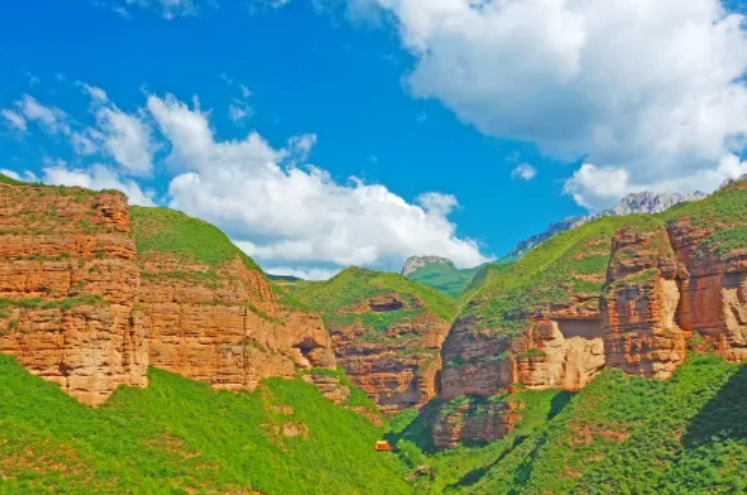
Located 5 km west of Yeliguan Town, this is a typical Danxia landform. Amidst lush green forests, ochre-colored rock cliffs suddenly appear, with the Yemu River flowing in front and extending to Baishi Mountain at the rear, reaching a depth of 20 km. A stream runs through the valley bottom, and the reddish sandstone cliffs on both sides, weathered and eroded, take on myriad shapes – screens, lions, tigers, monks, pythons, and more – inspiring endless imagination as one walks through.
Tianchi Yehai (Ye Lake of Heavenly Lake)
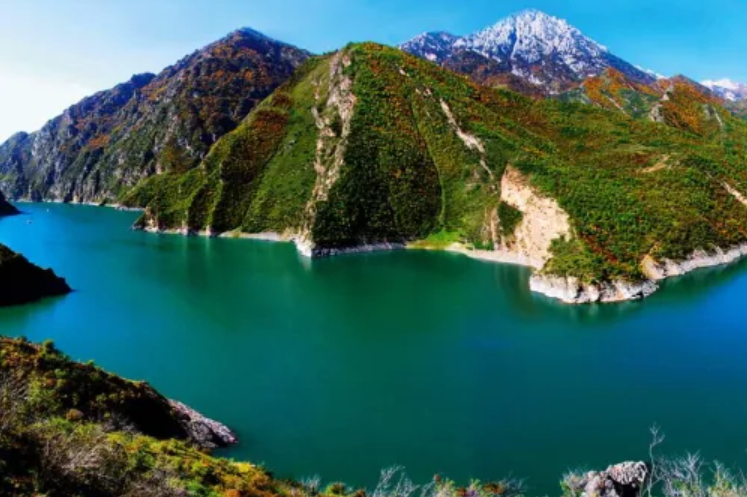
Situated between Baishi Mountain and Miaohua Mountain, 5 km north of Yeliguan Town, at an altitude of 2,610 meters, this is an alpine barrier lake. It is 5 km long and ranges from tens to over a hundred meters in width. The lake shimmers with emerald blue water, surrounded by verdant mountains, wildflowers, and green fields. At the hilltop by the lake stands the Changye Temple, enshrining a statue of General Chang Yuchun of the Ming Dynasty – hence it is also known as "Changye Pool." In deep winter, the lake freezes, and the ice surface displays strange and vivid patterns. Local villagers come on the eighth day of the twelfth lunar month each year to observe the ice patterns and predict the coming year's harvest.
General's Horse-Watering Spring
Located at the valley bottom below the Shimenkan (Stone Gate Pass) of Tianchi Yehai, this is a canyon flat spring, fed by the lake's water. It covers about 300 square meters and is roughly 1.7 meters deep. Legend has it that General Chang Yuchun watered his horse here during his campaigns, hence the ancient name "Horse-Watering Spring." The spring water remains abundant throughout the year at a constant level, earning it the nickname "Eye of the Earth."
Xiangshui Grassland
The Xiangshui River, one of the main water sources of Tianchi Yehai, is known as the "Source of Yehai." The grassland around it is called Xiangshui Grassland. Due to differences in gradient and rock composition along its course, the river forms a classic "meandering" (snake-like) channel pattern, resembling a serpent.
Yehai Ice Patterns
This is one of the famous "Eight Sights of Taozhou." During the coldest winter months, the mountains around Tianchi Yehai are draped in snow, and the lake surface freezes over, revealing a dazzling array of lifelike patterns on the ice – from small kitchen utensils to grand pavilions and towers. Standing on the crystal-clear ice, visitors feel as if they are in a crystal maze.
Shengzhi Cliff (Imperial Edict Cliff)
A typical Danxia stone-gate formation, composed of reddish clastic rocks with unevenly cemented ferruginous and calcareous materials. Cut by vertical or high-angle joints, and shaped by weathering, gravity, and dissolution, it resembles an imperial edict in form – hence the name.
Terraced Flower Sea
The terraced fields have now become a beautiful landmark of the Yeliguan Tourism Area. Viewed from above, the neatly arranged terraces cascade down one hillside and climb up another, creating a striking geometric beauty in layers.
Suggested Itinerary:
Recommended one-day route: Chibi Yougu (view Danxia landforms) → Tianchi Yehai (enjoy alpine lake scenery).
Travel Tips:
Wear comfortable hiking shoes, as some attractions (e.g., Chibi Yougu) require walking.
The plateau area has large temperature differences between day and night – bring a jacket for warmth, and sunscreen in summer.
Respect local ethnic minority customs; follow etiquette when visiting religious sites.
Check weather alerts in advance and avoid entering canyon areas on rainy days.
Important Reminders:
Do not pick plants or feed wildlife; protect the ecological environment.
Roads around Tianchi Yehai are narrow – stay safe and avoid approaching dangerous lakeside areas.
Do not make loud noises or damage Danxia landforms in Chibi Yougu.
Self-driving visitors must follow traffic guidance and park in designated areas.
When buying local specialties, choose reputable shops and confirm prices beforehand.
Transportation:
Self-driving: From Lanzhou, take the Lanzhou–Linxia Expressway to National Highway 213, passing through Lintao and Kangle – about 180 km, 3.5 hours' drive. From Hezuo (capital of Gannan Prefecture), take National Highway 316 for about 90 km, about 2 hours.
Public transport: Take a long-distance bus from Lanzhou South Bus Station to Lintan County, then transfer to a bus or tourist shuttle to Yeliguan Town – about 4.5 hours total.
Opening Hours:
Peak season: 07:30 – 19:00
Off-season: 09:00 – 16:00
For reference only. Hours may be adjusted due to extreme weather or special events. Visitors are advised to check the official channels for the latest information before departure.
Ticket Price:
Full-price ticket: 60 RMB/person.