Chagan Lake Tourist Resort is located in Qianguo'erluosi Mongol Autonomous County, Songyuan City, Jilin Province. It is a national 5A-level tourist attraction, situated in the plains at the confluence of the Songhua River and the Nen River. It is one of China's ten largest freshwater lakes and the largest inland lake in Jilin Province. The scenic area covers a total area of 500 square kilometers, of which the lake surface area is 307 square kilometers, with an average water depth of 2.5 meters and a maximum depth of 6 meters. Chagan Lake is characterized by "the wonder of winter fishing, grassland customs, and Mongolian culture," integrating natural ecology with ethnic culture. It is a comprehensive tourist resort that combines ecological sightseeing, folk custom experiences, and leisure vacations. The area contains a visitor center, a folk culture park, docks, and other facilities, with a total building area of approximately 12,000 square meters. It receives over one million visitors annually, with a large number of tourists drawn in winter (December-February) by the "ice lake winter fishing" activity, and monthly visitor numbers can reach 300,000.
Historical Culture
Human activity in the Chagan Lake area can be traced back to the Neolithic Age. Stone arrowheads, pottery, and other artifacts unearthed in the scenic area prove that ancestors lived and multiplied here thousands of years ago.
As a "royal fishing and hunting ground" during the Liao and Jin dynasties, Chagan Lake has a long history of fishing and hunting culture. Emperors of the Liao Dynasty once held the "spring Nabo" ceremony here (a spring fishing and hunting activity) to pray for national peace and prosperity, and this tradition continued through the Jin, Yuan, Ming, and Qing dynasties. Artifacts such as fishing gear and ceramics unearthed from existing Liao and Jin dynasty sites (such as the Tahucheng site, with a perimeter of 5,181 meters) corroborate the prosperity of fishing and hunting activities at that time.
Chagan Lake is also a Mongolian settlement area and has preserved a complete traditional Mongolian culture. "Chagan" means "white and holy" in Mongolian. The "Sacrifice to the Lake and Awakening of the Nets" ceremony held every winter is a living fossil of Mongolian fishing and hunting culture, including sutra chanting, presenting hada, and offering sacrificial wine, and has been included in the national intangible cultural heritage list. In addition, the Mongolian Nadam Fair, morin khuur art, and others have also been inherited and developed here, forming a unique ethnic cultural landscape.
Main Attractions
Chagan Lake Winter Fishing Scenic Area
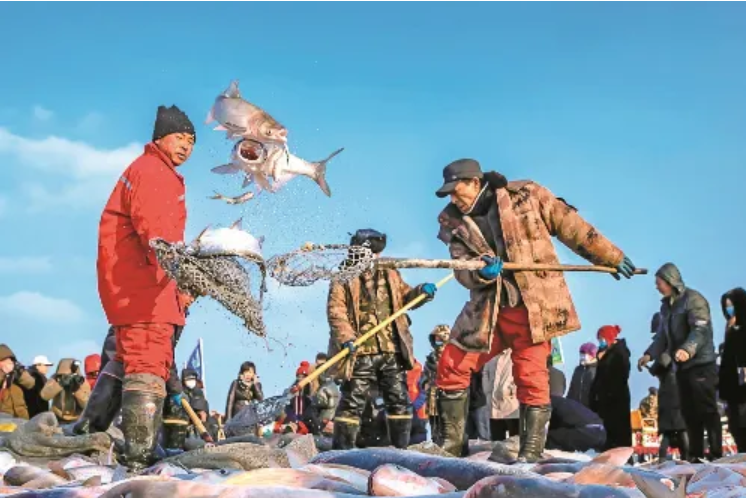
The Chagan Lake Winter Fishing Scenic Area is the core area of the resort and is famous at home and abroad for the wonder of fishing under ice in winter. From December to February of the following year, fishermen use the traditional "large under-ice seine net" method to fish, and a single net can catch more than 100,000 jin of fresh fish at most. The scenic area has a winter fishing viewing area, an ice entertainment area, and others. Tourists can watch the entire winter fishing process up close and experience projects such as ice fishing and snowmobiles. During the Winter Fishing Festival (opening on December 28 each year), activities such as the "Sacrifice to the Lake and Awakening of the Nets" ceremony and the auction of the first fish are also held. Among them, the auction price of the "first fish" has repeatedly hit new highs. In 2023, a 30-jin first fish sold for 2.99 million yuan.
Miaoyin Temple
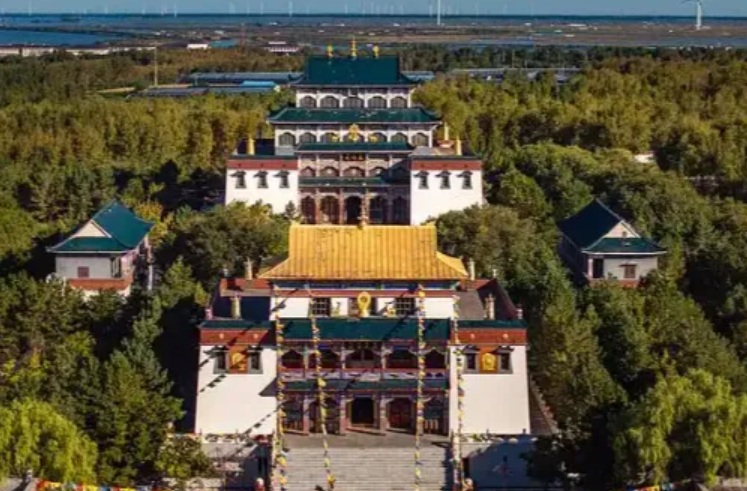
Miaoyin Temple is located on the east bank of Chagan Lake and is one of the largest Tibetan Buddhist temples in Jilin Province. It was first built in 1755 (the 20th year of the Qianlong reign of the Qing Dynasty) and rebuilt in 2000. It covers an area of 30,000 square meters, with a building area of 1,800 square meters. The temple adopts a combined Tibetan and Han architectural style. Its main buildings include the Mahavira Hall, the Hall of Heavenly Kings, and the Tripitaka Pavilion. Statues such as Sakyamuni and Guanyin are enshrined in the halls. Facilities such as the "prayer wheels" and "mani piles" in the temple reflect Tibetan Buddhist characteristics. A temple fair is held on the 19th day of the sixth lunar month each year, attracting many believers and tourists to pray for blessings.
Genghis Khan Temple
Genghis Khan Temple is located on the south bank of Chagan Lake and is an important place for commemorating Genghis Khan. It covers an area of 130,000 square meters, with a building area of 2,225 square meters, and was completed in 2004. The temple consists of a mountain gate, a Genghis Khan statue, a memorial hall, and others. The Genghis Khan statue is 2.5 meters high and cast in bronze; the memorial hall displays Genghis Khan's life deeds, weapons, documents, and others, showing the history and culture of the Mongol Empire. The architecture in the temple integrates Mongolian, Han, and Tibetan artistic styles and is an important window for understanding Genghis Khan culture.
Gorlos Prince Mansion
Gorlos Prince Mansion is located in the northwest part of the scenic area and is a reconstructed residence of the Jasak (prince) of Gorlos Front Banner in the Qing Dynasty. It covers an area of 40,000 square meters, with a building area of 5,213 square meters, reproducing the architectural layout of a Mongolian prince's mansion in the Qing Dynasty. The mansion is divided into a living area, a discussion area, and a sacrificial area, displaying more than 300 cultural relics such as Mongolian clothing, furniture, and weapons. Among them, the "gold-inlaid saddle" and "silver drinking vessels" are treasures of the collection. Through live recreations, interactive experiences, and other methods, tourists can learn about the life scenes and etiquette culture of Mongolian nobles in the Qing Dynasty.
Chagan Lake Wetland Birdwatching Park
Chagan Lake Wetland Birdwatching Park is located on the west bank of the lake and covers an area of 10 square kilometers. It is an important migratory bird habitat in Northeast Asia. The park has ecological environments such as reed marshes and shoals. Every spring and autumn, hundreds of thousands of migratory birds stop here, including more than 10 species of national first-class protected birds such as white cranes, red-crowned cranes, and oriental white storks. The scenic area has built a 5-kilometer-long wooden boardwalk and 8 birdwatching platforms (the highest at an altitude of 145 meters), equipped with high-powered telescopes to facilitate tourists in observing bird activities. It is an ideal place for ecological photography and nature education.
Tour Routes:
Recommended two-day tour route: Day 1: Arrive at the scenic area visitor center at 9:00 a.m., purchase a combo ticket, and go to Gorlos Prince Mansion (1.5 hours) to learn about Mongolian prince culture; at 11:00, go to Genghis Khan Temple (1 hour) to visit the memorial hall and statue; at 12:30 p.m., dine in a Mongolian yurt restaurant and taste hand-held mutton. In the afternoon at 14:30, go to Miaoyin Temple (1 hour) to experience Tibetan Buddhist culture; at 16:00, go to Chagan Lake Wetland Birdwatching Park (1.5 hours) and watch birds along the boardwalk; at 18:00, watch the sunset by the lake, and then stay in a Mongolian yurt homestay in the scenic area. Day 2: If it is winter (December-February), go to the winter fishing scenic area at 6:30 a.m. to watch the "Sacrifice to the Lake and Awakening of the Nets" ceremony (starting at 7:00) and the winter fishing process (about 2 hours); at 10:00, experience ice fishing or snowmobiles; at 12:00 p.m., taste a whole-fish feast. If it is another season, take a boat tour of Chagan Lake at 9:00 a.m. (1 hour, boat ticket 50 yuan/person); at 11:00, participate in folk experience activities by the lake (such as archery and horseback riding); at 14:00 p.m., return, and on the way you can buy specialties such as dried fish and dairy products.
Travel Suggestions:
The best seasons for visiting are winter (December-February, for winter fishing) and summer (June-August, for lake views). In winter, temperatures can drop to -20°C to -30°C, so warm clothing such as down jackets and snow boots are required; in summer, temperatures are relatively high, so pay attention to sun protection and bring mosquito repellent.
For watching winter fishing in winter, it is recommended to book accommodation one day in advance. Choosing a homestay in the scenic area allows for a closer experience, with prices around 300-500 yuan/night (Mongolian yurt); in summer, camping is possible, and the scenic area provides tent rentals at 100 yuan/tent/day.
Photography enthusiasts are advised to bring telephoto lenses (for winter fishing in winter and birds in spring and autumn). In winter, pay attention to keeping the camera warm to avoid rapid battery drain.
To participate in the "Sacrifice to the Lake and Awakening of the Nets" ceremony, you need to get up early. It is recommended to arrive at the site before 6:00 to occupy the best viewing position; the first fish auction is usually held at 10:00 a.m.
For purchasing fish specialties, it is recommended to choose the "aquatic product direct sales store" in the scenic area, where prices are transparent and on-site vacuum packaging is available. The price of a 10-jin bighead carp is about 150 yuan.
Precautions:
There are risks in winter ice activities. Activities must be carried out within designated areas, follow staff instructions, and unauthorized entry into undeveloped ice areas is prohibited. Safety warning signs are provided in the scenic area.
Respect Mongolian customs and habits. When entering a Mongolian yurt, take off your shoes. When receiving a hada, accept it with both hands, and do not step on the threshold. When watching the Nadam Fair, do not touch the equipment of horse racing or wrestling contestants at will.
Do not make loud noises in Miaoyin Temple. Do not use flash when taking photos, and walk clockwise around the prayer wheels.
Littering is prohibited in the scenic area, especially in lakeside areas. Violators will face fines of 50-200 yuan; fishing must be done in designated areas, and a fishing permit must be obtained (50 yuan/day).
During peak seasons (Spring Festival holiday, Winter Fishing Festival), tourists are dense. It is recommended to travel at off-peak times. Traffic in the scenic area may be congested, so you can choose to walk or take the scenic area sightseeing bus (20 yuan/person, unlimited rides).
Transportation:
Bus: In Songyuan City, take Tourist Line 1 to reach Chagan Lake Scenic Area directly. The fare is 15 yuan, with departures at 7:00, 8:30, and 10:00 daily, and the journey takes 1.5 hours; within Qianguo'erluosi Mongol Autonomous County, take Bus 2 to the scenic area entrance. The fare is 5 yuan, with one bus per hour.
Self-driving: From Songyuan City, drive north along Chagan Lake Avenue (S203) for about 30 kilometers to reach the scenic area, with a journey of 40 minutes; the scenic area parking lot charges 20 yuan/day for small vehicles and 50 yuan/day for large vehicles, and parking fees increase by 50% in winter (December-February).
Long-distance bus: Songyuan City Passenger Transport Station has a bus to Chagan Lake every 30 minutes. The fare is 10 yuan, and the journey takes 50 minutes; Changchun Passenger Transport Station also has direct buses to the scenic area, with one bus every 2 hours from 6:00 to 14:00, fare 50 yuan, journey 3 hours.
Train: Take train K7305 from Changchun Station to Songyuan Station. The journey takes 2.5 hours, and the fare is 32.5 yuan; taking a taxi from Songyuan Station to the scenic area is about 30 kilometers and costs 60 yuan, or transfer to Tourist Line 1.
Opening Hours:
The scenic area is open all year round, and opening hours are slightly adjusted according to the season: April-October (peak season) is 8:00-18:00 (last entry at 17:30); November-next March (off-season) is 9:00-17:00 (last entry at 16:30).
Among them, Chagan Lake Winter Fishing Scenic Area is only open from December to February, with daily opening hours of 8:30-16:30; Miaoyin Temple, Genghis Khan Temple, and Gorlos Prince Mansion have the same opening hours as the scenic area; the best viewing period for the Wetland Birdwatching Park is April-May and September-October, with opening hours of 8:00-17:30, and some areas are closed in other months.
Tickets:
Admission is free. Some attractions within the scenic area require separate charges.