Liuding Mountain Cultural Tourism Zone is located in the southern suburbs of Dunhua City, Yanbian Korean Autonomous Prefecture, Jilin Province, China. It is a National 5A-level Tourist Attraction and the first listed cultural tourism zone in Jilin Province. With Buddhist culture and Bohai culture as its core, the scenic area integrates natural ecology and cultural landscapes, and is known as a "Cultural Holy Land · Vacation Paradise." The scenic area covers a total area of about 52 square kilometers, of which the core scenic area covers about 10 square kilometers. Its main structures include the Golden Tripod Great Buddha, Zhengjue Temple, and the Bohai Ancient Tombs, forming a comprehensive tourist area that combines sightseeing and pilgrimage, cultural experience, and leisure vacation.
Historical Culture
The Liuding Mountain area has a long history, with human activity dating back to the Neolithic Age. During the Tang Dynasty, this area was an important region of the Bohai Kingdom. The existing Bohai Ancient Tombs are important remains of Bohai culture and provide valuable physical materials for studying the history, culture, and burial system of the Bohai Kingdom. Among them, the Tomb of Princess Zhenhui was the first Bohai tomb excavated in China, yielding a large number of cultural relics.
The inheritance of Buddhist culture at Liuding Mountain can be traced back to the Qing Dynasty. Zhengjue Temple was first built during the Guangxu period of the Qing Dynasty. After experiencing periods of rise and decline, reconstruction began in 2000, and it has now become one of the largest Buddhist temples in Northeast China. The Golden Tripod Great Buddha was completed and consecrated in 2011. At 48 meters tall, it is the world's tallest bronze seated statue of Shakyamuni Buddha, further establishing Liuding Mountain's status as a Buddhist holy site.
In 2006, the Bohai Ancient Tombs were listed as a Major Historical and Cultural Site Protected at the National Level; in 2015, Liuding Mountain Cultural Tourism Zone was rated as a National AAAAA-level Tourist Attraction, becoming an important window for displaying the historical culture and religious culture of the Yanbian region.
Main Attractions
Golden Tripod Great Buddha
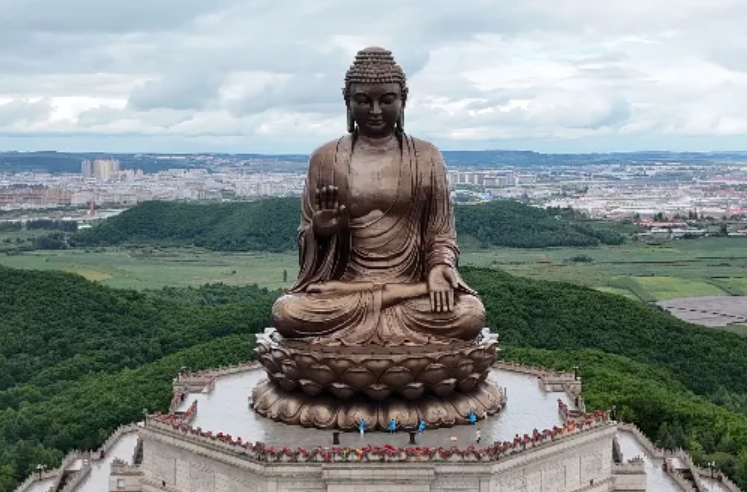
The Golden Tripod Great Buddha is located at the summit of Liuding Mountain and is the landmark landscape of the scenic area. The great Buddha is a bronze seated statue of Shakyamuni. Its total height is 48 meters, of which the Buddha body is 38.4 meters tall and the lotus pedestal is 9.6 meters tall, symbolizing "steadiness and stability in all directions, peace and joy everywhere." The statue uses a copper casting and gold gilding process, consuming about 500 tons of copper and about 25 kilograms of gold, and was cast by Nanjing Aerospace Chenguang Group. The great Buddha's left hand forms the meditation mudra, and the right hand forms the fearlessness mudra. It is solemn and kind, overlooking all beings. The Ten Thousand Buddha Hall at the foot of the great Buddha enshrines 10,000 small Buddha statues, forming with the Golden Tripod Great Buddha the scene of "ten thousand Buddhas paying homage to the supreme one."
Zhengjue Temple
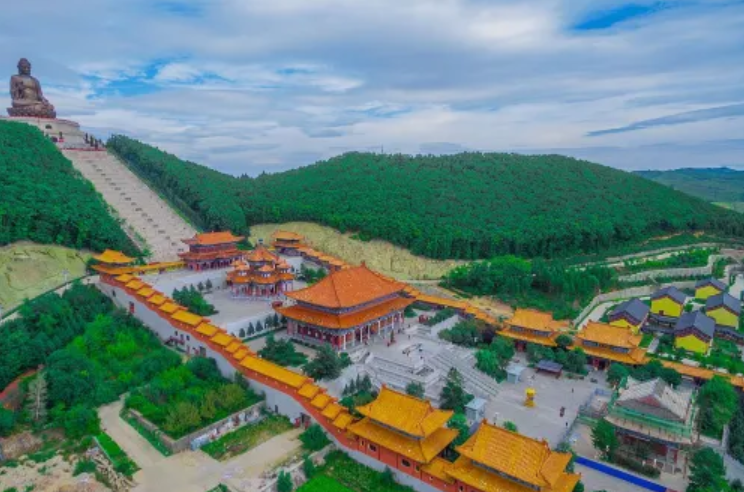
Zhengjue Temple is located below the Golden Tripod Great Buddha. It is a Chinese Buddhist temple with a total area of about 40,000 square meters and a building area of about 18,000 square meters. The temple adopts the architectural style of the Tang Dynasty. Along the central axis are distributed, in order, the mountain gate, Heavenly King Hall, Mahavira Hall, Guanyin Hall, and Sutra Library. The Mahavira Hall is the main building in the temple, 26 meters high, seven bays wide, and five bays deep. It enshrines the Buddhas of the Three Times, with Buddha statues 8.6 meters tall, solemn and majestic. The temple also has a Buddhist Culture and Art Museum, displaying a large number of Buddhist relics and art treasures, and is an important place for understanding Buddhist culture.
Bohai Ancient Tombs
The Bohai Ancient Tombs are located in the hinterland of Liuding Mountain and are the burial area for royal families and nobles of the Bohai Kingdom (698–926). About 100 tombs remain, among which the Tomb of Princess Zhenhui is the most famous. Princess Zhenhui was the second daughter of King Dae Heummu, the third king of the Bohai Kingdom. The tomb consists of three parts: the tomb chamber, corridor, and tomb passage, with a total length of 15 meters. Precious cultural relics such as a tombstone, stone lions, and pottery figurines were unearthed. Among them, the "Tombstone of Princess Zhenhui" is an important physical object for studying the writing and history of the Bohai Kingdom. The inscription is written in Chinese characters in regular script. Around the ancient tombs, there is also a Bohai Culture Museum, which systematically displays the history and culture of the Bohai Kingdom through cultural relic exhibitions, scene restorations, and other methods.
Qingzu Ancestral Hall
Qingzu Ancestral Hall was built to commemorate Bukūri Yong?on, the ancestor of the Manchu people. It covers a total area of about 50,000 square meters and has a building area of about 2,000 square meters. Its main buildings include a memorial archway, main gate, Qingzu Hall, and east and west side halls, adopting a design that combines Manchu architectural style with Qing royal architectural style. The Qingzu Hall enshrines a statue of Bukūri Yong?on. The statue is 3.8 meters tall, and on both sides are historical murals showing the origin and development of the Manchu people. Qingzu Ancestral Hall is an important place for studying Manchu culture and exploring the origins of the Qing Dynasty. Manchu cultural festivals and other activities are held here every year.
Liuding Mountain Lake
Liuding Mountain Lake is located in the central part of the scenic area. It is a natural lake with a surface area of about 1.2 square kilometers and a maximum depth of 12 meters. The lake water is clear to the bottom, surrounded by mountains and lush trees, forming a beautiful landscape of "mountains embracing the water." The shoreline is winding and stretches about 5 kilometers. There is a wooden boardwalk around the lake with a total length of about 3 kilometers, where visitors can stroll and enjoy the lake and mountain scenery. There is also a cruise pier on the lake, where visitors can take a boat tour (each boat can hold 50 people) and experience the comfort of "sailing on emerald waves, with people traveling through a painting."
Tour Route:
Recommended one-day tour route: After entering through the main gate of the scenic area, take the sightseeing bus (or walk) to the Bohai Ancient Tombs, visit the Tomb of Princess Zhenhui and the Bohai Culture Museum, and learn about the history of the Bohai Kingdom. This part takes about 1.5 hours. Then go to Qingzu Ancestral Hall to experience Manchu culture, with a visit of about 1 hour. At noon, dine at the vegetarian restaurant in the scenic area and experience Buddhist vegetarian cuisine. In the afternoon, take the sightseeing bus to Zhengjue Temple and visit the mountain gate, Heavenly King Hall, Mahavira Hall, and other buildings in sequence, with a visit of about 1.5 hours. After that, walk to the Golden Tripod Great Buddha, climb to the summit to worship the great Buddha and overlook the panoramic view of the scenic area, with a visit of about 1.5 hours. Finally, go to Liuding Mountain Lake, where you can choose to walk around the lake or take a boat tour, with a visit of about 1 hour. The whole journey takes about 6.5–7 hours, allowing a comprehensive experience of the scenic area's cultural and natural landscapes.
Travel Suggestions:
It is recommended to arrive at the scenic area before 9:00 a.m., when there are fewer tourists, avoiding the peak crowd, and the morning light is suitable for photography.
The scenic area is large and the attractions are scattered. It is recommended to buy a sightseeing bus pass (20 yuan/person) to save energy and improve touring efficiency; if you are in good physical condition, you can also choose to walk, as the scenery along the way is beautiful.
When visiting Buddhist sites, you must observe etiquette, dress appropriately (do not wear shorts, short skirts, or tank tops), do not make loud noises, and do not touch Buddha statues or ritual implements.
In summer, take sun protection measures, as the ultraviolet rays in the scenic area are strong; in winter, temperatures are low, so wear warm clothing, and some sections of road may have snow, so pay attention to slip prevention.
The vegetarian restaurant in the scenic area provides Buddhist vegetarian food. The ingredients are fresh and the taste is light. You may try it. The per capita consumption is about 30–50 yuan.
Notes:
Smoking and littering are prohibited in the scenic area. You must protect cultural relics and the natural environment and abide by the scenic area's regulations.
When entering the Bohai Ancient Tombs for visiting, it is prohibited to touch cultural relics or climb the tombs. You must visit in designated areas and follow the guidance of staff.
When taking a cruise, you must wear a life jacket, follow the crew's instructions, do not play or roughhouse on the boat, and pay attention to safety.
There is a medical room in the scenic area (located east of Zhengjue Temple) and a visitor service center. If you feel unwell or need help, contact staff promptly.
During holidays, there are many tourists in the scenic area. It is recommended to purchase tickets in advance through official channels to avoid queuing on site; at the same time, keep personal belongings safe to prevent loss.
Transportation:
Bus: Within Dunhua city, you can take Bus No. 8 directly to the main gate of Liuding Mountain Cultural Tourism Zone. The departure interval is about 30 minutes. The first bus is at 6:30 and the last bus is at 17:30. The fare is 2 yuan/person.
Tourist line: There is a Liuding Mountain tourist line at the Dunhua Railway Station square. It departs daily at 8:00, 9:00, and 10:00, and return times are 15:00, 16:00, and 17:00. The fare is 5 yuan/person, and the journey takes about 30 minutes.
Self-driving: From Dunhua city, drive south along Hanzhang Street for about 5 kilometers to reach the scenic area. There is a parking lot at the scenic area. The parking fee is 10 yuan/day for small vehicles and 20 yuan/day for large vehicles. The parking lot can accommodate about 500 motor vehicles.
Taxi: Taking a taxi from Dunhua city to the scenic area costs about 15–20 yuan, and the journey takes about 15 minutes.
Opening Hours:
Opening hours are adjusted slightly according to the seasons: from April 1 to October 31, it is the peak season, with opening hours of 7:30–17:30 (last entry at 17:00); from November 1 to March 31 of the following year, it is the off-season, with opening hours of 8:00–16:30 (last entry at 16:00). The opening hours of Buddhist activity sites in the scenic area (such as Zhengjue Temple) are 8:00–16:00, subject to the announcement of the day. During major holidays or special events, opening hours may be extended. It is recommended to check official information in advance.
Tickets:
Ticket: 110 yuan/person (including sightseeing bus).