Xiaoyaojin Park is located at No. 16 Shouchun Road, Luyang District, Hefei, Anhui Province. It is a comprehensive urban park in the core area of Hefei, a national 4A-level tourist attraction, and one of the city’s oldest and most renowned public parks. The park is famous for the historical tale of Zhang Liao’s heroic victory at Xiaoyaojin during the Three Kingdoms period. It integrates history and culture, leisure and entertainment, landscape gardening, and science education. Covering a total area of 31.3 hectares, including 11.2 hectares of water and 20.1 hectares of land, the park has a green coverage rate of over 80% and is home to more than 100 species of trees, shrubs, and flowers. Its buildings, totaling about 8,000 square meters, are mainly in the antique and garden-pavilion style. The overall layout follows the art of Jiangnan garden design, combining the grandeur of northern Chinese gardens with the elegance of southern ones.
History and Culture
The history of Xiaoyaojin dates back to the late Eastern Han Dynasty, over 1,800 years ago. Its name derives from Zhuangzi’s “Free and Easy Wandering.” In ancient times, it was a ferry on the Feishui River and served as a natural barrier on the northeastern edge of Hefei’s old city. During the Three Kingdoms period, it was a key battlefield between the Wei and Wu kingdoms. In the 20th year of Jian’an (AD 215), the Wei general Zhang Liao led 800 soldiers in a surprise attack on Sun Quan’s 100,000?strong Wu army, winning a famous victory that gave rise to the saying “Zhang Liao’s might shook Xiaoyaojin.” Since then, Xiaoyaojin has become an important landmark of Three Kingdoms culture.
During the Tang and Song dynasties, Xiaoyaojin gradually evolved from a military ferry into a scenic spot frequented by literati and became a leisure destination on the outskirts of Hefei. In the Ming and Qing dynasties, it was converted into private gardens, underwent multiple renovations, and gradually took shape as a garden complex, leaving behind many historical relics and inscribed works by scholars.
After Hefei was liberated in 1949, Xiaoyaojin was officially turned into a city park. It was formally named “Xiaoyaojin Park” in 1953 and fully opened to the public in 1954, becoming Hefei’s first comprehensive urban park. Since 2007, the park has been free to the public. A major renovation in 2020 preserved its historical and cultural heritage while improving its landscape and leisure facilities, making it a core carrier of Hefei’s Three Kingdoms culture and an iconic urban retreat.
Major Attractions
Statue of Zhang Liao
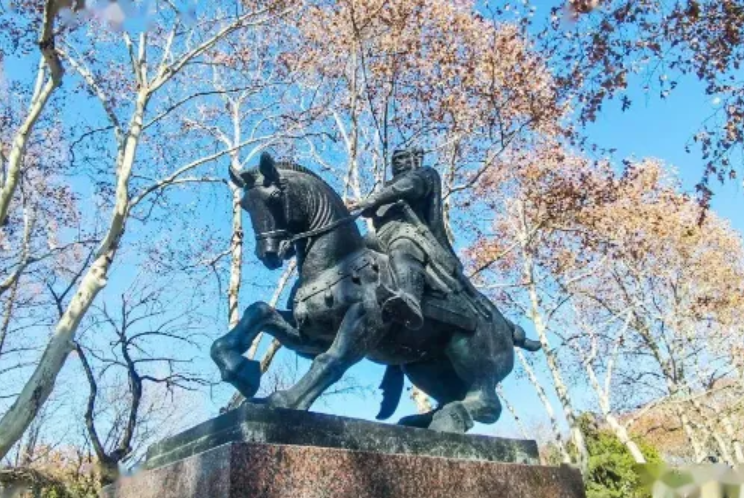
Located at the center of the park’s south gate square, the Statue of Zhang Liao is the park’s landmark. The monument stands 8 meters tall in total, with the figure itself 5 meters high and the base 3 meters high. Cast in bronze, it portrays Zhang Liao in armor, holding a long halberd, exuding the heroic spirit of ancient battlefields. The base bears an inscription recounting the historical tale of “Zhang Liao’s might shook Xiaoyaojin.” It is a must?visit spot for photos.
Xiaoyao Lake
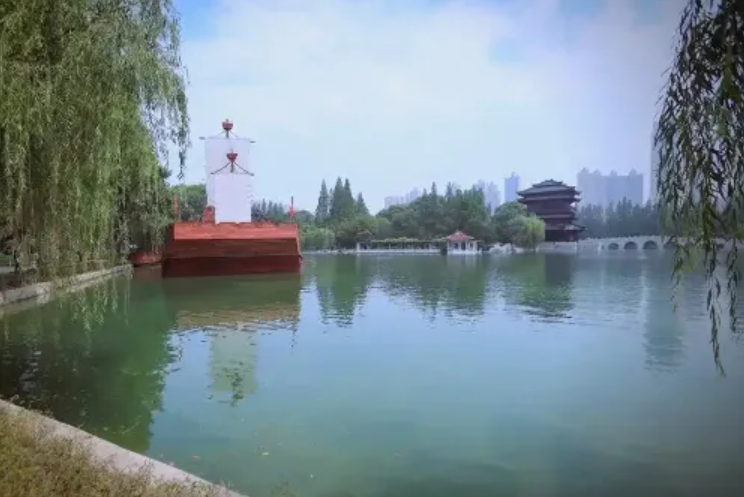
Xiaoyao Lake is the park’s central water feature, covering 11.2 hectares – more than one?third of the park’s total area. The lake is broad and clear, with three small islets – North, Middle, and South – connected by the Nine?Turn Bridge and the Jade Belt Bridge. Visitors can take boat rides to enjoy the lakeside scenery and experience the water?town atmosphere of the ancient ferry.
Xiaoyao Pavilion
Situated on the eastern shore of Xiaoyao Lake, Xiaoyao Pavilion is the park’s tallest building. It is a multi?story pavilion in the style of the Three Kingdoms period, with five floors, a total height of 22 meters, and a floor area of 1,500 square meters. Inside, the Three Kingdoms History Museum displays relics, historical materials, and sand?table models related to Hefei during that era, offering a comprehensive account of the Wei?Wu battles. From the top, visitors can enjoy a panoramic view of the park and the surrounding city.
Three Kingdoms History Museum
Housed within Xiaoyao Pavilion, the museum covers an exhibition area of 800 square meters, divided into four sections: battlefield re?creation, artifact display, historical education, and interactive experience. It features over 100 replicated artifacts and historical materials, including weapons, pottery, and coins from the Three Kingdoms period. Through texts, physical objects, and multimedia, it systematically explains the history of the Three Kingdoms and the details of the Xiaoyaojin campaign.
Dujin Bridge
Dujin Bridge is an antique stone?arch bridge spanning Xiaoyao Lake. It is 35 meters long and 5 meters wide, built with bluestone, and its balustrades are carved with scenes from Three Kingdoms stories. It serves as the main passage connecting the northern and southern parts of the park and offers one of the best viewpoints for a full view of Xiaoyao Lake. The bridge, lake, and pavilions together create a picturesque Jiangnan garden scene.
Peony Garden
Located on the northwest side of the park, the Peony Garden covers 1.2 hectares and is home to over 2,000 peony plants of nine color families and more than 100 varieties. In April each year, when the peonies bloom, it becomes one of the largest peony viewing areas within Hefei’s urban area. The garden also features other flowers such as tree peonies and roses, ensuring seasonal interest throughout the year.
Plum Blossom Hill
Plum Blossom Hill is an artificial hill in the park, with an elevation of 28 meters and an area of 0.8 hectares. It is planted with more than 1,000 plum trees, including red?flowered, green?flowered, and winter?flowering varieties. From January to March, when the plum blossoms are in full bloom, it is a popular winter attraction. The hill has scenic walking paths, and from the top visitors can overlook Xiaoyao Lake and Xiaoyao Pavilion.
Children’s Playground
Located on the east side of the park, the Children’s Playground covers 1.5 hectares and features over a dozen family?friendly rides and facilities, including carousels, small trains, slides, and sandpits, all meeting national safety standards. It is a dedicated recreational area for families with children.
Suggested Tour Routes:
The classic tour route starts from the South Gate and takes about 2?3 hours, covering a walking distance of about 3 kilometers. Enter through the South Gate, first admire the Statue of Zhang Liao, then head north along the square to the shore of Xiaoyao Lake, cross Dujin Bridge and enjoy the lake view; then go east to Xiaoyao Pavilion, climb up to visit the Three Kingdoms History Museum and get a bird’s?eye view of the park; then follow the lake north to Plum Blossom Hill (especially for winter plum viewing); then head west to the Peony Garden (best in spring); finally go east past the Children’s Playground and exit through the East Gate or return to the South Gate. For families, priority can be given to the Children’s Playground followed by a stroll along the lake, taking about 1.5 hours in total. For a more cultural experience, focus on the Statue of Zhang Liao, Xiaoyao Pavilion, and the museum, allowing about 3 hours.
Travel Tips:
The best seasons are spring (March?May) – mild climate, peonies and cherry blossoms – and autumn (September?November) – crisp weather and optimal garden scenery.
History enthusiasts are advised to set aside 1 hour to explore the Three Kingdoms History Museum for an in?depth understanding of the local history.
Families with children should prioritize the Children’s Playground and avoid peak holiday periods for a better experience.
Boating on Xiaoyao Lake is recommended during daytime; a boat ride lasts about 20 minutes, offering a full view of the lake.
When climbing Xiaoyao Pavilion, wear light clothing and watch your step on the stairs, which are relatively steep.
The park has many rest benches; you may bring your own drinking water, and convenience stores inside offer drinks and snacks.
Recommended photo spots: Statue of Zhang Liao, Xiaoyao Pavilion, Dujin Bridge, Plum Blossom Hill, and Peony Garden.
Important Notices:
The park is free of charge. Flammable, explosive, or controlled?knife items are prohibited.
Fishing, swimming, climbing trees, and stepping on lawns are forbidden. Please protect the plants and public facilities.
For paid activities such as boating and climbing the pavilion, follow the on?site regulations. Children must be accompanied by an adult when taking a boat.
During holidays, visitor numbers are high; please keep an eye on elderly and young children to avoid separation.
Spitting, littering, and other actions that harm the environment are not allowed.
Street vending, distributing advertisements, begging, and other disruptive activities are prohibited.
Pets are not allowed in the core areas of the park, except for guide dogs.
In case of severe weather, some facilities may be temporarily closed; follow the instructions of onsite staff.
Transportation:
Bus: Take Hefei buses No. 2, 15, 106, 136, 137, 143, or 155 to Xiaoyaojin Station, then walk 50 meters to the South Gate.
Metro: Take Hefei Metro Line 2 to Dadongmen Station, exit from Gate 4, and walk about 800 meters to the South Gate.
Driving: Nearby parking lots include Shouchun Road Parking Lot and Suzhou Road Parking Lot, with a total of 200 spaces. Parking can be tight on holidays; public transport is recommended.
Taxi/ride?hailing: Directly set your destination to “Xiaoyaojin Park South Gate” and you will be dropped off right at the entrance.
Opening Hours:
The park is open daily from 5:00 to 22:00.
Xiaoyao Pavilion and the Three Kingdoms History Museum are open from 8:30 to 17:30, with last entry at 17:00.
Boat rides operate from 8:00 to 18:00, with seasonal adjustments; in summer, hours may be extended to 19:00.
Admission:
Free of charge.