Located in the southeastern corner of Yunyang County, Chongqing Municipality, the Longgang Scenic Area borders Wanzhou District to the southwest, Lichuan City of Hubei Province to the south, and Fengjie County to the east. It stretches from Longku Gorge in the southeast of Nixi Township in the west to 500 meters east of the right bank of Shisun River in the east, and from the Chongqing?Hubei provincial boundary in the south to the outlet of Huangling Gorge in the north. With a maximum north?south length of about 37 km and an east?west width of about 19 km, the total area is approximately 296 km2, of which the core scenic area covers 17 km2. It is a national 5A?level tourist attraction and a large?scale comprehensive national geopark that features the Longgang karst tiankeng (giant sinkhole), complemented by meadow landscapes and Tujia ethnic cultural heritage. The area exhibits remarkable karst landforms, with sinkholes, stone teeth, peak clusters, and karst caves scattered throughout, as well as unique underground river scenery. The vegetation coverage rate reaches 70%, and the forest coverage rate is 91.7%, making it a typical biodiversity hotspot that is home to many rare and protected plant and animal species.
History and Culture
Before the Western Zhou Dynasty, indigenous people already lived in the old stockaded village area, which was the hereditary territory of the Cong people and a place for worshipping and offering sacrifices to goddesses. Later, dragon pillars (sacrificial pillars) were erected there. Due to its long history, locals came to call it the “Old Stockaded Village.” Artefacts such as zheng bells, dagger?axes, battle?axes, arrowheads, chime bells, and earthenware have been unearthed here, along with the adjacent ruins of the Cong people’s tiger?hunting tower. As for the origin of the name “Longgang” (Dragon Tank), legend has it that the area around Qingshui Longgang was once inhabited by a dragon family. The dragons lived in a dragon cave, but finding it inconvenient, the Old Dragon King ordered a bathing pool (Dragon Rolling Pool) to be built behind Banbian Street and a large water tank to be dug on Longgang for drinking water, which the common people called the “Dragon Tank.” The Tujia people also say that the Old Dragon King instructed that the tank should never be filled to the brim, so that clear water would remain in the Qingshui Ponds for the locals. Hence, the Dragon Tank is always half?full, and the three Qingshui Ponds remain crystal clear all year round.
Major Attractions
World’s Longgang Tiankeng
The Longgang tiankeng is an elliptical sinkhole with a long axis of 304–326 m, a short axis of 178–183 m, and a depth of 335 m, ranking third in China and fifth in the world. The inner walls are as sheer as if cut by a knife; pines and cypresses lean horizontally from the cliff crevices, ancient vines hang down, and the bottom remains green in all four seasons with birds singing. Because its shape resembles a huge natural stone tank and it is associated with a love legend between a woodcutter and a dragon maiden, it is known as Longgang and hailed as the “Number One Tank under Heaven.” The walls are nearly vertical and extremely precipitous, surrounded by cliffs. A narrow winding path leads down – the widest part is about 2 m, while the narrowest is less than 0.4 m.
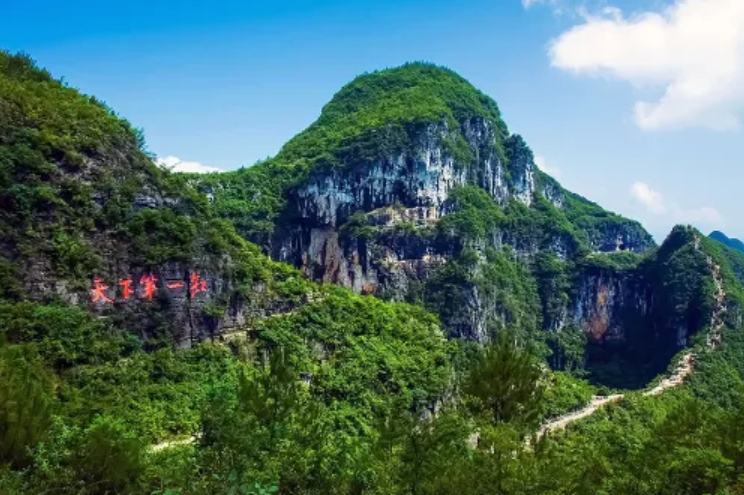
Glass Plank Road
Built on a cliff nearly 1,000 m high, the glass plank road is 3.2 km long and extends 2.2 m outward, of which more than 300 m are suspended glass sections. Walking on it offers a thrilling experience and sweeping views of the surrounding canyon scenery.
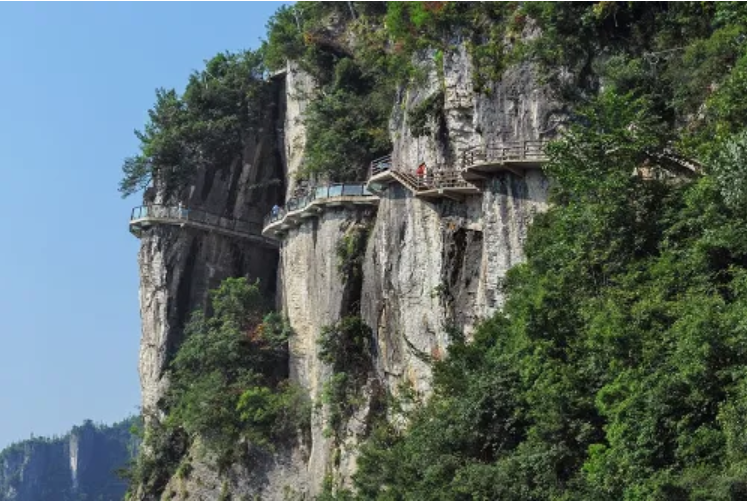
Old Stockaded Village
This site was inhabited by indigenous people before the Western Zhou Dynasty and served as the hereditary territory of the Cong people. It was once a place for worshipping and offering sacrifices to goddesses, and later dragon pillars (sacrificial pillars) were erected here. Attractions within the Old Stockaded Village include “Lady’s Pool,” “Dragon Pillar,” and “White Dragon Cave.” Visitors can also enjoy natural views such as “Golden Roc Spreading Wings,” “Misty Gorge at Dawn,” “Golden Buddha Halo,” “Seven?Peak Sunrise,” “Sunset Melting Gold,” “Monkeys Frolicking in the Forest,” “Reversed Gorge Flow,” and “White Rock Hanging Cave.”
Monkey Viewing Terrace
This is a favourite playground for wild monkeys, where the resident macaques are accustomed to humans and sometimes come forward to beg for food. From the terrace, visitors can overlook the canyon scenery and, after rain, witness the “Misty Gorge at Dawn” and “Monkeys Frolicking in the Forest” spectacles.
Dragon Cave
The cave consists of two chambers. The front chamber is circular, about 40 m wide, nearly 50 m high, and 120 m long, covering an area of 4,800 m2, filled with stalactites forming natural shapes such as “White Jade Dragon Bed,” “Dragon Umbrella,” “Dragon Pot,” “Dragon Chair,” “Dragon Stool,” “Lotus Terrace,” and “Heavenly Rooster Announcing Dawn.” The rear chamber is pentagonal, 30 m high, over 300 m long, and covers 6,000 m2, with stalactites resembling lions, elephants, dragons, phoenixes, and more.
Reflecting Moon Cave
Located on a cliff more than 100 m north?northeast of the Longgang tiankeng, this is the first?level karst cave of the Longgang area. The cave is 43 m long and runs northeast by east. The southern entrance is 3.9 m high and 3.4 m in diameter; the northern entrance is 2.4 m high and is the outlet of an underground river. On the night of the Mid?Autumn Festival each year, shortly after the moon rises, moonlight fills the entire cave and a concentrated silvery beam shoots out from the south to the north, creating the “Moonlight Through the Cave” spectacle.
Qixi Pavilion
Situated at the highest peak of the Longgang Scenic Area, at an elevation of 1,185 m, the pavilion has seven storeys and stands 33.44 m tall, symbolising everlasting love and eternal union. It covers a floor area of 1,000 m2. Despite the narrow and steep terrain, which made construction difficult, its elevated position offers excellent 360?degree panoramic views. It is also a special attraction dedicated to the Saltwater Goddess and a centre for love?themed culture.
Qingshui Lake
Located within the scenic area at an average elevation of 800 m, the lake is named after the Qingshui (Clear Water) area and its perpetually crystal?clear water. The dam is 160 m high with a thickness?to?height ratio of only 0.106, making it the thinnest double?curvature arch dam in Asia. The water level is maintained at 392 m, with an average depth of about 100 m and a maximum depth of over 150 m. The lake covers 6.85 km2 and has a storage capacity of 354 million m3. The lake water links the 15?km?long Laoya, Yulong, and Shisun gorges along the Shisun River.
Shisun River
Originating from Gaixia Dam in the north and flowing to Shuanghekou in the south, the river is 12.5 km long and features a karst gorge landscape. Its clear waters are rich in turtles and soft?shelled turtles. The area also hosts odd pines, emerald cypresses, bamboo, fir trees, and valuable medicinal plants such as yellow vine, gastrodia, fritillary, and coptis, as well as wildlife including yellow sheep, musk deer, yellow muntjac, golden monkeys, wild boars, and birds like golden pheasants, orioles, cuckoos, kingfishers, and parrots.
Cloud Sky Corridor
Built on a cliff at an elevation of 1,010 m with a vertical drop of 718 m, the cantilevered glass corridor extends 26.68 m – more than 5 m longer than the Grand Canyon Skywalk in the United States, making it the world’s longest of its kind. It covers an area of 6,386.88 m2, involved an investment of about 40 million yuan, and took one year to construct.
Cloud Sky Swing
Located on the east side of the Cloud Sky Corridor exit, this swing has a device height of 12 m, a swing angle of nearly 80 degrees, and swings out 8–10 m over the cliff, which is over 700 m high – higher than the swing at the Grand Canyon in Colorado. As visitors soar through the air, they can look down upon the sheer precipice for an extreme thrill.
Cloud Sky Colourful Bridge
This project consists of a via ferrata, suspension bridges, the Twelve Zodiac Bridges, a plank road, Myanmar bridges, cliff huts, the Cloud Sky Colourful Bridge, and the Cloud Sky Suspension Bridge, totalling more than 800 m in length. The entire project is built on a cliff over 700 m above the Shisun River. The bridge decks are painted in various colours and scenic patterns, giving it its name. The anchoring system uses chemical anchor bolts embedded more than 1 m into the rock, with each steel cable capable of bearing over 2 tonnes. The entire route is equipped with a continuous safety line and Italian?imported continuous steel locks.
Cloud Sky Rainbow Swing
Located at the Monkey Saddle in the Longgang Scenic Area, this swing is installed on the edge of a cliff more than 600 m above the Shisun River. It has a main structure height of 108 m, a maximum speed of about 120–130 km/h, a lift height of 96 m, and a maximum swing distance of about 80 m from the cliff. It holds the world records for the highest, fastest, and widest?swinging ride of its kind.
Suggested Tour Route:
Visitors can start at the World’s Longgang Tiankeng to marvel at the steep and magnificent sinkhole, then proceed to the Glass Plank Road for a thrilling suspended walk. Next, head to the Old Stockaded Village to explore ancient history and enjoy natural scenery, followed by the Monkey Viewing Terrace to interact with wild macaques and overlook the canyon. After that, visit the Dragon Cave to admire stalactite formations, then the Reflecting Moon Cave to learn about the unique Mid?Autumn “Moonlight Through the Cave” phenomenon. Climb the Qixi Pavilion for 360?degree views and love?themed culture, then go to Qingshui Lake to enjoy the lakeside scenery, and finally tour the Shisun River to experience the distinctive gorge landscape. The full tour typically takes 1–2 days; visitors may adjust their stay according to personal fitness and interests.
Travel Tips:
Check the weather forecast in advance and choose a clear day for better views; rainy weather may make some paths slippery and affect the experience.
Wear comfortable sports shoes, as the scenic area involves long walking distances over mountainous terrain.
Bring some snacks and drinking water, as refreshment kiosks may be scarce in some parts.
For thrill rides such as the Cloud Sky Swing, check queue times in advance and plan accordingly.
At culturally significant sites like the Old Stockaded Village, consider hiring a guide to gain deeper insight into the historical and cultural background.
Important Notes:
Comply with scenic area regulations; do not climb on or touch facilities, protect the environment, and do not litter.
On thrilling attractions such as the Glass Plank Road and Cloud Sky Corridor, follow staff instructions and do not run or jump.
When interacting with wild macaques, do not feed them unsuitable food and avoid being scratched.
Mobile phone signals may be weak in some areas; inform family or friends of your itinerary and expected return time in advance.
When using shuttle buses or participating in rides, fasten your seatbelt and ensure your own safety.
Transportation:
Self?driving: From downtown Chongqing, take the Hurong Expressway and Zhangnan Expressway – the journey takes about 2.5–3 hours. From Yunyang county seat, take S305 and other roads – about 1.5 hours to the scenic area.
Public transport: Take a bus from Yunyang Bus Station to Qingshui Township, then transfer to the scenic area shuttle. Alternatively, take a high?speed train from Chongqing North Station or other stations to Yunyang, then transfer to a local bus to the scenic area.
Opening Hours:
The scenic area is open year?round, usually from 08:30 to 17:30. However, during extreme weather (e.g., heavy rain, snowstorms) or for maintenance, hours may be adjusted or the area may be temporarily closed. It is advisable to check the latest updates on the official WeChat account before travelling.
Tickets:
Full price: 100 yuan
Half price: 50 yuan