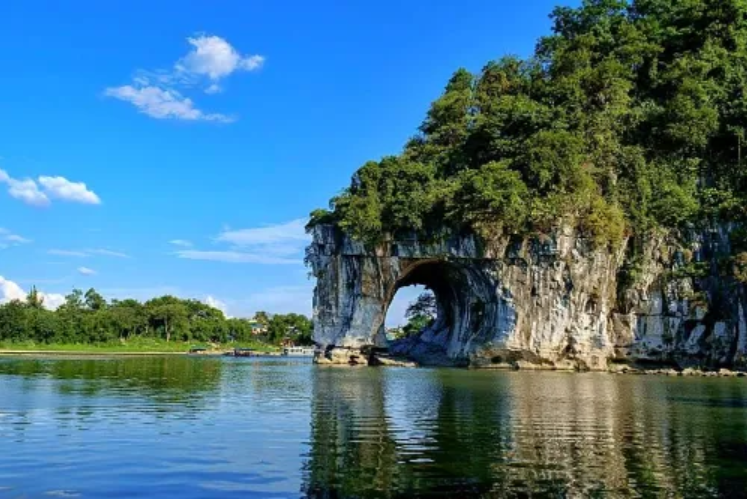
The Guilin Two Rivers and Four Lakes · Elephant Trunk Hill Scenic Area is located in Guilin, Guangxi Zhuang Autonomous Region, and is a national 5A-level tourist attraction. It comprises the Li River, the Taohua River, Shanhu Lake, Ronghu Lake, Guihu Lake, and Mulong Lake, together with the iconic Elephant Trunk Hill, forming a unique landscape where mountains and waters intermingle and the city and scenery coexist in harmony.
The city?ring water system of the Two Rivers and Four Lakes stretches 7.33 kilometres in total length, with a water surface area of 385,900 square metres. Here, “the city lies within the scenery, and the scenery lies within the city”. A boat cruise allows visitors to enjoy a splendid view of numerous historical and cultural relics as well as modern architecture, all reflecting each other’s beauty. Elephant Trunk Hill, the centrepiece of the Elephant Trunk Hill Scenic Area, is 200 metres above sea level, with a relative height of 55 metres, a length of 108 metres, and a width of 100 metres. Its name derives from its striking resemblance to a giant elephant standing by the riverbank, dipping its trunk to drink the sweet water of the Li River, and it has become the very symbol of Guilin’s landscape.
History and Culture
The history of the Two Rivers and Four Lakes can be traced back to the Tang Dynasty, when Guilin already possessed a water system of considerable scale. In the Song Dynasty, large?scale construction of a city?ring water network began, giving rise to the embryonic form of today’s Two Rivers and Four Lakes. At that time, the water system served not only for city defence and drainage but also for transportation and sightseeing, marking the prosperity of Guilin.
Through the Yuan, Ming, and Qing dynasties, the Two Rivers and Four Lakes were constantly repaired and maintained. However, in modern times, due to various reasons, parts of the water system gradually dried up or became blocked. It was not until the end of the 20th century that the Guilin municipal government carried out extensive renovation and restoration projects, bringing back the former glory of the Two Rivers and Four Lakes and making them once again a shining highlight of Guilin tourism.
Elephant Trunk Hill is also steeped in cultural heritage. As early as the Tang and Song dynasties, it had already become a favourite subject for literati and poets, with many verses and odes praising its beauty. The Water?Moon Cave (Shuiyuedong) on the hill is a remarkable wonder: the river flows through the cave, and when the moon is reflected on the water, it looks as if a bright moon is floating on the surface. A poem by the Song?dynasty hermit Ji Bei reads: “Below the water there is a bright moon; above the water the bright moon floats. The water flows but the moon stays; the moon goes but the water still flows.”
Major Attractions
Elephant Trunk Hill:
Elephant Trunk Hill is the core attraction of the scenic area, located at the confluence of the Taohua River and the Li River within Guilin city. Its shape is vividly like a giant elephant stretching out its trunk to drink from the river. On the hill, the Elephant?Eye Rock (Xiangyan) runs through left and right, resembling the eyes of the elephant. The Water?Moon Cave lies between the trunk and the legs, with river water flowing through it like a bright moon in the air. Inside the cave, many cliff inscriptions record the history and culture of Elephant Trunk Hill. Visitors can follow the hiking trail up to the hilltop for a panoramic view of the beautiful scenery along both banks of the Li River.
Li River:
The Li River is the mother river of Guilin and an important part of the Two Rivers and Four Lakes. Its waters are clear and emerald green, winding gracefully between oddly shaped peaks on both sides. A boat cruise on the Li River offers views of famous spots such as the “Nine?Horse Mural Hill” and the “Yellow Cloth Reflection”. The landscape along the Li River is as poetic as a painting, representing the quintessence of Chinese mountain?and?water scenery and attracting countless visitors from home and abroad.

Taohua River:
The Taohua River is a tributary of the Li River, with clear water and rich vegetation along its banks. In spring, peach blossoms bloom profusely by the river, their pink petals contrasting beautifully with the green water, creating a stunning sight. Occasionally, bamboo rafts glide across the river, adding a touch of leisurely charm. Visitors can take a stroll along the riverbank and enjoy the tranquility and beauty of nature.
Shanhu Lake:
Shanhu Lake is situated in the centre of Guilin and is named after the cedar trees (or firs) planted around it. In the lake stand two pagodas: the Sun Pagoda (Rita), made of copper, and the Moon Pagoda (Yue Pagoda), made of glazed tiles. The two pagodas are connected by an underwater tunnel 10 metres long beneath the lake. At night, the pagodas are brilliantly illuminated, and their reflections in the water create a dazzling spectacle, making them an essential part of Guilin’s nightscape.
Ronghu Lake:
Ronghu Lake is adjacent to Shanhu Lake and gets its name from the many banyan trees growing along its shores. Beside the lake stands the Ancient South Gate (Gu Nan Men), the oldest city gate tower in Guilin, originally built in the Tang Dynasty, with the existing structure rebuilt in the Song Dynasty. Around Ronghu Lake there are also numerous pavilions and bridges, such as the Rongxi Bridge and the Glass Bridge, each with its own architectural style, complementing the water and greenery to form a beautiful picture.
Guihu Lake:
Guihu Lake is an important part of the Two Rivers and Four Lakes and is famous for its osmanthus trees. Every autumn, the fragrance of osmanthus blossoms fills the air along both sides of the lake, intoxicating visitors. The lake is spanned by many bridges, including Baoji Bridge and Guanyi Bridge, which are not only transport links but also unique scenic features. Around the lake there are also many historical and cultural sites, such as the city wall from the Song Dynasty, bearing witness to Guilin’s historical changes.
Mulong Lake:
Mulong Lake is an artificially excavated lake in the Two Rivers and Four Lakes project, with the Mulong Pagoda as its landmark building. The pagoda is an imitation of a Song?style ancient tower, 35 metres high, with a seven?storey pavilion?style structure. The construction of Mulong Lake recreates the city walls, pavilions, and terraces of Song?dynasty Guilin, allowing visitors to immerse themselves in a rich Song?dynasty cultural atmosphere.
Suggested Itinerary:
Visitors may start with the Elephant Trunk Hill Scenic Area: follow the trail up to Elephant Trunk Hill, appreciate its distinctive shape and the surrounding Li River scenery, and visit attractions such as the Elephant?Eye Rock and the Water?Moon Cave to experience the historical and cultural heritage.
After that, proceed to the Two Rivers and Four Lakes pier and take a boat cruise. A daytime cruise lets you enjoy the natural scenery and historical sites along the banks, such as the Ancient South Gate and the Song?dynasty city wall; a night cruise offers the dazzling night lights, especially the spectacular light show of the Sun and Moon Pagodas. On board, you can also listen to the guide’s commentary on the history and culture of the Two Rivers and Four Lakes, gaining a deeper understanding of the city of Guilin.
During the visit, you may stop at restaurants near the scenic area to sample Guilin’s specialities, such as Guilin rice noodles and beer fish, enjoying both good food and beautiful views.
Travel Tips:
Check the ticket prices, preferential policies, and opening hours in advance through the official website or online travel platforms, and plan your itinerary accordingly.
If you wish to enjoy the night views of the Two Rivers and Four Lakes, we recommend choosing a night cruise and booking your tickets early to avoid delays. During the night cruise, the lighting on the boat is dimmer, so please be careful.
Wear comfortable shoes and clothing, as the Elephant Trunk Hill area involves some climbing; proper attire will make your visit more enjoyable.
When tasting local food, choose reputable restaurants and food stalls to ensure hygiene and quality. Try local specialities such as Guilin rice noodles and beer fish, but eat in moderation to avoid stomach upsets.
On the cruise, listen attentively to the guide’s explanation to better understand the history, culture, and stories behind the sites.
If travelling with elderly people or children, take care of their physical condition and avoid over?exertion. Plan appropriate rest stops at the designated resting areas within the scenic area.
Important Notices:
Observe the rules and order of the scenic area. Do not carve, spit, or litter; keep the area clean and tidy.
When climbing Elephant Trunk Hill, pay attention to safety, follow the signposts and staff guidance, and do not venture into dangerous areas. Be especially careful on rainy days or when paths are slippery to prevent falls.
When boarding the boat, follow the crew’s instructions and wear your life jacket. Do not walk around or make dangerous moves on the boat to avoid accidents.
There may be commercial activities and sales pitches within the scenic area; remain rational in your spending and avoid unnecessary expenses.
Keep your personal belongings safe, especially in crowded places such as piers and entrances, to prevent loss or theft.
In case of severe weather, such as heavy rain or strong winds, boat operations may be suspended and some areas of Elephant Trunk Hill Scenic Area may be closed. Pay attention to official notices and announcements, and adjust your travel plans accordingly.
Transportation:
Bus: Take city buses No. 2, 16, 23, or 33 and get off at Xiangshan Park Station for Elephant Trunk Hill Scenic Area. For some attractions of the Two Rivers and Four Lakes, take buses No. 10, 11, or 14 and get off at Jiefang Bridge or Yangqiao Station.
Taxi / Ride?hailing: In the urban area of Guilin, take a taxi or use a ride?hailing app and enter “Guilin Two Rivers and Four Lakes · Elephant Trunk Hill Scenic Area” or the specific attraction name as the destination – it is quick and convenient.
Bicycle: There are many shared bicycles in Guilin city; visitors can cycle to the scenic area, enjoying the city views along the way, and there are designated parking areas around the site.
Walking: If you are staying in the city centre, you may choose to walk to the scenic area, especially for some attractions of the Two Rivers and Four Lakes that are located right in the downtown area; walking allows you to better appreciate the city’s atmosphere.
Opening Hours:
For the Two Rivers and Four Lakes · Elephant Trunk Hill Scenic Area, Elephant Trunk Hill is generally open daily from 7:00 to 18:30. Boat cruises on the Two Rivers and Four Lakes are divided into daytime and night cruises: daytime cruises usually run from about 9:00 to 16:00, while night cruises generally start from 19:00. Specific times may be adjusted according to the season and weather conditions. Before your visit, please check the official website or consult the staff for the latest opening hours and plan your schedule accordingly.
Tickets:
Boat tickets start from 105 yuan.